Showing posts with label toll roads. Show all posts

Monday, July 13, 2015

Stress Over Tampa Bay Express

This Tribune article recently reported that the Tampa Bay Express (TBX) project is coming under scrutiny by residents of Tampa Heights concerned with the widening damaging their neighborhood. Widening I-275 has been in the plans of FDOT for decades as most elected officials have or should have known.

TBX would be additional capacity added as tolled express lanes similar to what I-95 Express is down in South Florida. I have used the I-95 Express lanes in Miami and found that they work. Toll lanes are also used by Express buses service to increase transit service options.

Some questions could be raised regarding some of the comments and information in the Tribune article. An Adam Metz, a transit advocate stated
“They’re going to put this massive highway in a place where it just doesn’t belong and they’re going to tax everyone to use it,” said Adam Metz, a transit advocate and Tampa resident.
I-275 has been around since the 1960's. Is expanding the existing interstate that FDOT has had plans for decades to expand putting a massive highway where it doesn't belong? Tolls are a user fee not a tax so what exactly does Adam mean that we're all being taxed to use the express lanes?  Individuals get to individually decide whether they want to pay the toll or not. Taxes are always coercive - you have no choice but to pay them.

Central Florida, which many are quick to tout now that they have SunRail, has over 100 miles of toll lanes. The toll roads in Central Florida are so successful that their coffers are overflowing with toll monies. So now there is a proposal to use some of that road toll money to pay for SunRail which is drowning in red ink. We don't believe it's right to rob toll monies, which are user fees for roads, to pay for trains. 

ALL Florida taxpayers are currently paying for SunRail but in 2021 the local municipalities must pick up the operating and maintenance costs. The municipalities currently do not have a long term funding source to pay for SunRail. Robbing the lucrative toll monies to pay for SunRail gives the policy makers an easy way out -  a  steady stream of money to pay for SunRail without forcing higher taxes or finding the money elsewhere.  Since it's obvious the toll roads are more than paying for themselves, why aren't they reducing the tolls and raising SunRail fares instead?  The closer to user pays the fairest it is for everyone.

Now FDOT has started the Ultimate I-4 project, a public-private partnership, adding express toll lanes to I-4 as additional capacity. The Central Florida pot of enticing toll money will only be getting bigger and a more lucrative pot of money to use for other "stuff" if the precedence is set.

The term "Lexus Lanes" is used by those who oppose toll lanes to insinuate that only affluent drivers will use the Express lanes. That is absolute nonsense. Where is the evidence that backs up such an accusation? Also, those who don't pay the toll will get a benefit from those who individually choose to pay the toll.

The Tribune article stated
" ...critics in Tampa skeptical that the investment in express lanes will pay off here because of the volume of traffic and a dearth of mass transit alternatives.
Kevin Thurman with transit lobbyist Connect Tampa Bay weighed in on why isn't mass transit being integrated into the transportation network with the toll lanes. Mentioned was South Florida has Tri-Rail and Metrorail and Thurman's comment
It's a completely different night and day approach.
Thurman's been in Florida since the end of 2012 so we are not sure what he knows about Tri-Rail and Metrorail. Yes it is different with those trains in South Florida and very costly.

In the 2009 special session of our state legislature, the State of Florida approved the beginning of an annual bail out of aout $15 million a year to Tri-Rail that was drowning in red ink. In addition, according to Tri-Rail's 2013 Financial Report (latest online), the State also provided in 2013 over $17 million of state funds for operating and assistance. In 2013 alone, the state provided $30 million to Tri-Rail. The operating loss to operating revenue for Tri-Rail in 2013 was a loss of over $87 million. When all the subsidies were added in from the state and local governments as non-operating revenue in 2013, the operating loss was still $29 million.

The weekday ridership for Tri-Rail is about 14,400 according to Wikipedia.  The 2014 populations of Miami-Dade, Broward and Palm Beach counties are:
Miami-Dade over 2.6 million
Broward over 1.8 million
Palm Beach almost 1.4 million


The total population of the three counties is about 5.8 million. With a weekday daily ridership of 14,400, .24% of population ride Tri-Rail - about a quarter percent of the population.

What about MetoRail? The daily ridership in 2014 for MetroRail was 78,100. The daily ridership for the Metro Mover, which is a 4.4 mile link of MetroRail, was 34,700. The Metro Mover is free to all passengers as there is no paid fare and it is 100% subsidized.

MetroRail is run by Miami-Dade Transit. With Miami-Dade population about 2.6 million and a fare paying daily ridership of 78,100, then approximately 3% of the population uses MetroRail.
MetroRail in Miami-Dade
In 2002, a half-cent sales tax increase called the "People's Transportation Plan" was passed in Miami-Dade to expand the existing MetroRail in all directions. To date, the only rail implemented is a 2.4 million link to the airport for which costs soared. Miami-Dade Transit started running a deficit and the tax was used to close the books and today much of it is used for operating and maintenance.

Like Thurman said, South Florida is different as it has Tri-Rail and MetroRail but few ride them at a huge cost to taxpayers.

Guess the rest of the 5.8 million population of South Florida are using the roads and the tolled Express lanes. The buses use the Express lanes too.

Hillsborough population is half of Miami-Dade's, Implementing a Tri-Rail or MetroRail in Hillsborough is not the answer.

We do understand there are concerns from neighborhoods impacted by I-275 road widening and we hope they will be addressed. 

Sunday, March 15, 2015

A $9 billion answer?

Today the Tribune published their lead commentary, A $9 billion question, about the proposed Tampa Bay Express project by the Florida DOT, written by Brian C. Willis. There is much to dissect about Willis' commentary.

First of all, Brian C. Willis, is more than "an attorney in Tampa", which is the only information about himself disclosed in the commentary.  Brian Willis has been active in urbanist and transit issues for years in Tampa Bay. He is one of the co-founders and President of local transit activist Connect Tampa Bay. Willis actively supported of Greenlight Pinellas, where he spoke in support of the referendum on numerous occasions, as well as participating in denigrating its opponents. That omission of his personal positions is telling, as he is not some independent minded wise man providing unique insights on transportation issues.

Willis opens with several misleading statements
The Florida Department of Transportation’s $9 billion express lane plan needs further scrutiny before proceeding. There are unanswered questions about the toll lanes’ design, and DOT has not explained why investing $9 billion in a single transportation project is the best use of limited taxpayer resources. Hillsborough County has a diverse population that lives in neighborhoods ranging from rural to urban. DOT should take time to listen to the community and develop plans that reflect the needs of our entire county.
Of course the plans need further scrutiny.  No one has suggested otherwise, and there were in fact two FDOT hosted workshops the week of January 25.  There has been no money budgeted for Tampa Bay Express, nor are the lanes designed. The only concept that exists is the general idea for tolled express lanes shared with express bus routes on Tampa Bay interstates and some rough budgetary estimates. If the plans progress, FDOT will schedule further workshops and other avenues for public comment, as is required by their process.

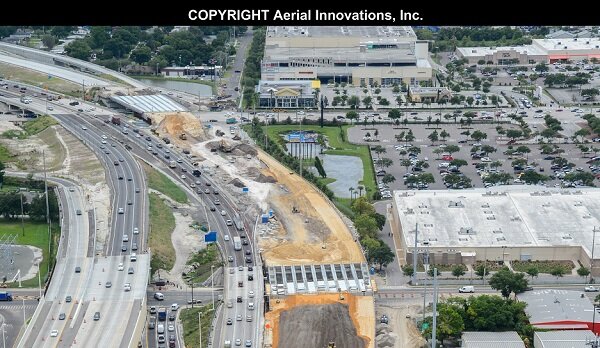
Reconstruction and widening of southbound I-275 at Himes Avenue (bottom of photo) and Dale Mabry Highway (top).
FDOT is primarily responsible for state roads and bridges, and the interstate highways in Florida. Obviously highways connect to county and city roads, but those roads are the responsibility of the local authorities, not the FDOT.

Willis then suggests South Florida got it wrong
In support of the plan, officials with DOT cite similar toll lanes built in South Florida. As someone who had the misfortune of driving in Miami, I question whether South Florida should serve as a model for Hillsborough County.

The Sun Sentinel recently reported that the South Florida lanes met DOT’s traffic goals only 59 percent of the time during the afternoon rush hour in November and December. To get traffic moving on the express lanes, DOT is now looking to raise the maximum toll in Miami from $10 to $14 — or higher.
...
WLRN, a South Florida television station, recently reported that the Miami express lanes have come under fire because they lack space for disabled vehicles to pull over and because drivers attempt to “dive” out of the express lanes, through upright plastic dividers, and into the untolled lanes of traffic.

WLRN’s report raises questions about whether FDOT’s express lane designs are safe.
As a frequent traveler to South Florida over the years, traffic in South Florida, and Miami in particular, is worse than Tampa Bay. The addition of the Express lanes has improved traffic flow. I regularly drive on I-95 non-express lanes during rush hour. It is never fun, but it has improved in my experience and reduced congestion on the non-express lanes, which at times can flow faster than express lanes. WLRN is correct that the I-95 Express lanes in Miami do have design issues on some segments (I recently listened to some of those reports live on WLRN while in South Florida on I-95). However,  the recently opened I-595 Express reversible 3 lanes in Ft. Lauderdale, similar in concept to the Selmon Express Lanes, are safe and convenient.

It's interesting that Willis ignores the success of the Selmon Express Lanes in his own backyard, built with no taxes or highway funds.
Level of service was upgraded from an "F" to an "A" as commuters are now able to travel at full speed, cutting travel time by as much as 60 minutes per day. The elevated lanes project won the prestigious "2007 IBTTA President's Award: Most Innovative Toll Transportation Project in the World," along with 22 awards for engineering excellence and community-friendly design. This modern solution is a prototype for eliminating urban traffic congestion and reducing green house gases.
No on likes paying tolls, much less up to $14 for tolls. Tampa Bay is not Miami, but the demand is clearly there from the Miami drivers. The express lanes may have become a victim of their own success. The drivers clearly see value in their time and are willing to pay to save time. These drivers are voting every day by paying the tolls, which are used to maintain and fund further road improvements.

Willis further on toll roads
Residents have strongly opposed prior toll projects, like the infamous “Green Swath of Death” beltway, which was proposed for the Tampa Bay area several years ago but never materialized. Many of the toll lanes that did get built in Hillsborough have not provided a long-term solution. I grew up in Carrollwood and remember when the Veterans Expressway opened. It initially offered a quick ride into Westshore. The road is now the site of daily traffic jams.
The "Green Swath of Death" (I thought it was black) may have helped ease congestion in the highest growth areas in east and south Hillsborough County.  Formally known as the Tampa Bay Beltway project, it was killed in 2007, largely since it didn't fit in with the future transportation vision of light rail and express buses throughout Hillsborough County. Where are we now?  

Not having the "Green Swath of Death" certainly has not inhibited development, which of course has resulted in some of the worse congested roads in the county.

Even with the Veterans, the demand soon exceeded the capacity of the road. Drivers see value in paying the toll, even if they are in slow moving traffic for 5 - 10 minutes, it is still better than the alternative surface routes.

Is Willis suggesting that we should not have the Veterans at all, much less the current improvements well underway, and that would improve transportation in Northwest Hillsborough?

Orlando, much of South Florida and many other larger metropolitan areas rely heavily on toll roads which are highly utilized. Drivers will pay for the convenience and speed. They value the toll roads with their own hard earned dollars.

Willis then transitions his commentary to local bus services, bicyclists, pedestrians and complete streets. Express buses will take advantage of any Express lanes, but bicyclists, pedestrians, and complete streets are completely irrelevant to the Express lanes discussion.
If we wanted to try to reduce the number of people killed while walking or riding a bike, we could design safer “complete” streets.

A recent program by FDOT to reduce deaths and injuries on Fletcher Avenue cost $1.6 million per mile. For a fraction of the cost of the express lanes we could build more complete streets and make our neighborhoods safer.
The jury on "complete streets" is still out. See our report on the Fletcher complete streets project for more information.  Increasing bicycling is a goal I support, but if bikes are too closely intermingled with traffic, we may further increase bicycling injuries and fatalities.

By the way, complete streets include "narrower lanes" and other traffic calming measures, such as reduced speed limits, as is the case on Fletcher.

Willis stated his concern about congestion and traffic of toll roads, yet he is proposing more solutions such as complete streets that are designed to create more congestion for drivers.

Willis then closes with a reference to Greenlight Pinellas which he actively supported, apparently still in denial of Greenlight's overwhelming defeat by the voters in 2014, 62% - 38%.
The Greenlight Pinellas plan would have added 24 miles of light rail and dramatically improved bus service in Pinellas County. Greenlight Pinellas would have cost $2.2 billion to build and operate for 30 years. For a fraction of the cost of the express lanes we could build and operate a light-rail system with an extensive bus network.
Greenlight projected about 18,000 rides (about 9,000 actual riders) a day for $2.2 billion (really over $3.3 billion if you read the fine print).  As a comparison, the active I-275 widening between downtown Tampa and SR-60 has nearly 200,000 vehicles per day and is costing $216.7 million. Which one benefits the most people?

The voters of Pinellas held their "government ... accountable for how taxpayer dollars are spent on transportation", so Willis should be satisfied the voters had their say.

Is Willis's solution to "decades of highway expansion have only led to more gridlock" is more Greenlight?

We have lots of questions about the Tampa Bay Express proposal, and of course our overall transportation strategy. But we need to use more imagination and develop solutions that relieve congestion and improve mobility.

Sunday, June 22, 2014

Readying for a Referendum?

This is Part 2 covering the HART Board Strategic Planning Workshop held Monday, June 9, reporting on the update from the County Administrator on the Hillsborough County Transportation and Economic Development Policy Leadership Group.  

Below are some slides from County Administrator Mike Merrill's presentation: (click slides to enlarge) with my takeaways. When Merrill showed slide 1 (below), I thought I was looking at a stack and pack city out of the movie Bladerunner not any rendition of downtown Tampa.


  • Goal is to move people and goods with cost-effective, convenient, reliable and safe interconnected mobility
  • Merrill said reducing or mitigating congestion was not called out but inferred


Here's a closer view of Merrill's pic:

And here's a scene from the 1982 movie Bladerunner set in the year 2019:


At least Bladerunner had flying cars.

Make you wonder why our elected officials want to tie our transportation solutions so closely to land use?  Do they want to coerce (force) densification and stack and pack us to pursue their agenda, including more public transit?

More slides from Merrill's presentation follow:
  • Some of the success factors were defined as walkable streets and denser development in certain areas
  • The plan needs to be consumer driven and multi-modal to force/coerce a cultural change to "get us out of our cars"
What is the Livable Centers Initiative?  
It was started in Atlanta in 1999.  Livable Centers Initiative encourages local jurisdictions to plan and implement strategies that link transportation improvements with land use development strategies to create sustainable, livable communities consistent with regional development policies.

Reason Foundation found issues with this initiative in 2012:
  • LCIs use federal gas tax funds to support local projects. Funding for this program comes specifically from the L-230 funds in the highway section of the state’s transportation bill, not the transit section or the intermodal section 
  • ...non-motorized transport (sidewalks and bike paths) receives most of the resources from LCI grants. 
  • ...most of the projects have little to do with transportation. Transportation funds should not support economic development projects.
  • LCI often fails to spur any development.
When our politicians complain that roads don't pay for themselves, well, neither, apparently, do "livable centers".
  • What Are We Agreed On? The Policy Leadership Group or who? 
  • Who says we "must" attract choice riders and taxpayers must highly subsidize choice riders? 
  • Why wouldn't choice riders pay market price?
  • Agree we must optimize our existing infrastructure - biggest bang for the buck
Transportation doesn't pay for itself......but transit is much more highly subsidized than roads.  According to this Heritage Foundation article published last year highway user fees supported each transit passenger mile 17 times more than each highway passenger mile ($0.1130 for transit; $0.0067 for highways). 

Federal Gas Tax User Fee Expenditures roads vs transit 2010
  • According to Merrill, this plan is "something for everyone" 
  • BRT would be the foundation and the plan would not exclude rail  
  • As transit ridership grew over time and we became more transit-centered, we would grow into rail and into a fully functioning multi-modal system. 
Where's Ride-sharing services like Uber & Lyft, Jitneys, De-regulated Super Shuttle?

We will note that roads are multi-modal as vehicles, buses, bikes, pedestrians and even sometimes golf carts use them.


  • A one cent sales tax increase would generate $200 million/year, a half cent sales tax increase would generate $100 million/year and there is an assumption of a 3% growth rate per year
  • The bedrock of the funding plan is federal (which is ever dwindling) and state grant money and local sales tax

  • Social Impact Bonds aka Pay for Success is a new financing mechanism for private and philanthropic organizations to finance projects that provide a specific social outcome with a modest return on investment
Merrill mentioned another long term 30 year tax. (HART can bond and borrow and go into debt like the county commission did with our 30 year CIT tax)


  • Good to see Public Safety at the top as highest priority
  • Good to see next highest priority is preserving our existing infrastructure

Economic Development has totally different drivers; there are numerous other agencies and organizations, some whom get our tax dollars, responsible for Economic Development 

Transportation solutions must be for mobility


Merrill mentioned that the CIT tax "worked well". That was a bit disturbing because the CIT did not deliver what was promised the voters and it was all spent less than halfway through the 30 year life of the tax. There are at least $127-$130 million of projects Merrill stated should have been paid for through the CIT tax but were shelved due to no funding.

Merrill stated there will be a comprehensive list of proposed projects at the next Policy Leadership Group meeting on June 26 that will include a BRT demo project, people movers, etc.  When asked by a Board member what the BRT demo project was, Merrill didn't answer the question. We'll have to find out more at the June 26 meeting because no details were provided by Merrill about the list of proposed projects.

Merrill stated "there is no more capacity in our budget and we cannot move forward without a tax increase". Really? Did he say that on behalf of himself, the County Commissioners or the Policy Leadership Group? The proposed FY 2015 Hillsborough County budget is almost $4 Billion. Are our spending priorities in the right place?  Do we have existing assets that could be repurposed to a higher priority like roads?  


Commissioner Sharpe voiced concern about "the plan" being "road-centric". What plan? There's been no official plan made public but Merrill stated the sales tax increase would probably be a 50/50 split between roads and transit.  We already spend more money in Hillsborough County for transit than we do on our roads.


If 50% of the transportation dollars are spent to serve 2% of traveler’s ‘passenger miles’, the remaining 98% of travelers that use roads will suffer increasing gridlock and congestion. HART does not have this critical funding shortage today that our roads do: 

It is estimated that the county needs approximately $160 million per year to add 200 lane miles of roads every 5 years to keep county roads up with current population growth.
The plan must be road-centric!

Regarding the hostile takeover vote by the Policy Leadership Group we reported here, there were a number of concerns raised by the existing Board members about the proposed restructuring and re-purposing of HART. Below, with a few edits I added, is the chart Merrill presented that reflects this new Governance entity.


Proposed Restructured Politicized HART
This new entity would oversee a huge bucket of money. How will this work considering our strict Sunshine Laws? The biggest risk is our transportation solutions will be politicized which then enables wasteful spending, cronyism and corruption. The money starts flowing but where is it going?  

In addition, why is money going to TBARTA?  That's the same as handing our tax dollars off to part of the rail cartel Tampa Bay Partnership.

We did find out that the hostile takeover vote by the Policy Leadership Group was non-binding. Maybe that was why they voted without allowing any opportunity for public comment. The vote didn't actually do anything except provide a perception that it did or serve as a trial balloon.

It also appears that the existing HART board would have to vote to make the changes the Transportation Policy Leadership Group is proposing. That would basically mean the existing Board would have to vote to kick most of themselves off the board. Would they?


The restructuring and repurposing of HART still remains murky and there are questions that will need answering. 


Was this the start of a push for a referendum?  Was Merrill's presentation a sales pitch that seemed to conveniently coalesce with the new Super Sized expensive HART plan revealed at the beginning of this workshop that we posted about here?

But before any referendum is pursued to increase taxes, the county must put our "checkbook online". Then when money starts flowing, taxpayers know where it's going!

UPDATE:  The June 26th meeting that was going to be about transit and provide a list of transportation projects has been postponed to August 21st.

Thursday, February 20, 2014

Real choice: Gateway Express toll project vs light rail fiscal cliff

Governor Scott announced the Pinellas Gateway Express toll road project this week as the Tribune reported:
Gov. Rick Scott announced Monday that work will begin in 2017 on a $337 million expressway to link I-275 and U.S. 19 with elevated tollways. The five-year project, known as the Gateway Express, also includes a link from I-275 to the St. Petersburg-Clearwater International Airport. The project was not expected to be funded for another 15 years
Pinellas Gateway Express Project
This project will create an express link connecting  I-275 to the St. Petersburg-Clearwater airport and US 19 via an elevated and street level toll road.  It will be paid for with existing funds, requiring no new revenues.  We like user-pays.  New toll roads providing additional capacity allows users the freedom to decide whether they want to use the toll road or not.  It's a win-win.  As those who want to pay the toll take the express lanes, it helps relieve congestion on the existing non-tolled lanes for those who do not want to pay the toll.  Now that is true freedom of choice.

The Tampa Bay Times reported  
The elevated roadway linking I-275 and U.S. 19 will run over 118th Avenue and then north to the airport. Once completed, the expressway could potentially shave 9 to 13 minutes off commuters' rush-hour drives.
Will this project compete with the Greenlight Pinellas proposal?  Google maps reflect the normal (non-peak) commute time between downtown St. Petersburg and downtown Clearwater is about a half hour.

Drive Commute from Downtown St. Petersburg to Downtown Clearwater
According to the Greenlight Pinellas plan, the 24 mile light rail system from downtown St. Petersburg through the Gateway area to downtown Clearwater with 16 stops will take almost an HOUR.
Greenlight Pinellas light rail plan 
Do some fear that the Gateway Express Project will compete with Greenlight Pinellas? Suddenly there's a coordinated effort telling us Greenlight "complements" roads. Are the power brokers making it up as they go along? The Tribune's initial report on the Gateway project:
“To me, it’s complementary,” said Chris Steinocher, CEO of the St. Petersburg Chamber of Commerce and a leader of the Yes for Greenlight campaign. “You get great roads and you have great mass transportation.”
The Tribune's subsequent Op-Ed:
This is the rationale behind Greenlight, which is meant to complement the road system, not compete with it. People will still have the option to commute alone in their cars. But for others, there will be choices.
Greenlight Pinellas plan does not have anything to do with roads. There is nothing in the Greenlight Pinellas plan that states the plan is complementary to roads. Greenlight Pinellas is only about transit, land use and  transit-oriented development. The only reference to roads is the Park and Ride, which indicates, you still need a car.
Only reference to roads in Greenlight Pinellas plan
Reality is the Gateway Express toll road project provides the "real" power and freedom of choice.  If you decide to use the toll road, you pay the toll. Greenlight Pinellas forces you to pay higher taxes into perpetuity whether you ever benefit from or use the train. In addition, with Gateway Express, you will be able to drive in half the time or less the same distance that the $2.5 BILLION train will take.  Who is going to take the train?  Why pay for it?

The Greenlight Pinellas plan is not only a boondoggle, it now looks more like a fiscal cliff.

It's been a bad week for Greenlight Pinellas……

Update:  Tampa Bay Business Journal online poll