Showing posts with label taxes. Show all posts

Wednesday, August 4, 2021

Bad Case of Distrust: County Tries to Hold Road Funding Hostage to Force Funding Costly Rail/Transit

Guest Contributor: Dr. Jim Davison

  
No wonder there's a bad case of Distrust with County Center in Hillsborough.

The effort by the Hillsborough County BOCC and County Administrator to place a second sales tax for transit on the ballot has already begun. Even before returning the $532 million illegally taken in their last attempt, they are planning to place essentially the same $16 billion-dollar 30-year rail tax on the ballot. They plan on using the same lies and pronouncements used in 2018 to get you to give them the money.

Wednesday, February 26, 2020

Who Knew? HART's Mega Millions Spending Spree Funds Existing Services With New Transit Tax

As we posted in November 2018, transit agency HART has no plans for how to spend Billions of new All for Transportation (AFT) sales tax monies.

So right out of the gate, HART plans to fund their existing services, currently funded by property tax revenues, with the new AFT tax.

Tuesday, June 4, 2019

Costly Disaster! Tearing Down Interstates, the AFT Rail Tax and Train Rides for "Free"

Sunshine Citizens is registered in Florida as a “501c3 nonprofit" and has a federal tax exempt status from the IRS. 

Sunshine Citizens website reflects they are a transit "advocacy” group who wants to reduce "our dependence on the automobile". And in reality, they are an activist group who advocates for their urbanist agenda.

Sunshine Citizens has been “actively” opposing FDOT’s plans to expand and improve I-275 and fix malfunction junction since they were created in 2015. They were successful in causing FDOT to delay planned and funded interstate improvements in 2017. 

That delay caused Hillsborough County to "lose" hundreds of millions of state/federal gas tax dollars  slated to go to Hillsborough County interstate improvements, to go elsewhere. FDOT redirected those millions already paid by taxpayers, to Orlando and Central Florida for their massive interstate expansion projects. 
Now, Sunshine Citizens not only opposes interstate expansion projects, they are “advocating” to tear down the north corridor of I-275 and replace it with a street level Boulevard with a train. 

Thursday, August 9, 2018

The Three Faces of Hagan


Anyone who has been a county commissioner for 16 long years has a history. One's own political history is the best predictor of what one will do in the future, not campaign rhetoric.

Therefore, what does one do when their political history includes growing local government, ballooning the bureaucracy, blowing out future Community Investment (CIT) revenues, pushing for unnecessary massive tax hike boondoggles - multiple times - and pursuing a billion dollar baseball stadium to subsidize and enrich another wealthy sports team owner? They try to rewrite their own history.

Today we can clearly see the "Three Faces" of Hillsborough County Commissioner Ken Hagan. Two of the faces reflect Hagan's actual past history. The third face is Hagan's self-described campaign rhetoric in his campaign mailers trying to rewrite his own history.

Hagan even used a picture of him and Gov. Scott from 2012 without Scott's approval. Isn't that illegal or at least unethical? Ironically, Gov. Scott touts the need to get rid of career politicians - that includes Hagan.

Fiscal conservatism includes lower taxes, less spending, less debt and smaller government.

While Hagan self describes himself as "conservative" in his campaign rhetoric, let's review some history.

Most of the property tax millage rate cuts Hagan touts were made during the housing bubble. Property tax revenues were flooding County Center from escalating property values and new growth while property owners were getting angry about the increasing property taxes.

Floridians were so angry about escalating property taxes that the state legislature passed a bill in 2007 to roll back property tax rates to 2006 levels and mandated deeper cuts based on how much a local government collected in property tax dollars. In addition Amendment 1 was overwhelmingly passed by voters in 2008 64-36% that added an additional homestead exemption, the portability of Save Our Homes benefit and an assessment cap on non-homesteaded property.

Even with some millage rate cuts, according to tax-rates.org:
Hillsborough County has one of the highest median property taxes in the United States, and is ranked 376th of the 3143 counties in order of median property taxes.
Hillsborough County's Comprehensive Annual Financial Reports (CAFR) reflect Hillsborough County became the second largest county employer behind the Hillsborough County school system after Hagan was elected in 2002. The number of county employees rose from 9,774 in 2003 to 11,169 in 2007, an increase of over 14% (approx 1400 employees) in FOUR short years. (Note: The 2017 CAFR reflects the county is currently the fourth largest county employer with 9336 employees.)

Then the recession hit in 2008 and the county had created its own big problem. It had ballooned the bureaucracy, was blowing thru county tax dollars like a drunken sailor and wrongfully assumed the housing bubble would never burst - aka bad judgment.

The county was then forced to make cuts to balance the county budget. Where did the county decide to cut? Transportation - which is a primary responsibility of local government.

Transportation funding got a double whammy hit with the recession under Hagan's tenure. The county diverted ALL property tax revenues previously funding transportation to other places to balance the budget. In addition, the Community Investment Tax (CIT) funding for transportation evaporated because the county had gone on a huge debt spree of borrowing against future CIT revenues right before the recession hit.

In 2007, Hagan, who led the Transportation Task force, and then county debt/bond manager Mike Merrill recommended the risky huge borrowing against future CIT revenues - just 11 years into the 30 year tax. This broke the promise the county made to spend the CIT revenues in 5 year increments as part of their 5 year Capital Improvement Plan (CIP).

Merrill told the commissioners in 2007 that the CIT tax would continue growing leaps and bounds and CIT revenue growth would be so great there would not be any problems funding future needs. Such bad judgment. Everyone else knew the housing bubble was going to burst at some point. The borrowing spree tied the hands of future commission Boards for years after the recession hit.

And Surprise! In 2007 Hagan's close PR confidante Beth Leytham was hired and paid with county tax dollars to be a consultant to his Transportation Task Force. Sound familiar?

When the county commission voted in 2009 to fire then county administrator Pat Bean, it was Hagan who recommended and lined up debt manager Mike Merrill to replace her - promoting the person who had provided such bad judgment to blow out future CIT monies.

Hagan's transportation task force was in two phases. Phase 1 borrowed the future CIT revenues and Phase 2 pushed the 2010 huge 30 year 1% rail tax hike.  In the 2007 BOCC meeting where Hagan pitched his debt spree, he also stated (emphasis mine):
THE SECOND PHASE, WHICH WILL BEGIN IN THE FALL, WILL FOCUS ON LONG-TERM SOLUTIONS, WHICH PRIMARILY INCLUDE LIGHT RAIL OR COMMUTER RAIL OR RAIL OF SOME FASHION.
Three years later when the unemployment rate in Hillsborough County was running 10-11%, Tax Hike Hagan voted at the May 13 2010 public hearing to put the multi-BILLION dollar rail boondoggle sales tax hike on the 2010 ballot. While many Hillsborough County residents were still hurting and struggling from the recession, Hagan decided it was time to put a sales tax hike on the ballot. Hagan was Chair of the county commission in 2010.

Again - such bad judgment! The multi-BILLION dollar tax hike was not conservative and certainly showed no compassion for those still financially reeling from the recession. Thankfully it was overwhelmingly defeated because it had a basic 3rd grade math problem and was a bad plan.

Tax Hike Hagan's pursuit of huge tax hikes and his alter ego District Rays Candidate Hagan's pursuit of a billion dollar baseball stadium have been a package deal for almost a decade. As we reported here, Hagan invited the baseball coalition to speak at the May 19, 2010 BOCC meeting immediately after he had voted to put the rail tax on the November ballot.

The tax hike came back courtesy of the crony Go Hillsborough (GH) campaign in 2014 as Hagan was heading toward his second countywide term. The District Rays Candidate Hagan saw his stadium clock ticking away. His alter ego Tax Hike Hagan knows he needs a new funding source to pay for a billion dollar stadium and he saw the GH tax hike as the ticket.

After getting the Parsons/Leytham team in place for the GH tax hike by August 2014, District Rays Candidate Hagan began actively pushing the baseball stadium issue.

By January 2015 with the tax hike GH campaign underway, District Rays Candidate Hagan and his alter ego Tax Hike Hagan had his baseball and tax hike agenda both lined up. The District Rays Candidate Hagan had gotten his secret baseball committee created and got the county to hire an expensive NY baseball law firm Foley and Lardner to negotiate with the Rays. 

The GH Parsons/Leytham team had to propose another 30 year tax hike because that was always part of the phony campaign. In the middle of the GH community meetings, Tax Hike Hagan came out supporting a tax hike. 

Tax Hike Hagan voted for the unnecessary 30 year, $7 BILLION tax hike at both Go Hillsborough public hearings in 2016. Apparently Hagan's "when you cut taxes, you ignite job growth" slogan is his lip service and meant only for his campaign flyers.

Tax Hike Hagan held local road funding hostage for almost a decade while he pursued multiple  massive county tax hikes for trains. This #FakeNews flyer of false advertising reflects how Tax Hike Hagan will say anything to get elected.  
Tax Hike Hagan flyer full of egregious False Advertising
It was Tax Hike Hagan who fought Commissioner Murman's proposal to use growth of the existing budget to fund roads and transportation. Because of Tax Hike Hagan, Murman's original proposal got watered down. (Transcript of August 10, 2016 BOCC Budget Workshop meeting can be found here.)

District Rays Candidate Hagan is now pursuing some creative public financing scheme scam to fund the billion dollar baseball stadium. Incurring another huge round of debt putting taxpayers at risk to subsidize a wealthy sports team owner is not conservative or fiscally responsible.

Who should you believe -  Hagan with a history of bad judgment or Economists?
"The idea that sports is a catalyst for economic development just doesn't hold water."
—Robert Baade, sports economist 
When surveyed, 86 percent of economists agreed that "local and state governments in the U.S. should eliminate subsidies to professional sports franchises.. 
In a 2017 poll, 83 percent of the economists surveyed agreed that "Providing state and local subsidies to build stadiums for professional sports teams is likely to cost the relevant taxpayers more than any local economic benefits that are generated.
The history of District Rays Candidate Hagan and his alter ego Tax Hike Hagan is pushing massive unnecessary sales tax hikes and risky financing schemes and pursuing a billion dollar baseball stadium. Words on his campaign flyer are just rhetoric to get elected.

The District Rays Candidate Hagan and his alter ego Tax Hike Hagan's donor base, who cannot even vote for him, (from his campaign filings with the SOE) is who he is beholden to.

After 16 too long years as a career county commissioner, Hagan is running again for a single district seat he already held. He is doing what no other commissioner has done since Hillsborough county's Charter was implemented in 1983 - violating the intent and spirit of the term limits in the Charter.

There are Three Faces of Hagan: Tax Hike Hagan, District Rays Candidate Hagan and Hagan's self-described [false] narrative of "Conservative" Hagan.

But the Three Faces of Hagan have a Primary challenger, Chris Paradies.

That provides an opportunity for voters in District 2 to reject all Three Faces of Hagan in this months Primary.

—————————————————————————-
Vote by Mail ballots are out
Early voting is August 13-26
Primary election day is August 28

Monday, February 12, 2018

San Diego Didn’t Fall for Shady Stadium Deal; Will Tampa?

Reposted by permission of Tampa Bay Beat.

By Jim Bleyer


Fifteen months ago the people and politicians of a major American city stood up to protect their region’s economic health and integrity by rejecting a shakedown from a billionaire owner of a big-league sports franchise.

But the citizens of San Diego had three major advantages over their counterparts in Hillsborough County where special interests are intent on bilking taxpayers to build a new baseball stadium for the Tampa Bay Rays.

—Public funding of a new stadium for the NFL Chargers was put to a referendum with passage requiring a 67 percent supermajority;

—The political will existed to push back against a blackmailing bully, in this case Dean Spanos, scion of real estate magnate Alex Spanos;

—Access to accurate, complete information from the San Diego Union-Tribune which reported all facets of the issue.

San Diegans killed public financing, 57-43 percent, not even a majority let alone the required threshold. The ballot measure asked voters whether they wanted to increase the city’s hotel room tax rate from 12.5% to 16.5%, with the proceeds to fund a new $1.8 billion stadium and convention center. The tax increase was to repay $1.15 billion in bonds, leaving the Chargers and NFL to pay the remaining $650 million.

What’s happened since the ballot defeat? The Chargers moved to a temporary facility in Costa Mesa playing the 2017 season to a fraction of the audience they drew in San Diego. Half the fans rooted for the opposition. The Rays are used to that; the Chargers weren’t. When the Chargers move to a larger, modern stadium in Inglewood for the 2020 season, the facility will be shared with the Los Angeles Rams.

Meanwhile, life goes on without the Chargers in San Diego. Most citizens are bitter at the Spanos family; a tiny minority actually trek to Charger games. The city is still a hotspot for high-tech innovation, an incubator for Broadway-bound theatre, home of the historic Gaslamp Quarter, culturally diverse and harmonic, an attractive beach and surfing destination and much more.

Despite offering a specific plan that had adequate access, didn’t destroy neighborhoods, and meshed with a convention center, San Diegans saw through the bamboozle of transferring wealth to a billionaire and shot down the proposal by a healthy margin.

The stadium scheme in Tampa has nothing to recommend it. A new playpen doesn’t guarantee Rays owner Stuart Sternberg will spend more than a pittance on payroll, reduce the abominable number of food safety violations, or ditch players coming into their prime to cut costs. It does guarantee to increase the value of the Rays franchise by a half billion. That’s the name of the game.

Look at the above rendering. The combo stadium-convention center in San Diego blends with the neighborhood and has adequate access. The proposed Rays stadium in Ybor City (be,ow) is shoehorned into a unique, celebrated district. Access and parking are difficult if not laughable.

San Diego also had one definitive financing source; Tampa’s revenue origins are uncertain as special interests and their toady politicians are scrambling to cobble together a taxpayer-funded sports subsidy.

As for the plan, San Diego actually had a specific one. The Union-Tribune ran factual balanced accounts about the stadium campaign, its pros and cons. Hillsborough County residents, the few who subscribe anyway, are not as fortunate with the Tampa Bay Times publishing slanted articles and omitting important facts.

The Times is rolling over for Sternberg, real estate interests, and the investors who temporarily bailed it out of bankruptcy.

Politicians love hotel taxes because this levy is the embodiment of taxation without representation. Prancers to the pork barrel polka, such as Tampa Mayor Bob Buckhorn and Hillsborough County Commissioner Ken Hagan, look for any means to leverage tax dollars to fund their “legacy.” They abhor referendums that allow the public to interfere with their gifts to special interests. They would find a super majority requirement lethal to their indulgences.

Taxpayers in other cities that paid for stadiums often discover they are still on the hook long after the team departed. In New York when the Giants bolted the Big Apple for New Jersey, taxpayers were still paying off $110 million in debt on the old stadium. St. Louis lost the Rams, but they didn’t lose $144 million in stadium debt the team bequeathed.

Philip K. Porter, Professor of Economics at the University of South Florida, terms sports subsidies as a “transfer of wealth” and competition for funding with more needed municipal services regardless of the revenue source.

Of the 38 metropolitan areas with at least one major professional sports team, Tampa ranks fourth in per capita subsidy, according to Porter. That number will only increase if the Ybor City boondoggle comes to fruition.

His report, “Public Subsidies and the Location and Pricing of Sports,” can be found here.

According to Michael Leeds, an economist at Temple University, “If every sports team in Chicago were to suddenly disappear, the impact on the Chicago economy would be a fraction of 1 percent. A baseball team has about the same impact on a community as a midsize department store.”

Victor Matheson, a sports economist at College of the Holy Cross, is dubious of the economic hype surrounding professional sports facilities.

“A good rule of thumb that economists use is to take what stadium boosters are telling you and move that one decimal place to the left, and that’s usually a good estimate of what you’re going to get,” Matheson says.

Economists say the biggest reason sports teams don’t have much impact is that they don’t ignite new spending. Most people have a limited entertainment budget, so the dollars they shell out for a game is money they would have spent elsewhere such as a restaurant or small businesses where more money would have stayed in the community. Matheson added that instead of drawing people to a neighborhood, games can actually repel them.

That certainly applies to Ybor, one of America’s most storied, culturally significant and eclectic neighborhoods. And how much of the money that absentee owner Sternberg rakes in from his revenue sharing/cheapskate payroll template do you think remains in the Bay area?

When politicians like Hagan and Buckhorn go directly to “how should we fund the stadium” omitting all the intermediate steps and any taxpayer comment let alone vote, they’ve already lubed the public to assume the position that shoveling tax bucks toward a sports facility should be the correct priority. It eliminates discussion of uplifting economically depressed neighborhoods, educating and assisting disenfranchised youth, properly training and retraining law enforcement officers, and addressing infrastructure needs.

Buckhorn and Hagan, abetted in their misinformation campaign by the Tampa Bay Times, obsess with burnishing their legacies, however fleeting, and rewarding their real estate cronies plus Sternberg with hundreds of millions.

Tampa residents are victims of this squeeze play.


Tuesday, November 21, 2017

Tax Them To No End!

As the Tampa Bay elites continue to scheme behind the scenes to "invest" in our their future, they implicitly acknowledge they don't have a good way to pay for their plans.  Multiple referendums and plans to raise taxes for transportation have failed, while we are struggling to pay for the necessary improvements for water and sewer infrastructure.

Recently the news of the Rays have expressed an interest in relocating from St. Petersburg to Ybor City, with an estimated price tag of $800 million, with $650 million expected to be financed somehow. Even Tampa mayor Bob Buckhorn has no idea on how to pay for it, previously stating Tampa has no money.

But we can always to get someone else to pay for their schemes, right?

Hence, get prepared to hear plans how we can make someone else pay for it by raising hotel and rental car taxes -- make our visitors pay.

It's one of the oldest tricks in the tax raising books, and not solely the domain of Tampa Bay.

But we are already maxing out these taxes, which are already among the highest in Florida.

For example, to help pay for the Tampa International Airport "expansion" for zero net new passenger capacity, rental car surcharges were increased to the point that in some cases, the fees and taxes can exceed 100% on a 3 day car rental!
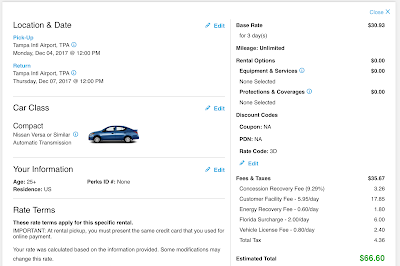
Payless rental from TIA with fees and taxes over 100%
The above screen shot shows a 3 day compact car rental booking from paylesscar.com, with a base rental rate for $30.93 for 3 days, and $35.67 in fees and taxes, for 115% fee and tax rate.

This is not unique to Tampa, as Miami airport is just under 100% for the same rental. However, Tampa does have the highest daily Customer Facility Fee at $5.95. compared to $3.26 at Orlando and $4.85 in Miami. There are some variance in the municipalities on the other taxes and fees, notably the Concession Recovery Fee, which Tampa at 9.29% is the lowest and Miami at 11% is the highest. A 9.29% tax is a good thing?

As a "smoke test" on the rental car fees and taxes, we note that the state and federal taxes in Florida are $1.34 per pack of cigarettes, in addition to the federal tax of $1.01 per pack, which purchase price averages around $6.30 per pack, for a mere 37% tax.

However, all this begs the question... How much more can we tax them?

Not to mention rental car companies are getting disrupted by ride sharing such as Uber and Lyft.
A new study out Thursday that tracks transportation choices by U.S. business travelers finds that travel by Uber, the ride-hailing startup, has surpassed rental cars. Uber accounted for 43 percent of ground transportation transactions, while rental cars had 40 percent. Led by Uber and Lyft, ride-hailing services surpassed rental cars for the first time in the fourth quarter of 2015 and have since widened their lead.
[snip]
The Certify study finds rental car transactions have fallen 15 percentage points in two years while taxis have dropped even more, by 23 percentage points over the same period. Taxis accounted for 14 percent of ground transportation transactions in the first quarter of 2016.
As we spend $1 billion on the airport Phase 1 (!), including a massive new rental car center complete with a $417 million people mover, the $5.95 daily Customer Facility Fee is expected to help recover those costs.

But with car rentals trending down, and already taxed to the max, its unclear how much increasing taxes and fees will cover costs, much less pay for more investments for us our elites.

Of course, our leaders now how to fix that.

Add more fees... on Uber and Lyft.
The Hillsborough County Aviation Authority board of directors approved contracts with rideshare companies Uber, Lyft and Wingz Thursday morning to drop off and pick up passengers at the airport. In agreeing to the contract, rideshare drivers will pay a per-trip fee of $3 for each ride beginning this month. 
The board approved a new user fee system to charge limos, taxis and rideshare companies per trip at the June board of directors meeting. User fees for ground transportation is used at many other major airports, including Orlando International Airport. The fees will rise each year, eventually to $5 a trip, in the third year.
Will it ever stop?

Perhaps there is a little hope.
In a possible blow to financing a new Tampa Bay Rays stadium in Hillsborough County, Florida House Speaker Richard Corcoran filed a lawsuit against the city of Tampa for what he called an "illegal tax" on hotel rooms.
Hillsborough County already charges 12% hotel taxes, among the highest in the state. Tampa started assessing $1.50 fee for Ybor City and Tampa hotels to further support marketing efforts, raising around $1 million per year. With some hope, of course, to expand into Hillsborough County.

If Corcoran's law suit is successful, it may hinder plans for the Rays.
That's because the financing of a new stadium may rely on another source of revenue, an entertainment tax, that could be levied on parts of the county that teem with nightlife and leisure activities. The $1.50 assessment is similar in that it is only charged in Ybor and downtown Tampa.
So far, no public funding for the Rays has been identified, and local support for increased taxes is non-existent. It is still early in the Rays relocation saga, so we are far from understanding what the Rays relocation taxing team will try next.

We are at the limit for what we are taxed for already, still waiting for roads, storm drainage and sewer fixes, while the elites are strategizing to tax us for their benefits.

The one thing we do know -- they will not give up trying to get them to pay for their profit.

But to the elites, "them" is you.

Sunday, November 5, 2017

Another County Mess: Taxation Without Representation


The Hillsborough county commission has created another mess. 

They continue to waive one of their own policies that has no waiver provision provided in it. In addition, the commissioners ignored the intentions of a Charter that created an independent special taxing district.

Why? Because they or someone(s) wants control of that taxing entity. The timing is not coincidental since it relates to the Hillsborough Area Regional Transit Authority (HART).

What the commissioners have done as a result of their recent HART Board appointments is disenfranchise HART's property taxpayers who reside in  unincorporated Hillsborough.

First, the background information.

Independent special districts have limited explicit - not implied - authority specified in its charter. 

Statutes, charters and policies provide the requirements, criteria and governance for establishing Boards, Committees, Authorities, Councils or Agencies and who may get appointed to them. In the interest of fairness, proportional and equitable representation is often a requirement, especially if the Board will be providing governance and oversight of a taxing authority.

Florida Statute 163.567 enabled the creation HART by allowing a home rule Charter to establish the transit agency. HART was founded in 1980 by a local Charter approved in 1979 by the county commission of Hillsborough and the city council of Tampa. 

HART's Charter defines a HART Member as "the unincorporated areas of a county or the incorporated areas of a municipality if such county or municipality has been admitted to membership the Authority.." 

HART's Charter states each HART member shall appoint one Director plus one additional Director for each 150,000 persons, or major fraction thereof, resident in that member's jurisdictional limits. In addition to those Board members, the Governor of Florida shall appoint two Directors.

HART's Charter specifies they are a special taxing district and may levy an ad valorem (property) tax not to exceed one half mill ($.0005) on taxable property within the jurisdictional limits of its members. Current jurisdictional members of HART include city of Tampa, city of Temple Terrace and unincorporated Hillsborough County. Plant City is not a member of HART and Plant City residents do not pay HART's property tax. 

To abide by the Charter's intent of ensuring equitable and proportional representation on the HART Board who oversees this taxing authority, Hillsborough County has a policy that appointees to the HART Board by the Hillsborough County commissioners MUST reside in unincorporated. From the county's website regarding HART Board applicants (emphasis mine):
Citizens appointed to this board must reside in the unincorporated area of Hillsborough County. 
In addition, according to Board of County Commissioners BOCC POLICY - SECTION NUMBER 0 1 . 3 0 . 0 0 . 0 0 for Appointing and/or Confirming Nominations of Citizens, Agency/Government Body Representatives, or Staff to any Board, Council, Committee and Authority (emphasis mine):
..applicants for certain boards/councils undergo background checks and/or be residents of the unincorporated area of Hillsborough County. All applicants must be residents of the state of Florida. 
In an effort to have boards/councils that include citizens who represent the entire county, the BOCC shall largely consider race, gender, and those citizens who actively participate in the community when making appointments and/or confirming nominations. Unless specifically approved by the Board of County Commissioners, no citizen may serve on more than one committee at a time
If an applicant does not meet the relevant requirements the application shall be rejected.  
Residency for appointment/confirmation applicants. The Board of County Commissioners has not established a general residency requirement for all board, council, committee, and/or authority appointments. However, citizens seeking appointments to the following boards councils, committees, or authorities shall reside in the unincorporated area of Hillsborough County.
  • Code Enforcement Board 
  • Code Enforcement Special Magistrate  
  • Cross Connection, Backflow & Back-Siphonage Control Board  
  • Enterprise Zone Development Agency 11 
  • Hillsborough County City-County Planning Commission 
  • Hillsborough Area Regional Transit Authority  
  • Historic Resources Review Board  
  • Land Use Appeals Board  
  • Nuisance Abatement Board – at least five (5) members 
  • Tampa Sports Authority * 
  • Water Conservation Technical Advisory Committee  
*Unincorporated residency requirements for the Tampa Sports Authority only may specifically be waived by the Board of County Commissioners (see Waiver Procedure below).  
ARTICLE V. WAIVER PROCEDURE The notice of a vacant position for the Tampa Sports Authority shall include a statement informing the public that the Board of County Commissioners has the authority to waive its unincorporated residency requirement, that, notwithstanding residency status, all citizens may apply; and that all names shall be presented to the Board of County Commissioners for consideration. The Boards and Councils Coordinator shall list all names on the ballot and identify those persons who met the residency requirement and those who did not.
Note: there is only a residency waiver procedure for appointments to the Tampa Sports Authority. 

Since 2012, based on population, there are thirteen HART Board members, appointed as follows:
  • City of Temple Terrace - 1
  • City of Tampa - 3
  • Unincorporated Hillsborough - 7
  • Gubernatorial - 2
Now let's review the unincorporated Hillsborough appointments made by the county commissioners since 2012.

The make up of the 7 HART Board members representing unincorporated in 2012 included 3 electeds, Beckner (lived in unincorporated), Murman and Sharpe (both lived in city of Tampa), and 4 citizen appointees Wallace Bowers, Karen Jaroch, Ann Madden and Steve Polzin who all lived in unincorporated Hillsborough.

Then along came the county's Policy Leadership Group (PLG) transportation initiative in 2014 led by the unelected County Mayor Mike Merrill.

Everything that is done down at County Center is in context.... 

About the same time that Ann Madden resigned from HART on June 16, 2014, Merrill was proposing a hostile takeover of HART by all electeds and creating some transportation super agency - see our post here. 

The commissioners never sought a citizen appointee to replace Madden, who lived in unincorporated and resigned June 16, 2014. 

Instead they sneakily used a July 31, 2014 Budget Workshop meeting, where public comment is not normally allowed and actions are not supposed to be taken, to appoint Madden's replacement on HART. That agenda item was added at the last minute to a meeting that had been publicly noticed as a Workshop.

This action occurred coincidentally right before the county handed Parsons Brinckerhoff their crony contract to launch the Go Hillsborough tax hike campaign.

The Eye reported about the county commissioners shenanigans on July 31, 2014 in this post Sneaking in Les:
There was an interesting non-budget item added to the Budget Reconciliation agenda, not on the original agenda, created by Commission Chair Mark Sharpe or County Administrator Mike Merrill, to fill an open seat on the HART Board. A BOCC citizen appointee to the HART Board, Anne Madden, resigned on June 16, and the Board needed to approve a new appointee. 
They have 20 days to fill vacancies accord to the law
There have been 2 BOCC meetings since Maddens' resignation. 
45 days is my count. Reading through the statute above, can the Commission even make a legal appointment now? 
Yet they waited for a Budget Reconciliation workshop to take up filling a HART Board vacancy? 
They did not follow the law.
And they even knew they weren't following the rules because the workshop agenda noted they were supposed to have filled the vacancy within 20 days of the resignation.
July 31, 2014 Budget Workshop improperly used for
HART Board appointment (click to enlarge)
In perfect orchestration at that workshop, Sandy Murman nominated Les Miller and Kevin Beckner seconded her nomination. The commissioners voted 5-1 to appoint Miller, who lives in the city of Tampa, to replace Madden, who lived in unincorporated south county. Higginbotham was absent and Crist voted no. 

Appointing Commissioner Miller to the HART Board changed the balance of the HART board. It tilted it toward more county electeds and more Board members who live in the city of Tampa. 

As of 8/1/2014, the 7 HART Board members representing unincorporated consisted of 4 electeds (Beckner, Miller, Murman, Sharpe) with only Beckner living in unincorporated Hillsborough and 3 citizens (Jaroch, Polzin, Bowers) who all lived in unincorporated. 

What happened next?

The three citizen appointees terms were expiring in November 2014. In October 2014, 17 applicants had submitted applications for a county appointment to HART Board. All three citizen appointees (Bowers, Jaroch, Polzin) applied to be reappointed. Steve Polzin is our local transit expert who works at CUTRour own transportation think tank at USF.

Having a transit expert on HART Board makes total common sense. And Polzin lives in unincorporated Lutz, satisfying the residency requirement.

Apparently not to the county commissioners. There were some political games to play. This appointment was occurring during the PLG transportation effort when Parsons Brinckerhoff had just been awarded their crony contract to kick off Go Hillsborough. 

Find all 17 HART Board applications here. A note below was included in the board packet of HART Board applicants stating that the BOCC can simply waive the residency requirement with their vote, without any discussion or a motion passed to do so. 

The commissioner's own BOCC policy 01.30.00.00 provides for a residency waiver only for Tampa Sports Authority appointments. When did the commissioners approve changing their policy to waive residency requirements for HART appointments? Or does Mike Merrill and the commissioners just make stuff up to fit an agenda?

According to the transcript of the October 15 BOCC meeting, there was no motion or discussion to waive their own policy. The commissioners just voted.
  
They reappointed Jaroch and Bowers, who lived in unincorporated and appointed Mickey Jacobs, who lives on Harbour Island in the city of Tampa. 

Jacobs is an architect who is a member of the Downtown Partnership and Tampa Chamber. According to this October 16, 2014 Times article 
Jacob's experience as an architect made him a favorable option because of his focus on economic development, a key issue for the area.
The county commissioners tossed Steve Polzin off HART who was the only transit expert on the transit authority board for someone who's focus is economic development. 

By October 2014 the HART Board tilted more towards members who lived in the city of Tampa. Only 3 of the 7 county appointed HART Board members lived in unincorporated. 

Subsequently Commissioner Sharpe was term limited and Stacy White elected in November 2014. White, who lives in unincorporated, replaced Sharpe on HART Board.

Then in November 2016 Beckner was term limited and Pat Kemp was elected. Kemp who lives in the city of Tampa replaced Beckner (who lived in unincorporated) on HART. 

What happened next?

The three citizen appointees terms were expiring in November 2017. Two of the three county citizen appointees, Jaroch and Bowers who both live in unincorporated, reapplied and Mickey Jacobs, who lived in the city of Tampa, did not reapply. 

The county received only 7 applications which can be found here. Again there is a note in the Board packet that the commissioners can simply waive their own residency requirement. 
Note to commissioners regarding residency requirement
for HART Board appointees
The commissioners actions were perfectly orchestrated again at the October 18, 2017 BOCC meeting. When the appointee agenda item came up, Commissioner Miller immediately made a motion to waive the residency requirement and Commissioner Murman seconded the motion. The motion passed 7-0. 

This go round the commissioners formally passed a motion instead of just voting as they did in 2014. But there was no discussion about the motion - it just passed unanimously 7-0. 

The HART Board appointee vote then proceeded as follows:
  • White chose Karen Jaroch, Marvin Knight, David Mechanik
  • Murman chose Adam Harden, Marvin Knight, David Mechanik.  
  • Miller chose Wallace Bowers, Marvin Knight, David Mechanik
  • Crist chose Wallace Bowers, Karen Jaroch, David Mechanik
  • Hagan chose Adam Harden, Marvin Knight, David Mechanick
  • Kemp chose Adam Harden, Marvin Knight, David Mechanik
  • Higginbotham chose Adam Harden, Karen Jaroch, David Mechanik
Murman prefaced her vote by some carefully worded mumbo jumbo about the two current board members being on the board quite a while and she wanted to rotate her appointments. Wallace Bowers had been on the board for about 18 years but Karen Jaroch had served for 6 years, less time than Sandy. 

Jaroch was the only county citizen appointee that was a woman and Murman tossed her off to vote for 3 males. We found this Times article highlighted on Murman's campaign website about her efforts to help women get appointed to committees and boards and that women should be helping each other.

That was 2014. Do those statements still mean anything or just more mumbo jumbo? 

Ironically, David Mechanik already had served as a city of Tampa HART Board appointee for 16 years between 1994 and 2011 - so much for worrying about being on the HART Board for "quite a while".....And Mechanik, who all 7 commissioners voted for, was on HART Board when HART gave us the Alternatives Analysis for the 2010 rail tax that was overwhelmingly defeated.
Hmmm.....

Three males, including Adam Harden and David Mechanik, who both live in the city of Tampa, and Marvin Knight, who lives in unincorporated were appointed to the HART Board October 18th. The county commissioners tossed Bowers and Jaroch, who live in unincorporated and abide by the residency requirements, off of HART Board. They were replaced by 2 appointees who live in the city of Tampa. 

According to the University of Florida BEBR, about 50% of Hillsborough county's population is female. The only county citizen appointee who was a woman and officially qualified, according to county policy and the Charter by living in unincorporated, was not reappointed. No woman was appointed by the county.

The commissioners could have delayed their HART Board appointments if they had wanted more applicants. They did not and that is telling. 

How did their actions impact the representation of the governing board of this independent special taxing district?

Five of the 7 (over 71%) of the HART Board members appointed to represent HART's unincorporated jurisdiction reside in the city of Tampa. An overwhelming majority, 10 of 13 or 77% of all the HART Board members reside in the municipalities of Tampa and one member from Temple Terrace. That leaves 3 of 13 or 23% of the Board members who reside in unincorporated.

Over 2/3 (67%) of the total population of Hillsborough county resides in unincorporated and about 2/3 of the property taxes paid to HART comes from unincorporated and the city of Tampa receives most of HART's services. 

The issue is the HART Board is totally upside down now with regards to who is paying the vast majority of HART's taxes and the overwhelmingly majority of HART Board members governing HART who reside in city of Tampa. 

HART's Charter clearly defines HART members as unincorporated OR incorporated municipalities that have been admitted. We are not lawyers but the use of the word "or" represents alternatives (apples or pears) when separating nouns. "Or" is used for exclusiveness because unincorporated Hillsborough or an incorporated municipality could withdraw as a member of HART. 

HART's financial documents, as seen in their 2016 Comprehensive Annual Financial Report (CAFR) includes the following:
It [HART] was originally chartered for the purpose of providing mass transit service to two charter members, the City of Tampa and the unincorporated areas of Hillsborough County
The commissioners have created another mess. Their own policy that requires HART Board appointments must live in unincorporated has no waiver provision. They just made it up. Merrill used the waiver procedure that county policy states is only for Tampa Sports Authority appointments on the board packet for the HART Board appointments.

It's never a good idea to simply waive policies without any discussion of the ramifications. Policies are put in place for a reason, especially policies affecting a governing board of an independent special taxing district created by a governing Charter.

Did the commissioners also violate HART's Charter? That is a legal question that should be answered. 

Is a remedy needed? Does anyone have standing to sue the county?

At the very least, taxpayers in unincorporated should put a microscope on HART and watch their every action.

This mess smells. The timing is not a coincidence. We can certainly speculate why some politicos want to stack HART Board with those who reside in the city of Tampa at the same time numerous transit initiatives are underway in Tampa Bay. Special interests....

This time the commissioners created an issue of taxation without proportional and equitable representation. Their actions have disenfranchised the vast majority of HART's property taxpayers who reside in unincorporated Hillsborough. 

No wonder there is little or no trust left with County Center.

Monday, October 2, 2017

Drain the Regional "Swamp" Before Its Filled


We're being setup AGAIN! 

As we posted here, Senator Latvala unscrupulously used his position as Senate Appropriations Chair to ram his crony TBARTA bill written by special interests thru the state legislature to create a new transit agency "Tampa Bay Area Regional Transit Authority."

While citizens in Tampa Bay never requested another transit bureaucracy, the largest supporter of tax hikes for rail boondoggles Tampa Bay Partnership did. Latvala obliged them by doing a back door end around the local delegations filing theTBARTA bill the weekend before the session started. He ensured the bill did not go through any of the local delegations and intentionally prevented citizens (including his own constituents) from weighing in.

While difficult for everyday citizens to get to Tallahassee, it's very easy for special interests to get there and lobby for their cause, as the Times reported Tampa Bay area business leaders lobby on contentious transit bill
The business delegation included Tampa Bay Lightning owner and developer Jeff Vinik, University of South Florida president Judy Genshaft, Sykes Enterprises CEO Chuck Sykes, Ashley Furniture founder Ron Wanek, influential Tampa attorney Rhea Law and the top Tampa executives of TECO Energy, BlueGrace Logistics, the BayCare Health System, PNC Bank, Vology and Florida Blue.
"It's so important for the legislative delegation from Tampa Bay to come together and support this," said Homans [CEO of Tampa Bay Partnership], "and recognize that transportation is unquestionably the biggest challenge facing the region."
Transportation needs addressing but we do not need another taxpayer funded transit agency to address it. We already fund our local transit agencies and local voters keep rejecting tax hikes for costly transit.

Because they keep losing locally, the special interests were forced to take their quest for costly transit boondoggles regional. The rail cartel needed a new regional bureaucratic "Swamp" to control that would empower them and take away local control.

Once a regional "Swamp" gets a big pot of money and a long term funding source, it becomes almost impossible to drain these Swamps no matter how deceitful, crony or corrupt they become. 

While Governor Scott unfortunately signed Latvala's bill to create the new TBARTA Swamp, he veto'ed their one-time appropriation from the state. 

The cry from the new TBARTA Board at their first meeting in August was TBARTA needs money and where is the money coming from. Hint: it's going to come from you thanks to Senator Latvala and the rail cartel. Watch out next legislative session.

Ray Chiarmonte, TBARTA's Executive Director, stated that TBARTA was established to be the hand off from the $1.5 million taxpayer funded regional premium transit campaign
,
That is exactly what the Eye predicted. 

But the timing of this regional transit campaign could not be worse.

Trust remains a big issue and all the campaign shenanigans does not help. There is probably less trust today than when transit tax hikes were on the ballot in 2010 and 2014.

Transit ridership is declining while vehicle miles travelled is set to be a record this year. More people are choosing (no coercion needed) to drive and/or use personal vehicles like ride-share than transit.   

Expensive rail systems must shut down days before an approaching hurricane or major storm. Trains can do nothing to help any evacuation effort in Tampa Bay and it takes days or a week or longer after the storm for trains to come back in service.  

Evacuation routes must be considered with any proposed mobility solution in Tampa Bay. If taxpayer big bucks are being spent on transportation in Tampa Bay, it better include accommodating evacuations.

Most importantly, this is a time of disruption for transportation/transit. 

But costly rail/fixed guideways are never about transportation and mobility. They are about land use and development.

The rail cartel cannot help themselves. Special interests want costly fixed guideways because they will greatly benefit from those projects paid for on the backs of the taxpayers. 

This latest taxpayer funded regional transit campaign was so predictable.

Taxpayers keep enriching the same consultants over and over who think the public is stupid.
Slide from Jacobs Engineering who is leading the
Regional Premium Transit Campaign
But these consultants, who operate mostly within their own echo chamber, keep pushing the same costly transit solutions repeatedly rejected by voters. They keep expecting a different outcome. Hmmm…Where's the stupidity?

This transit campaign is part of the regional "Swamp" shenanigans to set us up again for costly transit boondoggles. Rail is toxic in Tampa Bay but the rail cartel is tone deaf and prefers to ignore the will of the people and consent of the governed. 

We anticipate the regional "Swamp" herd will push another round of massive tax hike referendum(s) on voters in 2020 to pick the pockets of taxpayers to pay for their largesse.

But just as Amazon disrupted traditional retail, innovation, new and emerging technologies are disrupting traditional transit.

And the public knows it. 

Tampa Bay is well positioned to optimize and pursue new technology and rapidly emerging transportation innovation because we are not stuck paying for outdated costly rail boondoggles or bogged down yet in a regional "Swamp" bureaucracy.

Let's keep it that way.

Let's drain this regional "Swamp" before it's filled.

#RepealTBARTA

Monday, April 17, 2017

Sales Tax Hike For New Regional Transit Authority Will Be YUUGGE!

The Tampa Bay rail cartel is back, with their media accomplices attached.

And this time it is for regional power and regional taxing. 
Regional power requires regional taxes
Our skepticism of the $1.3 million taxpayer funded Go Hillsborough campaign was right on. We speculated it would end up with another unnecessary sales tax hike that included costly rail and it did.

The AEComm report, paid for by Hillsborough County in 2014, clearly stated Hillsborough does not have the transit ridership, the densities or the cost per trip requirements to meet the federal criteria to receive federal funds for fixed guideways. This is why the report was hidden and whitewashed by the County and by our local media because AEComm recommended (highlight is mine):
Initial transit investment should be in a travel corridor with the potential to generate very high transit ridership at a very low start-up cost to improve the project’s cost effectiveness and increasing the probability of obtaining federal funding support.
The prospect of a network of managed lanes within the Tampa Bay region provides an extremely attractive opportunity to provide high quality, higher speed Rapid Bus or Enhanced Bus on managed lane services to address regional travel and longer distance commuting markets. (aka FDOT's TBX project that has been delayed and Phase 1 funded by gas taxes we already pay)
Hillsborough County should approach making transit investments cautiously and prudently.
Even after voters soundly defeated the rail tax in 2010 and after the AEComm report, Go Hillsborough ignored the will of the voters and proposed another 30 year sales tax hike to pay for costly rail and fixed guideways. Why? Because some politicos, entrenched bureaucrats and special interests eyeing another big pot of tax dollars wanted it.

Even after Greenlight Pinellas was soundly defeated in 2014 and Go Hillsborough dumped last year, they are at it again with the $1.5 million taxpayer funded Regional Premium Transit Campaign currently underway. This time it is Go Hillsborough/Greenlight Pinellas on steroids - a regionalized campaign effort to sell another YUUGGE sales tax hike and this time it will be regional. 

And the new regional transit authority board will be run by almost all electeds  - another mismanaged PSTA on steroids…

How do we know this latest effort is about higher taxes in Tampa Bay? 

Because Jacobs Engineering, the same consultant who did Greenlight Pinellas and was a subcontractor to Parsons Brinckerhoff on Go Hillsborough, told us in their presentation responding to the RFP to get the campaign work. Their presentation slide below reflects their arrogant attitude - we are just too stupid for not wanting to raise our taxes to pay for boondoggles. This slide insults our intelligence and should have disqualified Jacobs.
Slide from Jacobs Engineering RFP presentation 
How else do we know?

Because it will take massive regional taxing to fund the regional transit projects we expect to pop out of this latest campaign - the CSX corridor and other costly rail/fixed guideway projects.

Jacobs' website for the regional transit campaign is here which clearly states the federal FTA is the primary audience. Information about their evaluation plan found here clearly states the need for local financial commitment. The map below that reflects projects Jacobs says they are considering is full of rail projects.
Projects Jacobs is considering includes
lots of rail projects 
With federal money for transit projects drying up, we seriously doubt our state legislators will allow another SunRail disaster to occur. The state way over paid for CSX tracks in Central Florida and the local municipalities still do not have a committed long term funding source. We doubt the state will pick up the big tab to cover what federal grants were previously covering.

That is why special interests Tampa Bay Partnership created Latvala's bill who hastily filed it before the session started. It forces taxpayers to fund another transit agency in Tampa Bay. This new regional transit authority will enable regional power an arms length away from voters and taxpayers, and provide the trigger for regional taxing. 

Latvala's bill must be stopped because regional transit authorities are how most, if not all, of the rail boondoggles across the country were pushed through. These regional transit authorities, especially over time, become powerful, arrogant and wasteful. Regional transit authorities empower deep pocketed special interests who then launch massive multi-million dollar campaigns for higher taxes. These regional entities often end up reeking of cronyism and corruption - a post for another day. 

A recent TBBJ article also confirms the Regional Premium Transit campaign is ignoring the will of the voters who have consistently rejected rail boondoggles. A subscription is required to access the article online so we included the entire article below (highlight mine).

Transit engineers to announce priority Tampa Bay corridors this week
The engineering firm responsible for targeting Tampa Bay area transit priorities as part of a state-funded process will announce this week five corridors it has identified as top attractors for federal funding. The announcement will serve as the first major step toward identifying a regional transit solution and pave the way for the next step, which is determining the mode of transit that will work best 
Transit in the Tampa Bay region has been so far left behind that a group of top-level CEOs came together with $50,000 each to recreate the Tampa Bay Partnership with a sole emphasis on transit improvements. 
The Florida Department of Transportation is funding the regional transit feasibility study through the Hillsborough Area Regional Transit Authority, aimed at honing transit across municipal boundaries rather than a piecemeal approach by county. Experts will evaluate more than 60 transit plans, most of which were never brought to fruition, to establish priorities. 
“The Tampa Bay area hasn’t been very good at that,” said Scott Pringle, a group director with Jacobs Engineering, the company conducting the transit study.
The announcement is likely to include connections between Tampa and St. Petersburg.  
One of the studies Jacobs Engineering (NYSE: JEC) employees are looking at is the 2014 Greenlight Pinellas plan that would have created a passenger rail line connecting downtown St. Pete, mid-Pinellas County in the Carillon area and downtown Clearwater. Voters rejected the one-penny sales tax increase to fund the measure. While the corridor will be a key step in improving transit throughout the region, identifying a mode is likely to be more controversial. Transit critics have historically blasted the idea of light rail projects as being too costly and outdated. 
Pringle rejects the notion that rail is an outdated means of moving people. “A lot of steel wheel solutions move a lot of people really fast,” Pringle said. “So if that’s what your corridor needs then it makes sense.” 
Engineers will study the makeup of the targeted transit corridor next to establish patterns like how many people travel portions of it and how often. That can help planners decide where to put stops and how frequently to service routes.
Solutions could range anywhere from increasing bus service to using autonomous vehicles. 
Knowing where transit service would work best could also increase the odds of receiving federal funding by showing the chosen transit mode will help connect people who don’t own cars to job centers. Pringle said that’s like “extra credit” for attracting federal dollars. 
While transit planners are quick to celebrate the study as a major step toward increasing regional transit options, there will always be the question of funding. 
Those who have worked for years to block transit spending often decry it as a waste of money, a notion Pringle and other transit supporters reject.
“It’s a critical part of our infrastructure to grow jobs and attract people,” Pringle said. “There aren’t really roadways that pay for themselves either.”
Scott Pringle is out of touch with reality. Costly rail is outdated except for the densest population areas like NYC. Tampa Bay does not have the densities for rail and the AEComm report that Hillsborough County tried to bury in 2014 confirmed that. Our roads are very highly utilized assets used by 98% of us everyday. Highly utilized assets reduces the cost per trip that increases the value of its use.

With getting federal money for new transit projects anytime soon becoming a pipe dream, what is their Plan B? State and local funding…..

That's why regional taxing will be required to fund the costly transit projects we speculate again will pop out of this latest taxpayer funded transit campaign.

And the regional taxing is gonna be YUUGGE!

—————————————————————————————————
Help stop the regional power grab that will trigger regional taxing. Contact state
legislators to voice opposition to HB1243 and SB1672
General Accountability Committee 
Community Affairs Committee
State Representatives (find your state rep)
State Senators (find your state senator)
Speaker Corcoran
Governor Scott