Thursday, June 5, 2014

Rallies in the Rain and PSTA on the Run

The Eye took a road trip over the Howard Frankland last Tuesday, May 27th, to Pinellas to check out some sign waving events regarding the Greenlight Pinellas referendum.

Luckily for me, the rain was just letting up as I got to the intersection of Belcher Road South and Brian Dairy Road in Largo where the events were taking place.  I pulled in to park and saw NoTaxForTracks Pinellas, the PAC opposing the Greenlight Pinellas referendum, had their signs planted and supporters with signs at 3 of the 4 corners of the large intersection. When I walked over to the intersection I then saw some supporters of the pro-referendum Connect Tampa Bay huddled around a bus bench across the street. The bus bench was not directly at the intersection but a ways down from the intersection.

I brought my camera to capture the fun and caught up with Betsi Burgess, a volunteer with NoTaxForTracks Pinellas, for a quick man on the street interview.


Barbara Haselden, the campaign manager for NoTaxForTracks, was there. I interviewed Barbara to find out why they were at this particular intersection this day.  I also got the latest information on the NoTaxForTracks campaign, including Greenlight Pinellas deciding to run away from having to speak at the same event as NoTaxForTracks that Greenlight had been scheduled to speak at too.


I did note that all the NoTaxForTracks supporters are voters who live in Pinellas.  I did see some supporters of Connect Tampa Bay who live in Hillsborough, and of course cannot vote in Pinellas, but came over to support their cause.  Regardless of that, the NoTaxForTracks supporters out numbered and way out signed the pro Greenlight folks.

NoTaxForTracks PAC raises their own private money to pay for all their own signs and literature.  Many of the Connect Tampa Bay supporters were holding the Greenlight Pinellas signs that taxpayer funded PSTA is handing out. The pro referendum supporters simply have to go to PSTA and pick up as many Greenlight Pinellas signs they want, all at taxpayer expense.  Convenient huh?
Greenlight Pinellas yard signs used to urge SUPPORT FOR Greenlight
paid for by taxpayers
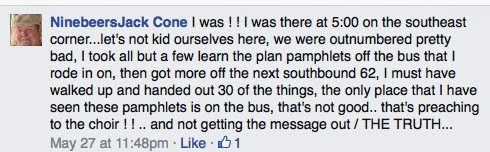
Connect TampaBay had created a Facebook event so I went there that evening to see any comments posted and this was the first comment I found.  I captured the text but this comment must have been deleted as it no longer appears on their page.
I don't want to bust on the people that did show up today, But man we need to take some lessons from this one... if you are going to have a rally for the cause, you need to have some signs ready for the people to use ! thanks Bruce for giving me your sign as you were leaving, but I could have used it an hour earlier, when I showed up there at 5:00, I felt like Newman & Redford in the last scene of Butch Cassidy & the Sundance Kid !...yes I know that some NTFT people are seeing this, but I got to hand it to them, they came out in force today and much better prepared...WE HAVE TO MATCH THAT EFFORT... WE NEED TO FIGHT RHETORIC ... WITH FACTS ! ! they were packing more baloney than Oscar Meyer out there today.. I know we took a lesson today..But WE WILL LEARN FROM THIS.. and be ready the the next rally...
Below is now the first comment displayed which appears to be a response to the above comment that got deleted.
Comment from Connect Tampa Bay event on Facebook
So we learned something else. Not only do Connect Tampa Bay supporters use taxpayer funded Greenlight Pinellas yard signs to urge SUPPORT FOR the referendum, they also pick up as many Greenlight Pinellas taxpayer funded pamphlets they can to distribute.  How easy is that when someone else (the taxpayer) gets to pick up the tab? 

That's what happens when taxpayer funded entities are allowed to use taxpayer funded resources to support a referendum to raise taxes that benefits them.

Just like NoTaxForTracks volunteer Betsi Burgess indicated, this is a David and Goliath battle, and I'll add it's Round 2, but once again NoTaxForTracks proves who the real grassroots activists are on this issue.

Wednesday, June 4, 2014

Increasing electric bills around Tampa Bay

The Tampa Bay Times reports that Tampa Electric may have to raise its rates to comply with the new federal EPA mandates to reduce CO2 emissions.
Tampa Electric customers could see higher electric bills under the proposed federal emission standards for coal-fired power plants, which produced 60 percent of the utility's power in 2013.
The utility already uses several technologies to cut carbon emissions at its coal plants. Still, it expects to have to make changes in its operations that will affect the pocketbooks of its 700,000 customers.
Tampa Electric heritage is in coal-powered electric generation, although they have converted quite a bit over to US produced natural gas in the last few years, they are the most coal dependent electric utility in the state.  Natural gas is cheaper than coal these days, and emits about half the amount of CO2 as coal.
President Barack Obama's administration announced the sweeping new emissions standards Monday to help curb pollutants blamed for climate change. The rules, outlined in a 645-page document, won't go into effect for at least a year. The goal is to cut power plants' carbon emissions by 30 percent from 2005 levels by 2030.
Only 645 pages?  What are we paying for up there in DC?

Of course, once the final rules and regulations are passed, state by state, it will explode into the tens of thousands pages.
Florida already has made significant strides toward reducing coal plant emissions.
The Georgetown Climate Center at the Georgetown University Law School in Washington, D.C., notes in its review of Florida's electricity production that the Sunshine State cut its carbon emissions 15 percent between 2005 and 2012. Electricity produced from coal dropped about 40 percent during that period.
How did that happen?  No recent government rules, regulations or Kyoto protocols drove down those reductions in carbon emissions.  It was the free market, new drilling technologies such as horizontal drilling and fracking that freed up the natural gas, and driving fuel prices down, making it an easy, cost effective decision for the power companies to adopt.

Meanwhile, how bad its our air?  It's not, in fact it's pretty good, and continues on an improving trend.  We answered that question last year.

We have more good news on that front.

The Tribune reported Florida must cut its emissions 38 percent, but also
Gov. Rick Scott's office on Monday touted Florida's air quality.
"Thanks to efforts to curb air pollution statewide, Florida air emissions are the lowest on record. The Florida Department of Environmental Protection will review the EPA's proposal and will work to continue to protect Florida's environment," said Scott's spokesman, John Tupps.
Last month, DEP officials said emissions of key industrial pollutants that contribute to the formation of ozone and fine particulate matter continued to decline in the state, and that power plant emissions of sulfur dioxide and nitrogen oxides decreased 83 percent over the last decade.
Closer to home, more good news. Our air is much cleaner that it was a couple of decades ago. The 2013 Hillsborough Environmental Protection Commission annual report also noted dramatic improvements.

Hillsborough EPC 2013 Annual report on air quality
So how much CO2 do we have?  We should know the starting point in Hillsborough if our Tampa Electric is expected to retool much of their power generation to reduce CO2 levels.  Surely the Hillsborough EPC has tracked CO2 over the the years.

If they have measured CO2 it's not available in the EPC's Air Quality technical reports.

This begs the question about how bad things really are, especially given the improvements in air quality over the last few decades.  Just how clean must it be?  Just how much more expensive will it get? Exactly how will we benefit?

The EPA mandate is not a cap on CO2 emissions, although it has elements for potential inter-state cap and trade.  India, China, and other global emerging economies will not penalize their economic growth by restricting CO2 emissions so CO2 will continue to rise globally despite the EPA mandates. This is only a cap on our personal earnings and the U.S. GDP.

The U.S. Chamber of Commerce has warned these regulations will cost jobs and reduce disposable income.
The impacts of higher energy costs, fewer jobs, and slower economic growth are seen in lower real disposable income per household. … The loss of annual real disposable income over the 2012-30 period will average over $200, with a peak loss of $367 in 2025. This translates into a shortfall in total disposable income for all U.S. households of $586 billion (in real 2012 dollars) over the next 17 year period 2014-30.
Even Democrats are starting to understand their own vulnerability on the EPA mandate.
Democrats running in conservative-leaning states in Appalachia and other energy-producing areas quickly distanced themselves from the draft rule released Monday by the Environmental Protection Agency....
Even in areas less dominated by coal, vulnerable Democrats criticized Mr. Obama for acting without congressional approval to advance his agenda. They sought to do so carefully to avoid alienating the party's base, which generally supports efforts to combat climate change.
They'll need a lot more than "distancing" to save themselves. How about they focus on their constituents jobs and state's economy?

But then again, there's Barbara Boxer.
"Thank goodness the president refuses to be bullied by those who have their heads in the sand, and whose obstruction is leading us off the climate change cliff," said Sen. Barbara Boxer (D., Calif.).
Head in the sand?  Sounds like she's got her head up her *ss!

We are all California now.

Not only will this mandate waste your money, it won't actually do anything for global C02 emissions.
And while making electricity creates 40 percent of the greenhouse gases in the U.S., cutting it as Obama proposes will not come close to meeting the global reduction scientists say is necessary to reverse warming. For one thing, the amount of the U.S. cuts would be replaced more than three times over by projected increases in China alone. (Emphasis mine.)
Where will this lead? Clearly more expensive electric bills. Everything else -- food, goods, cost of living, etc. -- that depend on electric power will increase. Electric utilities will likely convert more power generation to natural gas, which will lead to more fracking. Environmentalists will fight that, so we'll have more anti-fracking activists emerge. If the power conversion is not done right, there is an increasing risk of more brown outs and black outs.  If we're lucky, we'll get to watch some interesting internecine battles between the energy state Democrats and the environmental elitist wing of the party.

Yet global CO2 emissions will continue to rise.

We get to pay for it.  All for nothing.

Tuesday, June 3, 2014

Florida TaxWatch off the rails

As an independent, nonpartisan, nonprofit taxpayer research institute & government watchdog for more than one third of a century,it is the mission of Florida TaxWatch to provide the citizens of Florida and public officials with high quality, independent research and analysis of issues related to state and local government taxation, expenditures, policies, and programs.
We support that mission, and have found much of Florida TaxWatch's work good and upholding that mission. But they seemed to overlook a few things in their recent report, The Rise of Commuter Rails in Florida (PDF).

The report "reviews" two commuter rail projects in Florida.  The SunRail, just began operating in Central Florida as of May 1, 2014, and All Aboard Florida, a project in development by Florida East Coast Industries (FECI), running from Miami up the east coast, then over to Orlando.

The research appears to be mostly consisted of lifting a few paragraphs from some press releases from the respective projects.

Regarding SunRail, TaxWatch states
A significant amount of public funds has already been allocated to these projects. In order to share tracks and prevent disruption of freight service, the state agreed to pay $432 million to CSX Corporation for the track upgrades and for terminal costs. The state also agreed to pay $66 million for operating costs and maintenance over the first seven years of service.4 In addition to state funds, public funds were provided by all four counties benefited by the system, and the City of Orlando. The federal government provided 50 percent of the funding of Phase I through a federal transit grant.
TaxWatch  then cites some  projections on jobs, economic growth, such as 17,000 construction and permanent jobs, but don't break it out, or quantify job-years, the most realistic measure for infrastructure development projects.  Also cited from the Chamber of Commerce is another $1.7B of new and planned development along the SunRail lines, with out any critical analysis.

SunRail crashes
What's missing regarding their SunRail analysis that will directly impact Florida taxpayers?

  • All Florida taxpayers are paying to operate and maintain SunRail through 2020.
  • Central Florida municipalities must begin paying the O&M starting in 2021.  Not one municipality in the region currently has a long term funding source.
  • The agreement between the state and CSX that indemnifies CSX from an accident even if CSX is at fault, adding more risk to the Florida taxpayer.
  • Actual recent ridership on SunRail, which, after the free rides, is currently running under 4,000 riders per day.  As a comparison, I-4 in Central Florida runs up to 200,000 vehicles per day.
  • The fact that the $432 million paid to CSX to use 32 miles of track is the highest per mile amount ever paid. Some $13.5 million/mile.
  • The support from John Mica and his arm-twisting to wave federal ridership requirements to get federal funds.  Mica's top campaign contributor?  CSX.
The analysis on All Aboard Florida is also missing some key points.
All Aboard Florida would connect Miami, Fort Lauderdale, West Palm Beach, and Orlando upon completion. This proposed commuter rail system will be the first privately-owned, operated, and maintained passenger rail system in the U.S in 50 years. Developed by Florida East Coast Industries (FECI), this system is intended to connect about 9 million residents along the rail line corridor.
First of all, in a conversations with an AAF representative, AAF is NOT a commuter rail going after the commuter market.  They are targeting the tourist market.  Additionally, South Florida already has Tri-Rail, a commuter rail, which is not mentioned in the report.  We note the state of Florida continues to bail out Tri-Rail at the rate of $15 million per year.
Finally, though South Florida’s newest rail line is privately funded, public money will still be needed for a variety of related projects, including local governments bearing the cost of rail crossing upgrades, and the current state budget includes $10 million to establish quiet zones at certain crossings. Essentially, unfunded mandates require cities and counties to pay for the upgrades needed at approximately 320 grade crossings between Miami-Dade and Brevard counties due to higher safety standards resulting from the increased rail traffic.
There is also no mention of the fact that AAF has applied for between $600M to $1.8B in
Federal Railroad Association loans. We are unsure of the actual loan amounts because they have not been made public. Regardless, AAF is not entirely privately-funded, it looks more like a public-private partnership. Additionally, TaxWatch does mention that there are unfunded mandates for upgraded road crossings and quiet zones that local municipalities must find a way to pay.  What will the municipalities do?  They've already started going to the state for more taxpayer money.

All Aboard Florida planned routes

As we've told All Aboard Florida, they would benefit from more transparency on their plans and funding.

Why is Florida TaxWatch rather soft in their analysis?  Could it be their funding and Board of Directors?  For example, The Walt Disney Company is represented on the Board of Directors, and TaxWatch actually cites a Bloomberg article Governor Rick Scott heeding the urgings of Disney. Coincidentally, Tucker/Hall, a Tampa Bay public relations firm formerly in charge of the Greenlight Pinellas campaign, is also on the BoD.  Additionally, a former Disney executive was recently named co-president and COO of All Aboard Florida.

Erstwhile Tampa Tribune rail cheerleader Joe Henderson could not resist writing about Florida TaxWatch against the grain report.  Henderson quotes his brother in mass-transit
“That’s interesting, coming from those guys,” Hillsborough County Commissioner and mass-transit advocate Mark Sharpe said. “I think the reality is starting to engage for all of us. People talk about how expensive rail is, but roads aren’t free, either."
Henderson then states
It’s almost impossible around here to engage skeptics of commuter rail. They have decided it will be a massive government boondoggle where the rich will get richer while the public gets fleeced. Because of that, their standard response to rail is to shout “NO” as loudly and often as possible.
Joe, the fact is that neither you nor the rest of the media are doing their job in reporting the facts.  We've just done more original reporting the one hour to write this blog post than you've done in a year in trying to understand the tradeoffs with rail investment that the media refuses to investigate.  Florida TaxWatch's soft report only adds to the skepticism.

If I can connect the dots in a hour, why can't those that are paid do it in the media or Florida TaxWatch do it?

Monday, June 2, 2014

Hostile Takeover of HART

The May Hillsborough County Transportation Policy Leadership Group (PLG) meeting was held last Wednesday and the Eye was there.  The Tampa Bay Times reported Thursday on the major unanimous vote taken by this group: Hillsborough elected officials approve larger transit role for HART.  The Tribune, it appears, never even reported on the PLG meeting at all.

However, Saturday's Tribune included an editorial Revamped HART would give transportation directions on a subject they never even reported on. That certainly is a way to get their own opinion out without allowing readers to read any "objective" reporting on the subject.


So what really happened at that meeting and what is this restructuring really all about?


The Times reported
County Commissioner Mark Sharpe, who has been advocating for transit change for years, called the plan a "HART transplant" on Twitter. The changes will create a far more robust HART capable of running more buses, taking on larger projects and increasing opportunities for transit-oriented development, he said.
We will differ with Commissioner Sharpe.  This restructuring and repurposing of HART is a "hostile takeover" of the existing sovereign HART board. The PLG voted on this restructuring and repurposing with ZERO public input.  NO public comment was available before the PLG voted.  While the HART board knew of the proposal, this vote was done by the PLG before even allowing discussion and public comment be made before the existing HART board. The PLG has not publicly brought forward any plan of their proposed transportation solutions.  Yet they vote on this new restructured HART governance model before anyone, at least in the public, has seen any plan.  Does this behavior reflect a transplant or a hostile takeover to push a plan the PLG knows about but not the public?

Back to the proposed restructuring and repurposing of HART. County Administrator Mike Merrill stated at the meeting this proposal is recommended because it is the "path of least resistance".  Keeping the two gubernatorial appointees helps the "path of least resistance".  However, these two appointees will be outnumbered 10-2 by elected commissioners and mayors so their influence will be totally diluted.

The proposed restructuring re-purposes HART under a new name, Hillsborough Transportation Authority, to serve a broader transportation mission that supposedly will more highly integrate public mass transit and roadways. Merrill must know about a plan that hasn't been made public yet because he stated that there would be an initial thrust for BRT than "evolve" to rail. We're not sure what kind of BRT he meant. We also heard Mayor Buckhorn say that on rail "we're going to get it done".


Therefore the rationale for re-purposing HART is because HART can receive federal tax dollars for transit projects. We get it. The restructured, politicized HART will be sitting in line to feed at the trough of the dwindling federal gas tax bucket.


But that federal gas tax bucket the federal Highway Trust Fund is bankrupt. We have witnessed how well this fund has been managed over the last decades - pork barrel projects, gas taxes diverted to high cost rail projects and other non-road projects and bridges to nowhere.  No surprises the fund is out of money.  The days of getting large federal grants for transit boondoggles may be over.

According to Merrill, the HART board change can be made without any state level approval and HART already has the appointment powers for elected officials to appoint themselves to the HART Board.  What about the re-purposing of HART?  Can the Board simply appoint themselves, dissolve the old board and then change the charter for the new board?  Is that legal?  Does the public have any say?


The current charter that created HART states it's purpose is for "mass transit" facilities and to service the mass transit needs of Hillsborough County.  We highlight the word NEEDS is used, NOT WANTS.  There is no mention of roads, economic development or transit-oriented development.


HART Charter

The new Mission of the restructured, re-purposed HART will include:
  • Advocacy to FDOT and Federal Government
  • Manage construction of major elements supporting a "spine network" in Key Economic Spaces
  • Develop a more comprehensive (emphasis mine) public transit system
  • Manage an Opportunity Fund to take advantage of Transit-Oriented Development (TOD) through Public-Private Partnerships. 
The elected officials are already very busy and have full plates as it is.

I have been to numerous HART board meetings.  I applaud and know the time and effort the existing board members put into their duties to ensure they have all the right information, ask the right questions and deliberate to make the right decision. Our elected officials are extremely busy with the duties they currently have with their elected office, overseeing huge budgets as well as sitting on numerous other boards and agencies.  The county commissioners also make up the entire Environmental Protection Commission (EPC).  Is it even possible to think that they could have the same focus, time and due diligence needed to manage this new expanded mission?  If they cannot provide the same or higher level of focus and attention as the current Board members do to this expanded mission, the elected officials will rely on others - aides or staff which increases the influence and power of unelected and non-appointed bureaucrats.

Commissioner Sharpe made a somewhat snickering remark at Wednesday's meeting about Philip Hale, the HART CEO who took over after the defeat of the 2010 referendum and just recently retired.  However, it was Hale who righted the ship after the 2010 debacle and he had the vision to implement the successful, cost-effective MetroRapid BRT in less than year and under budget. As a result, HART returned millions of tax dollars to the county.  In comparison, cost overruns for rail projects average 45%.


A buzz word around transit is "choice" riders.

First of all what is a choice rider?  According to the Encyclopedia Britannica:

The mass transportation market—its riders and potential riders—comprises two broad groups, captive riders and choice riders. Captive transit riders must rely on mass transit; they do not have an alternative way to travel for some or all of their trips because an automobile is required but none is available or because they cannot drive or cannot afford an automobile. Choice riders use transit if it provides service superior to that of their principal alternative, usually the automobile (emphasis mine). 
To meet the needs of captive riders, broad coverage of the region, the day, and the week is desired. Choice riders are more likely to consider transit for work trips to dense employment centers during peak periods.
Commissioner Murman asked what will it take to get those "choice" riders and get people out of their cars?  The fact is after all the billions have been spent on transit, it's still a small percentage on average 2-5% who use transit. We like our cars. That's why LA County, that has ever transit mode possible, timed ALL their traffic lights - to get more throughput on their existing roads. 

Here's a recent article from the Tampa Bay Business Journal about our local commute times.
The average commute in Hillsborough County takes 26 minutes. It’s three minutes shorter in Pinellas. (Pasco’s average trip to work is a half hour.)
The important question is how much would it cost to provide transit for "choice" riders because our commute times are reasonable, we don't have density, we do have dispersed work centers and we still must provide service to those riders who need public transit because they do not have ANY other alternative.  The recent survey reflects almost 72% do not use public transit at all.
Survey question:  How often do you take public transit?
Perhaps that's why Commissioner Beckner stated that we need a "cultural shift to get the public to take transit".  Really?  Is a build transit and they will come attitude fiscally responsible when the first priority needs to be our roads? 

The apparent goal of a restructured HART is to go after more tax dollars so the new board made up of almost all elected official will be overseeing a new big bucket of tax dollars, including some "Opportunity Fund" for TOD (development around transit stations). Where are those funds coming from?


Our transportation solutions will now be based on political decisions which may not always be in the best interest of the taxpayers who will be paying. A politicized board rather than a sovereign board serves to enable cronyism and corruption. Will we see the deep pocketed Tampa Bay "rail cartel" gain more influence as they pad the pockets of our politicians? Perhaps the Boards new name should be the "incumbent protection board" as we start to watch campaign monies flowing into the politicians wallets. Is that why instead of eliminating the PTC, this group wants to move the PTC under this new board structure?  The PTC's cronyism can fit right in and then they all can share in the benefits from the taxi company donations.

Every survey indicates the highest priority is our roads and that Hillsborough County has a critical funding gap to maintain our existing road infrastructure.  We don't need a restructured, politicized HART to fix our roads.  We need our elected officials to figure out how we close our road funding gap to fix and maintain our roads NOW.


In addition, HART's 10 year Transportation Development Plan, if funded, DOUBLES our bus service in Hillsborough County. We can double our bus service at a fraction of the cost of the Greenlight Pinellas plan costing billions that supposedly will only improve bus service in Pinellas by 65%.  We don't need a restructured, politicized HART board to improve our bus service.

Disney World in Orlando has the third largest bus fleet in the state, behind Miami-Dade and Duval (Jacksonville) counties. They never continued to build out their monorail.  Disney's monorail has not been expanded in more than 30 years, despite the construction of two additional theme parks and more than a dozen new resorts. Why? Financial reasons. It did not take Disney long to figure out that buses are a much more cost-effective, efficient and flexible way to move lots of people. Here is a Working Paper comparison of bus vs rail from the CATO Institute that confirms what Disney figured out.  We were in Las Vegas a few weeks ago. We saw their double decker bus express routes being heavily used up and down the Strip.  We also saw their bankrupt and costly ($654 million for just 4.4 miles—almost $150 million per mile) monorail running empty.  One of our taxi drivers was telling us about their monorail debacle and that taxpayers may have to bail it out.
Las Vegas double decker bus on the Strip
Merrill did mention a 2016 referendum and he stated this new politicized board needs to be in place by the end of this year to get ready for the referendum.  We'll watch that closely. Any future referendum(s) should be single issue initiatives that stand on their own financial merits, expire in 10 years or less so that taxpayers can decide whether the initiative was successful, implemented what was promised and decide to extend it or not.

The warning signal should be this. When the government takes your tax dollars for comprehensive plans and the "something for everyone" strategy, the results end up costing more and getting less than what was promised.


What happens time and time and time again when politicians get large buckets of money to oversee?


It's ironic that the Tribune editorial stated:

Establishing an accountable governing body would be a key step toward winning voters’ confidence
What happened the last time Hillsborough County Commissioners, the accountable governing body, got a new bucket of tax dollars to manage with our Community Investment tax?  They blew it.  They blew out what was supposed to be a 30 year revenue stream in 12 years.

Credibility and trust will be won when our elected representatives have a Transportation plan focused on MOBILITY and our highest priorities:
  • Fixing our roads first, 
  • Improving our bus service in a fiscally responsible, cost effective manner,
  • Getting rid of the PTC and its burdensome regulations, 
  • Leading the way for autonomous vehicles, 
  • Embracing new technology and free market principles to enable the private sector to launch new services 
  • STOP talking about high cost trains.  

Tuesday, May 20, 2014

Manipulating the Polls

The Tampa Tribune today published the results of a transportation poll in an article they titled Hillsborough poll shows support for all transit options that reported
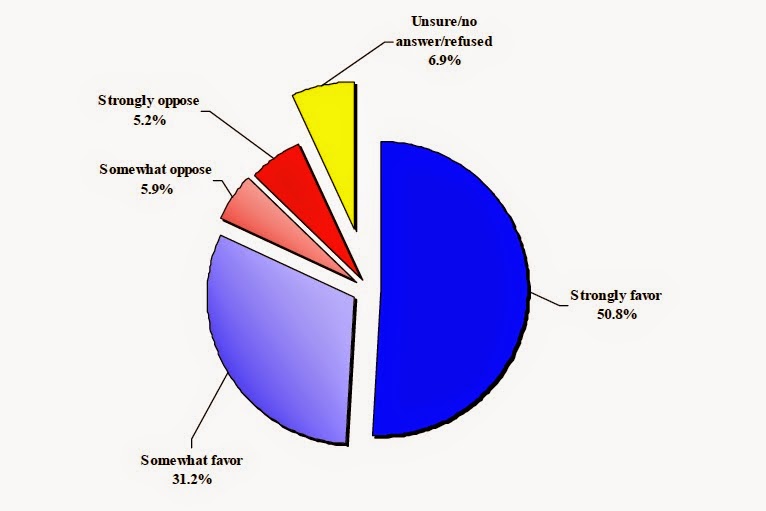
Also strongly favored at 73 percent was increasing transit options to include toll lanes on interstates, a high-speed ferry from southern Hillsborough to MacDill Air Force Base, and a light rail system.
After speaking with Eric Johnson at county center, the Eye found out it wasn't the county who was publicizing the results of their poll today.  It wasn't the county who handed the results to Salinero.  It wasn't even Salinero of the Tribune asking the county for the poll results.  We are told the county had planned to publicize the results at next weeks Transportation Policy Leadership Group meeting.

It was Kevin Thurman, a paid lobbyist as Executive Director of the pro transit group Connect Tampa Bay, who requested the poll results from the county.  It was Kevin Thurman who handed the results off to Mike Salinero.  Since that information was not pointed out in Salinero's article, readers probably thought Salinero got the poll results directly from the county or Transportation Policy Leadership Group.  We wonder how the Transportation Policy Leadership Group must feel about a poll they sanctioned being released to the media before they have had a chance to review and comment on the results.

The subtitle of the print version of Salinero's article states
Poll shows 82%of people in Hillsborough favor more bus routes, 73% like light rail. 
What was left out of that subtitle was that 81% favor improving and maximizing our existing assets first (see findings below). 

The handling of how this poll was released to the media forced those in the County who sanctioned the poll to speak with Salinero for some clarification.
The poll, conducted May 4-8, was light on specifics (emphasis mine), and that was by design, said Eric Johnson, the county’s director of strategic planning and grant management. Johnson said the transportation policy group wanted an early indication of whether the public supports the county’s quest to improve transportation on a broad scale. Later polls will get more specific on projects and funding.
“Basically what I think comes out of this is we really validated the people agree with our approach,” Johnson said. “We’re not at the point of describing specific projects; we’re not at the point of asking, ‘If you like these projects are you willing to pull out your wallets and pay for them?’”
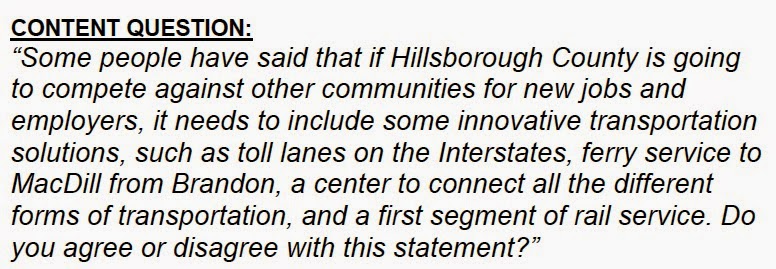
So the poll was intended to validate an "approach" the county was using to get to a future conclusion on specific projects but the Tribune article pushes the narrative that 73% like light rail. This was the actual content question in the poll:
Poll question regarding "innovative" transportation solutions
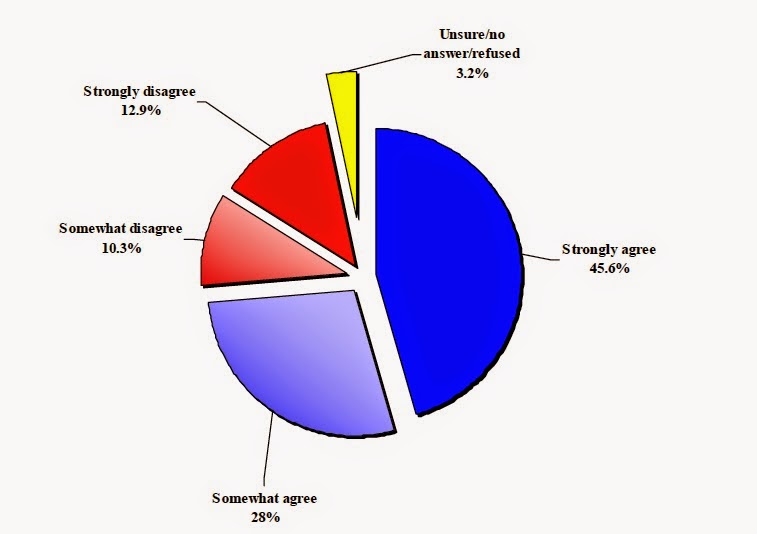
And the Key finding was:
Poll result reflecting support for "innovative" transportation solutions
Some respondents must have picked up on lumping all these solution into one question because this poll question had the highest number who opposed, almost 25% disagreed.  Did the Tribune report that finding?
Largest opposition was question including light rail
The question was regarding "innovative" transportation solutions and then stated various options as examples.  It FORCED anyone answering the question to agree with the statement that residents in Hillsborough county "want it all" even if they may only agree with one or two of the options stated.  Talk about a leading question.  

Innovative transportation solutions could also include building out more MetroRapid BRT's, reducing regulations and enabling ride sharing services like Uber, Lyft to compete in Hillsborough County or allowing Jitney taxis or eliminating the $50 minimum limousine charge or opening up the skies to jet packs, flying cars and deliveries by drones. It could be embracing autonomous vehicles or the next new technology that becomes available. 

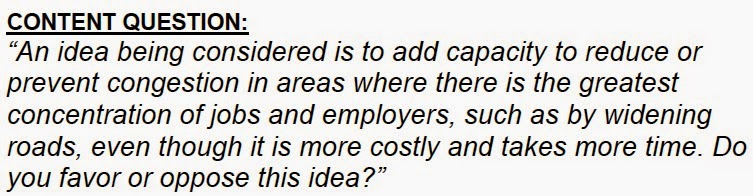
The poll also included this question:
Poll question regarding adding capacity where needed
Why does the question include a statement that widening roads is "more costly and takes more time" That appears to be an editorial open ended negative description. Roads are more costly than what?    95-98% of us use the roads everyday, including the buses. Light rail, the most subsidized mode of transit, isn't costly? Roads take more time than what? Than light rail that takes decades, if ever, to build out?  

Remember the media previously reported a concern from transit supporters about "leading" poll questions in their report about a poll done a couple of months ago showing opposition to Greenlight Pinellas.  We previously posted here the Tribune's report regarding that poll:
A new poll on the Greenlight Pinellas campaign to build a light-rail system and put more buses on the road has sparked controversy about whether the survey misled residents. 
But transit supporters say the questions written by McKalip were designed to skew the results (emphasis mine).
Maybe it's selective concern about "leading" poll questions.

The polling company the county used for this poll, Florida Opinion Research, is one that has done transportation polls before. They did a poll for Polk County on the way to Polk County commissioners voting this year to put a transportation sales tax increase referendum for roads and buses on the November ballot.

As reported, those polled were 1100 "residents" of Hillsborough county.  The poll attempted to capture both home and workplace zip codes to help find out results from those areas the county has already deemed "work centers" and the poll did include cell phone users.  They specifically avoided targeting voters because how to fund any of these options was not included in what they deem is this more broad based poll.

Improving bus routes did poll the highest at 82% but it also had the highest percentage of those who were unsure or refused to answer.
Result of question inferred to be about expanding bus service
The second highest support at 81% was this poll question regarding maximizing our existing assets by improving traffic flow and intersection improvements. For all the "noise" about Millenials do not want to drive and want to use transit, the Key Findng of this poll is that Millenials favored this option the most.
Highest support for maximizing existing assets is with Millenials
Also included in the Key Findings for this question is what we have stated previously about ensuring we maximize our existing infrastructure FIRST.

What information do the results of this poll provide?  Not much except there is support for transportation improvements but any specifics are unclear.

Public out reach from the Transportation Leadership Policy Group will begin soon and more polls will be forthcoming.  Next polling needs more information regarding specific improvements - the financials, the cost/benefit, the return on investment, timeframes, ridership, fiscal sustainability in the long term, will it help reduce traffic congestion for each separate option.

Different transportation solutions or options should NOT be lumped into a single poll question.  Each option should stand on it's own financial, return on investment, and realistic timeframe merits. Those being polled should be able to differentiate and answer each option separately.

Maybe next time the Transportation Leadership Policy Group, who sanctions the polls, will get to review the results before a lobbyist or the media reports their spin.

But the "let's do it all, something for everyone" comprehensive approach was tried before in Hillsborough County with the Community Investment Tax.  We know how that turned out.  Do we want to go down that path again?

Tuesday, May 13, 2014

Money Can't Buy Me Love

The Political Action Committees (PAC's) to support and oppose the Greenlight Pinellas light rail referendum are required to file their campaign reports of their donors, donations and expenditures each month. 

The pro Greenlight Pinellas PAC, Friends of Greenlight, has raised almost a half million dollars. Their filings can be found at the Pinellas County Supervisor of Elections website here.  

Who are their heavy hitter donors?
  • Duke Energy - $50K - the seed money for Yes for Greenlight
  • SEIU Florida Public Services Union - $2.5K (the same group we previously posted funds the Progressive Peoples Budget Review organization)
  • Pinellas Realtor Organization - $10K
  • Tampa Bay Partnership - over $18K of in kind Administrative, Accounting Services and Office Supplies (this special interest organization was the symbiotic twin of pro rail PAC Moving Hillsborough Florida in 2010, pushed to create TBARTA and apparently coordinates their legislative agenda with taxpayer funded TBARTA)
  • National Association of Realtors with an address out of Chicago, IL - $245K (the Chicago way comes to Pinellas...)
  • Tampa Bay Rays - $25K (they're looking for a new taxpayer funded stadium but apparently can blow $25K on a train)
  • Carlton Fields - Tampa - $10K (this law firm helped lead the failed rail effort in Hillsborough)
  • Baycare - $25K (healthcare wanting to take more out of our wallets?)
  • Raymond James - $50K (aren't they planning to move to Pasco?)
  • Sykes in Tampa -  $50K (Sykes was the largest donor to the pro rail PAC Moving Hillsborough Forward in Hillsborough in 2010) 
  • TECO Energy - $20K
There are some individuals that contributed, mostly nominal amounts, including a number of donors from Tampa who can't vote in Pinellas but support the "cause". Many of the donors, whether individual or corporate, are associated with the Tampa Bay Partnership.

Does this look eerily familiar? It is. The 2010 money is the same as the 2014 money. These corporations and organizations must be doing very well today.  They keep throwing tens of thousands of dollars towards their "hopes" of getting a train.  Do they have money to burn or will they benefit?

Friends of Greenlight spent money on direct mail, consulting, yard signs, video production and their new PR firm. They had to drop their former PR firm Tucker Hall who was already representing PSTA's Greenlight Pinellas campaign......

The opposition PAC, No Tax For Tracks, campaign filing can be found here.  No Tax For Tracks has raised about $30.5K.  Besides the vast difference in the amounts each PAC has raised, the other big difference is that ALL donations to No Tax For Tracks are from individuals and they are donors who live in Pinellas and can vote. 
David vs Goliath
We'll continue following the Money "Train" and report this information as the election cycle heats up. This David vs Goliath will be worth watching (again).

But like the old Beatles song - "Money Can't Buy Me Love"

Monday, May 12, 2014

Greenlight Pinellas: Deception, Skepticism and Abuse of Taxpayer Monies Continues

The Clearwater Beach Chamber of Commerce sent this letter to PSTA regarding Greenlight Pinellas.

The letter begins by stating the Chamber's support for Greenlight and continues that there is a need to pursue improvements in the County's transportation system. But what exactly does the "high expectations" of our international visitors mean? Did the Chamber survey  international visitors and find these visitors have an overwhelming demand for a $2.5 Billion train to take them from downtown St. Pete to downtown Clearwater?  Or are these international visitors demanding improved bus service? How many international visitors did they survey? No matter how many international visitors come to Pinellas, the huge capital costs for Greenlight, especially for light rail, will be paid for by US/local taxpayers not international visitors.  

Then the Chamber letter becomes even less clear.

The Chamber admits that some of it's members have valid concerns about PSTA.  Well PSTA did spend over $4 million of taxpayer money on their Alternatives Analysis and there are still many questions left unanswered. Has PSTA been good stewards of your tax dollars in the past? How confident are you that PSTA will be good stewards of billions of new tax dollars headed their way?

Then it appears the Chamber "hopes" Greenlight Pinellas has done it's proper research regarding what is actually needed, the county's population growth and that Greenlight Pinellas is not being swayed by politics.  

The Chamber must have missed our previous post about Greenlight's misleading population growth numbers Greenlight was touting. Greenlight Pinellas spent $400K last year lobbying politicians and targeting specific groups to get the Pinellas County commissioners to put the referendum on the ballot. Greenlight Pinellas is spending at least another $400K this year advocating for the initiative and is currently being investigated by the FDOT about these questionable and ethically challenged expenditures. None of that is political sway?

Did the Chamber also miss the fact that high cost light rail does nothing to reduce traffic congestion? Certainly there are smart folks at the Chambers and elsewhere in Pinellas who understand there's no need to waste taxpayer dollars on a $2.5 BILLION train to improve Pinellas County's bus service. Improving bus service can be implemented at a fraction of the cost of light rail.

Proper research would have easily found the truth about Pinellas County's future population growth. Proper research would find studies indicating light rail does not reduce traffic congestion, that it costs too much, benefits too few and ends up hurting bus service. 

This Chamber appears somewhat skeptical of Greenlight Pinellas - and they should be...because the deception of Greenlight Pinellas continues.

Greenlight Pinellas has spent more taxpayer dollars retooling and scrubbing their website. They conspicuously scrubbed their website of the picture below which advertised their taxpayer funded trinkets they were giving away. Do you think that was done because Greenlight is now being investigated for how they have and are wastefully spending taxpayer dollars?
Display of trinkets now scrubbed from Greenlight Pinellas webpage
Greenlight Pinellas and their supporters know that high cost light rail is so toxic they are now deceptively attempting to portray the plan as a bus improvement plan. Scroll thru the banners at the top of their homepage. Below is the ONLY reference to a rail or train that is made and it includes a nebulous false statement.  
Banner of new webpage with false statement that rail will reduce congestion
The FACT is rail does NOT reduce traffic congestion.  Even the Washington Post reported 
...over at Atlantic Cities, researchers have had trouble finding evidence that urban light-rail systems really do curtail traffic congestion.
The other point is that mass-transit systems can lessen road traffic, but only if they're part of a broader shift by a city to move to denser development. 
Did PSTA/Greenlight Pinellas not do their proper research or are they simply ignoring the results of actual studies?  Did PSTA/Greenlight Pinellas miss or ignore any of this type of information Light Rail Doesn’t Work?  

PSTA CEO Brad Miller, stated at an event last summer when asked why rail is part of the Greenlight Pinellas plan, that rail is included for "economic development".  Study after study reflects trains are NOT for mobility and congestion relief - they are to enable transit-oriented development, which most of the time is also taxpayer subsidized.  Is that why so many special interests developers support Greenlight?  Could this be why the Pinellas Realtor's association gave the pro rail Friends of Greenlight PAC $250K?  Follow the money!

We have previously stated that light rail cannibalizes bus service and takes ridership from previous bus riders not from those driving their cars.  That can result in bus service being cut which negatively impacts the lower income who depend on the bus to get to work.  Atlantic Cities blog posted the conclusion of research done
Growing rail shares in the light rail corridors have mainly come from buses and the evidence for light rail reducing car use is less clear. This latter finding is of particular significance, given that a major justification for investment in light rail rather than bus schemes is their presumed ability to bring about major modal shift by attracting substantial numbers of car users. 
With that in mind, the work still underscores some important lessons. For starters, it offers a sound piece of advice: cities considering a light rail system should strongly consider whether improving the local bus system would be cheaper and just as effective (emphasis mine).
Greenlight Pinellas deception continues with "their" description of "Preparing for Two Futures".  Where's the train? Note there is NO mention that if the 14% sales tax increase passed, the taxpayers are on the hook to pay for a $2.5 BILLION light rail train and to sustain it's operating and maintenance costs into perpetuity.  In addition, light rail systems must be replaced or incur major rehab in about 25 years.  Where is that money going to come from?  The US currently has about $78 BILLION in backlogged rail system major maintenance today and we haven't figured out how to pay for that.

Why would Greenlight Pinellas not highlight light rail as being part of their plan - it's a huge cost.  Is light rail that toxic?  Does Greenlight Pinellas think everyone is a low information voter in Pinellas? 

Of course PSTA resorts to threats of bus service cuts if the referendum fails, and it is very likely to fail.  PSTA said the same thing when they voted to raise property taxes 30% just a few short years ago.

If PSTA truly wanted to improve their bus service, then PSTA should have proposed a common sense, fiscally responsible plan to do just that at a fraction of high cost light rail. 

Instead, it's all about getting federal tax dollars. However, once federal dollars, with all the strings attached, are taken for rail boondoggles, it's like Hotel California:  you can check in but you can never check out without paying back the feds all the money that was taken.

Federal dollars are dwindling and the Highway Trust Fund (HTF) is bankrupt. Greenlight Pinellas plans to get over 36% of the light rail capital costs from the bankrupted HTF - your federal gas tax dollars. How likely is that? If all the federal dollars don't come thru, aren't the local taxpayers on the hook for the gap? There are no guarantees of getting any federal dollars.

In addition, Sunbeam Times blog just reported the suspected misuse by PSTA/Greenlight Pinellas of Federal DHS grant money that is supposed to be used to help protect transportation infrastructure.
The DHS Transit Security grants were used to create three television ads (scripts at bottom and youtube video above). The three ads separately feature happy bus riders and extoll the virtues of the PSTA bus system’s link to technology, convenience and environmental friendliness. Each ad ends the same way: “And PSTA is working to make it easier to get around the county. To learn more, visit Greenlight Pinellas.com or PSTA.net”. The end of each ad features a Greenlight Pinellas logo, PSTA CARES logo and disclaimer indicating the ad was paid for by a grant from the Department of Homeland Security.
These ads are totally misleading. They are not educating the public about transit security and how to look for suspicious packages, they are advocacy ads asking the public to go to the Greenlight Pinellas website "to learn more".

Pinellas county voters and taxpayers deserve honesty, clarity and accountability, not systematic deception and abuse of the use of their tax dollars by PSTA/Greenlight Pinellas.

PSTA needs an immediate overhaul and new management, not another cent of taxpayer money!

Vote No on Greenlight Pinellas in November and send PSTA packing back to the drawing board.