Sunday, June 22, 2014

North Pinellas Regional Chamber of Commerce: Against Greenlight Pinellas


The North Pinellas Regional Chamber of Commerce held a town hall meeting on June 12, 2014 at their offices, located at 3150 Curlew Rd, Oldsmar. Representatives from Friends of Greenlight and No Tax For Tracks were invited to advocate for their respective positions. Each had an opportunity to speak to a packed house and used graphics and supportive materials to present their respective positions. The presentations were followed by questions from those in attendance. Both sides were represented by supportive constituents.

The North Pinellas Regional Chamber of Commerce, having heard from both sides, has made a decision not to support Greenlight Pinellas.

“It is the opinion of our Board, based on a consensus of our members, those present at the Town Hall meeting, a polling of our local small business owners and our Board of Directors that Greenlight Pinellas is not in the best interests of the small businesses in the communities that we serve” states, Tory Perfetti, Chairman of the NPRCC Governmental Affairs committee.

 The North Pinellas Regional Chamber of Commerce is a regional Chamber serving the Clearwater, Safety Harbor, Dunedin, Tarpon Springs, Oldsmar and Palm Harbor communities.

“Many of our citizens have expressed that an increase in the local sales tax to pay for the light rail system is not in their best interests”, says Steve Fiske, Chairman of the Board of the NPRCC, adding, “that while m GREENLIGHT Pinellas, TBARTA,PSTA,No Tax For Tracks,Brad Miller,Light Rail,TBARTA,Pinellas County,Pinellas County Commission,buses,ferry,intermodal,sales tax,Pinellas Sales Tax Referendum
any of the people we spoke with feel the PSTA is in dire need of improving their various routes, frequency and services, the net sum gain to our area businesses as it is presented is not significant enough to warrant an increase in our local sales tax.

There were other concerns about the validity of the proposed Greenlight Pinellas budget and implementation of the plan as well as a host of questions about how North Pinellas businesses could benefit from the rail and bus improvements as presented”.

For any further questions regarding the North Pinellas Regional Chamber of Commerce please contact Steve Fiske, Chairman of The Board, NPRCC at stevefiske13@gmail.com

Posted by:      
E-mail Doc at: dr.webb@verizon.net. Or send me a Facebook (Gene Webb) Friend request. Please comment below, and be sure to share on Facebook and Twitter.
Disclosures: Contributor to
No Tax for Tracks

Readying for a Referendum?

This is Part 2 covering the HART Board Strategic Planning Workshop held Monday, June 9, reporting on the update from the County Administrator on the Hillsborough County Transportation and Economic Development Policy Leadership Group.  

Below are some slides from County Administrator Mike Merrill's presentation: (click slides to enlarge) with my takeaways. When Merrill showed slide 1 (below), I thought I was looking at a stack and pack city out of the movie Bladerunner not any rendition of downtown Tampa.


  • Goal is to move people and goods with cost-effective, convenient, reliable and safe interconnected mobility
  • Merrill said reducing or mitigating congestion was not called out but inferred


Here's a closer view of Merrill's pic:

And here's a scene from the 1982 movie Bladerunner set in the year 2019:


At least Bladerunner had flying cars.

Make you wonder why our elected officials want to tie our transportation solutions so closely to land use?  Do they want to coerce (force) densification and stack and pack us to pursue their agenda, including more public transit?

More slides from Merrill's presentation follow:
  • Some of the success factors were defined as walkable streets and denser development in certain areas
  • The plan needs to be consumer driven and multi-modal to force/coerce a cultural change to "get us out of our cars"
What is the Livable Centers Initiative?  
It was started in Atlanta in 1999.  Livable Centers Initiative encourages local jurisdictions to plan and implement strategies that link transportation improvements with land use development strategies to create sustainable, livable communities consistent with regional development policies.

Reason Foundation found issues with this initiative in 2012:
  • LCIs use federal gas tax funds to support local projects. Funding for this program comes specifically from the L-230 funds in the highway section of the state’s transportation bill, not the transit section or the intermodal section 
  • ...non-motorized transport (sidewalks and bike paths) receives most of the resources from LCI grants. 
  • ...most of the projects have little to do with transportation. Transportation funds should not support economic development projects.
  • LCI often fails to spur any development.
When our politicians complain that roads don't pay for themselves, well, neither, apparently, do "livable centers".
  • What Are We Agreed On? The Policy Leadership Group or who? 
  • Who says we "must" attract choice riders and taxpayers must highly subsidize choice riders? 
  • Why wouldn't choice riders pay market price?
  • Agree we must optimize our existing infrastructure - biggest bang for the buck
Transportation doesn't pay for itself......but transit is much more highly subsidized than roads.  According to this Heritage Foundation article published last year highway user fees supported each transit passenger mile 17 times more than each highway passenger mile ($0.1130 for transit; $0.0067 for highways). 

Federal Gas Tax User Fee Expenditures roads vs transit 2010
  • According to Merrill, this plan is "something for everyone" 
  • BRT would be the foundation and the plan would not exclude rail  
  • As transit ridership grew over time and we became more transit-centered, we would grow into rail and into a fully functioning multi-modal system. 
Where's Ride-sharing services like Uber & Lyft, Jitneys, De-regulated Super Shuttle?

We will note that roads are multi-modal as vehicles, buses, bikes, pedestrians and even sometimes golf carts use them.


  • A one cent sales tax increase would generate $200 million/year, a half cent sales tax increase would generate $100 million/year and there is an assumption of a 3% growth rate per year
  • The bedrock of the funding plan is federal (which is ever dwindling) and state grant money and local sales tax

  • Social Impact Bonds aka Pay for Success is a new financing mechanism for private and philanthropic organizations to finance projects that provide a specific social outcome with a modest return on investment
Merrill mentioned another long term 30 year tax. (HART can bond and borrow and go into debt like the county commission did with our 30 year CIT tax)


  • Good to see Public Safety at the top as highest priority
  • Good to see next highest priority is preserving our existing infrastructure

Economic Development has totally different drivers; there are numerous other agencies and organizations, some whom get our tax dollars, responsible for Economic Development 

Transportation solutions must be for mobility


Merrill mentioned that the CIT tax "worked well". That was a bit disturbing because the CIT did not deliver what was promised the voters and it was all spent less than halfway through the 30 year life of the tax. There are at least $127-$130 million of projects Merrill stated should have been paid for through the CIT tax but were shelved due to no funding.

Merrill stated there will be a comprehensive list of proposed projects at the next Policy Leadership Group meeting on June 26 that will include a BRT demo project, people movers, etc.  When asked by a Board member what the BRT demo project was, Merrill didn't answer the question. We'll have to find out more at the June 26 meeting because no details were provided by Merrill about the list of proposed projects.

Merrill stated "there is no more capacity in our budget and we cannot move forward without a tax increase". Really? Did he say that on behalf of himself, the County Commissioners or the Policy Leadership Group? The proposed FY 2015 Hillsborough County budget is almost $4 Billion. Are our spending priorities in the right place?  Do we have existing assets that could be repurposed to a higher priority like roads?  


Commissioner Sharpe voiced concern about "the plan" being "road-centric". What plan? There's been no official plan made public but Merrill stated the sales tax increase would probably be a 50/50 split between roads and transit.  We already spend more money in Hillsborough County for transit than we do on our roads.


If 50% of the transportation dollars are spent to serve 2% of traveler’s ‘passenger miles’, the remaining 98% of travelers that use roads will suffer increasing gridlock and congestion. HART does not have this critical funding shortage today that our roads do: 

It is estimated that the county needs approximately $160 million per year to add 200 lane miles of roads every 5 years to keep county roads up with current population growth.
The plan must be road-centric!

Regarding the hostile takeover vote by the Policy Leadership Group we reported here, there were a number of concerns raised by the existing Board members about the proposed restructuring and re-purposing of HART. Below, with a few edits I added, is the chart Merrill presented that reflects this new Governance entity.


Proposed Restructured Politicized HART
This new entity would oversee a huge bucket of money. How will this work considering our strict Sunshine Laws? The biggest risk is our transportation solutions will be politicized which then enables wasteful spending, cronyism and corruption. The money starts flowing but where is it going?  

In addition, why is money going to TBARTA?  That's the same as handing our tax dollars off to part of the rail cartel Tampa Bay Partnership.

We did find out that the hostile takeover vote by the Policy Leadership Group was non-binding. Maybe that was why they voted without allowing any opportunity for public comment. The vote didn't actually do anything except provide a perception that it did or serve as a trial balloon.

It also appears that the existing HART board would have to vote to make the changes the Transportation Policy Leadership Group is proposing. That would basically mean the existing Board would have to vote to kick most of themselves off the board. Would they?


The restructuring and repurposing of HART still remains murky and there are questions that will need answering. 


Was this the start of a push for a referendum?  Was Merrill's presentation a sales pitch that seemed to conveniently coalesce with the new Super Sized expensive HART plan revealed at the beginning of this workshop that we posted about here?

But before any referendum is pursued to increase taxes, the county must put our "checkbook online". Then when money starts flowing, taxpayers know where it's going!

UPDATE:  The June 26th meeting that was going to be about transit and provide a list of transportation projects has been postponed to August 21st.

Sunday June 22, 2014 Is St. Pete Really Headed in the Right Direction?


By: E. Eugene Webb PhD 

St. Petersburg - The last several St. Petersburg administrations, including the current Kriseman team, have been fascinated with the millennials. Their primary objective seems to be to convert St. Petersburg into a millennia utopia replete with high rises, walking destinations, bars, more bars and the ever elusive "high tech" firms to provide jobs for the new St. Pete population. 
While the local politicians have been wildly chasing the next "super secret" high tech company that will bring a whopping 65 jobs to St. Pete in return for what will likely be significant tax credits, St. Petersburg population inched downward and the City quietly slipped from Florida's 4th largest City to 5th place.

The Pew Research Center says "Roughly 10,000 Baby Boomers will turn 65 today, and about 10,000 more will cross that threshold every day for the next 19 years." In case you missed it that's 10,000 per day.  

If St. Pete's population is declining it's a pretty good bet the City is not attracting its share of the baby boomer retirees.  

St. Petersburg used to be a retirement destination: a place high up on the list of desirable places for retirees to consider.  

Oh sure those retirees that can afford a million dollar condo on Beach Drive and gush about the arts are welcome, but Joe Lunch Bucket, who did 35 years in the auto industry, and his wife who have very comfortable retirement are not the object of the City's marketing effort.  

Overlooked is the fact that the retired population of St. Petersburg still owns the vast majority of residential property in St. Petersburg.  The steady flow of income from retirement accounts and social security payments have long served as a damper from economic shock waves. 

But a retirement based population requires steady replenishment as the natural course of life takes its toll. For that to happen, St. Petersburg has to remain and be marketed as a place for all people to come and enjoy their retirement years.

It seems to me that there is a bad case of millennial myopia at City Hall. I think it stems from not being able to see clearly past about 9th Street North.

The craft brewery infested, alcohol powered concrete canyon that downtown St. Pete is becoming cannot be extended to cover all of St. Petersburg. And while the downtown tax base  may be growing, care must be taken that the rest of the City tax base remains strong.

The millennials are a fluid group. They buy a lot of cars, drink a lot of booze and lease a lot of their living spaces. By design they have to ready and capable of shifting with the fortunes of their generation. When it comes time to leave they simply leave.

And those high tech jobs and their promises, they tend be just a fleeting as the millennials they employ. Just look at the unfulfilled promises of Jabil Circuit to St. Petersburg.

E-mail Doc at: dr.webb@verizon.net. Or send me a Facebook (Gene Webb) Friend request. Please comment below, and be sure to share on Facebook and Twitter.
Disclosures: Contributor to
No Tax for Tracks

Wednesday, June 18, 2014

What Plans for Transit? Our Transportation Funding Crisis is Roads

This will be Part 1 about what direction HART, our local transit agency, may be going.

A HART Board Strategic Planning Workshop was held last Monday, June 9.  The Eye was there. The purpose of the workshop was to discuss the strategic direction of HART and to get an update from the County Administrator on the Hillsborough County Transportation and Economic Development Policy Leadership Group. The update from the County Administrator will be covered in a subsequent post.

HART spends about $66 million a year to currently run the bus service. You will find their 10 year Transportation Development Plan (TDP) here.  The TDP is required to be updated each year. HART's ridership increased between 2010 and 2012 but the increase appears to now be flatlining. Why? We don't know. Perhaps with the uptick in our local economy, with our unemployment rate down and more people are working, they can afford a car and are driving.

HART currently receives approximately $30 million a year in county property taxes, which have been inching up since the housing bubble burst. About 20% of the revenue comes from their fare box recovery and the rest from federal transit formula funds and state/federal grants.

As HART's TDP reflects, their Status Quo plan does increase service hours and is currently funded. There will be a need for some increased funding in a few years, even with the Status Quo plan, as buses will need replacing.

HART's Vision Plan, which is not currently funded, was discussed at this meeting. This plan includes building out additional cost-effective Metro Rapid Bus Rapid Transit (BRT) services, increasing some express services and local circulators. The Vision Plan has been vetted and approved by HART if funding was available. It would require $400 million in capital to implement and $110-150 million a year to operate. The Vision Plan would double HART's existing bus service in the county and about double the operating costs. It was noted that the much more costly Greenlight Pinellas plan will only improve bus service by 65% in Pinellas. The Vision plan could probably be locally funded with a short term tax increase without using federal dollars that have strings attached and increase the cost. As we previously posted, the Highway Trust Fund is bankrupt and we're almost $18 Trillion in debt.

Interim HART CEO Katherine Eagan said HART has saturated their current market and HART should move into new markets of potential riders, address different parts of the county that have different needs and be more customer focused.

So how do they do that? With the big, bold Super Sized plan that goes beyond the Vision Plan to target new markets of "choice" riders.

Where did this Super Sized plan come from? What I gleaned from the HART board discussion was Eagan was working on some of this with County Administrator Mike Merrill and Board Member Dr. Polzin.  Dr. Polzin, for transparency, stated he was working with the County on behalf of CUTR (Center for Urban Transportation Research at USF) where Dr. Polzin works.

The Super Sized plan had never been brought before the entire HART board before. This was the first time all the board members heard about it. This plan that has not been vetted by HART would require capital costs of at least a Billion dollars and will cost approximately $330 million a year to operate. It appears this plan would implement the gold standard BRT in dedicated lanes which cost at least $20-25 million a mile which would create a permanent transit corridor.  It was unclear if these bus lanes would be managed bus toll lanes, added as additional capacity and shared with users who choose to pay a toll, or strictly dedicated bus lanes.  Due to this plan's large capital cost, it would require large amounts of federal funds to implement.

While the Transportation Policy Leadership Group has not agreed on a plan yet, County Administrator Mike Merrill stated at the last Transportation Policy Leadership Group meeting in May, that we need to reach out to a new population of riders and entice them in various ways. He said that we need an integrated system that ties a new Bus Rapid Transit System to a new managed bus system and to rail, and that we're going to need a lot of federal dollars. Merrill's comments sounded much like the new Super Sized plan discussed at this HART board workshop.

Several board members asked that HART staff provide a comparison or menu of each of these plans, the Status Quo, Vision plan and Super Sized plan that includes cost estimates for each. I was glad to hear it stated that the cost component part must be included as part of the community outreach to help determine what taxpayers are actually willing to pay for.  What is the cost benefit of these various plans?

There was much discussion about the plans but both Commissioner Sharpe and Murman stated they wanted to "go big and bold" with the Super Sized plan.

Let's step back and ask where is the actual transportation funding crisis?  It's with our roads.  The county has been neglecting our roads for years which has created this mess of F-rated roads.


F-rated Deficient Roads in Hillsborough
Next year there is only between $5-9 million for roads. Our local gas tax only fills our pot holes. The real transportation funding crisis is we have no money to maintain and improve our roads and this crisis must be addressed.

The Transportation Leadership Policy group is also looking at road improvements as even buses need our roads. Before we consider a Super Sized transit plan, let's see the big bold plan for roads since 98% of us use them everyday.  

And no "enticement" is needed.

Monday, June 9, 2014

Eliminate the Highway Trust Fund and Empower the States

Saturday's Tribune had a commentary courtesy of the Washington Post, No road work ahead, that states:
The federal Highway Trust Fund is set to run out of money this summer. Without a fix, federally backed transportation projects all over the country — not just highways — would be in danger of severe disruption or cancellation.
Yes, the Highway Trust Fund is running out of money - soon.  The Highway Trust Fund was funded exclusively through our federal gas taxes, user fees, until 2008 when Congress began transferring monies from the General Fund to cover deficits in the Highway Trust Fund. This allowed spending to continue (with borrowed dollars) and basically kick the systemic problems of the Highway Trust Fund deficit spending down the road.  

How did we get here? CATO Institute provides a Dept. of Transportation Timeline of Growth from 1787 - 2009. 

The federal gas tax was implemented in 1956 under President Eisenhower to fund roads, highways and bridges and to specifically build out our Interstate system.  Gas taxes are a "user fee" paid for by those who use our roads. The federal gas tax today, which has been in place since 1993, is 18.4 cents per gallon for gas and 24.4 cents per gallon for diesel. The tax was originally set to expire in 1972 but instead has been extended ever since and it's scope greatly expanded well beyond the Interstate system and roads. 

In 1983 Congress created the Mass Transit account within the Highway Trust Fund. This act began the diversion of our road user fees, federal gas taxes, to mass transit. This enabled greater expanded siphoning of our federal gas taxes to rail and bus transit, ferry boats, bike paths, sidewalks and recreational trails.  Today our federal gas taxes are expanded beyond even those activities and includes air quality mitigation, historic resources, environmental goals and other ancillary purposes.
Today HTF allocations fund much more than just highways 
At the same time the scope for the use of our federal gas taxes was being greatly expanded, vehicles continued to become more fuel efficient and vehicles fueled by other types of energy began to be introduced:  hybrids, electric, natural gas, etc.  As CAFE standards increase fuel efficiency and the public uses more non-gasoline powered vehicles, the funding problem gets worse. The circular logic of heavily subsidizing mass transit and other ancillary activities through dwindling vehicle user fees eventually becomes unsustainable and reality hits.  

Have you heard of earmarks?  The first earmarks EVER, which began the use and abuse of earmarks, was in the Federal Aid Highway Act of 1982. That bill included 10 earmarks for funding transportation projects in certain Congressional districts. Ironically, that same year, 1982, then President Reagan proposed ending the federal gas tax and federal highway funding. Congress refused to support Reagan's proposal because apparently they did not want to give up their power and control over this huge pot of tax dollars. The House Transportation Committee, who oversees the Highway Trust Fund, is the largest committee in the House. That's a lot of power, influence and control.

President Reagan vetoed a transportation bill in 1987 because it had too many earmarks - 151.  Earmarks continued to grow and grow as Congress continued earmarking pork barrel projects for their home districts. Transportation funding became the poster child for earmark pork projects.  The last long term 5 year Transportation bill passed by Congress in 2005 had a record breaking 6,371 earmarks in it.  This pork laden bill brought public outrage with the infamous "Bridge to Nowhere" earmark for Alaska. The "Bridge to Nowhere" earmark became a national symbol of Congressional porkmania wasteful spending.

Earmarks were banned in 2010 when the Republicans took control of the House.  But the Fed system is such a mess we now have "orphaned earmarks" according to this USA Today article in 2011:
During the past 20 years, orphan earmarks reduced the amount of money that states would have received in federal highway funding by about $7.5 billion, USA TODAY found. That's $7.5 billion that states could have used to replace obsolete bridges, repair aging roads and bring jobs to rural areas.
It's 3 years later in 2014 and Rep. James Lankford (R-OK) introduced a bill last month, HR4715, and we're not making this up, called the Orphan Earmarks Act, "to rescind and remove idle earmarks for Department of Transportation (DOT) projects, some of which were approved more than 20 years ago." 
Lankford’s bill would void earmarked funds in DOT accounts with 90 percent or more of the original dollar amount left unobligated after ten fiscal years. The bill also requires DOT to submit a report each year detailing which projects were funded through earmarked dollars and which funds remain available for funding at the end of the fiscal year. Additionally, it provides flexibility to DOT to ensure projects slated to begin in the immediate future can still take place.
Isn't that the least we could do in this funding crisis?  Clean up the orphaned earmark funds!

The rubber is hitting the road with our current Highway Trust Fund situation. According to this CBO testimony on the Status of the Highway Trust Fund presented to Congress last July:

  • The current status of the Highway Trust Fund is unsustainable.  Starting in fiscal year 2015, the trust fund will have insufficient resources to meet all of its obligations, resulting in steadily accumulating shortfalls.
  • Since 2008, the Congress has avoided such shortfalls by transferring $41 BILLION from the General Fund of the Treasury to the Highway Trust Fund.  The Congress has enacted an additional transfer of $12.6 BILLION that is to be included in 2014.  If lawmakers choose to continue authorizing such transfers, they would have to transfer an additional $15 BILLION and increasing amounts in subsequent years to prevent future shortfalls, if spending was maintained at the 2013 level, as adjusted for inflation.
  • Lawmakers could also address the projected annual shortfalls by substantially reducing spending for transportation surface programs, by boosting revenues, or by adopting some combination of the two approaches.  Bringing the trust fund into balance in 2015 would require entirely eliminating the authority in that year to obligate funds (projected to be about $51 BILLION), raising the taxes on motor fuels by about 10 cents per gallon, or undertaking some combination of those approaches.

CBO HTF projected shortfalls
This is not a pretty picture as we must maintain our existing infrastructure and our gas tax revenue is declining.  So what do we do?  Doing nothing will only create a bigger mess to dig out from. The easiest thing to do is keep spending and continue bailing out the Highway Trust Fund with General Funds. That truly shoots user fees and user pays out the door. We could raise the tax. According to The Hill, a bill has been submitted to almost double our federal gas tax and it's been endorsed by the US Chamber of Commerce:
Rep. Earl Blumenauer (D-Ore.) is introducing legislation that would nearly double the 18.4-cents-per-gallon federal gas tax that is traditionally used to pay for federal transportation projects.

Blumenauer's bill would increase the gas tax by 15 cents, matching a proposal that was included in the 2011 Simpson-Bowles budget reform recommendations.

The legislation would result in drivers paying an extra 33.4 cents per gallon on their purchases, in addition to state taxes.
The Oregon lawmaker is scheduled to appear with representatives from the AFL-CIO's Transportation Trades Department, the U.S. Chamber of Commerce, Labors International Union of North America, the American Society of Civil Engineers, Reconnecting America and the American Public Transportation Association.
Blumenauer's bill would also index the federal gas tax to an inflation index. Indexing the gas tax would conveniently enable it to go up, up and up without having to hold future Congressional reps accountable. The organizations Blumenauer was appearing with to tout this bill looks like the typical organizations who support tax increases because it will benefit "them".

Even Senator Barbara Boxer who chairs the Senate Transportation Committee said at a legislative briefing in February, "I don't see support for raising the gas tax".  She's right.  A Gallop poll taken last year found two-thirds of Americans opposed a gas tax hike even it went toward infrastructure improvements.  

A big problem today is that taxpayers do not trust how the federal government is spending our current gas tax dollars so why should we give them more to waste or spend on pet projects. Taxpayers are wiser today as we witness our exploding federal debt approach $18 TRILLION. That is unsustainable.

But we have a transportation funding problem so is there a better solution? Yes! There are bills in the House and Senate that would do what President Reagan wanted to do in 1982 - kill the federal gas tax.  In an article, Death to the Gas Tax at Reason.com these bills (HR 3486 and S1702) would "kill the gas tax and remove Washington from transportation policy":
Last November, Graves introduced the Transportation Empowerment Act, which was cosponsored through Senate legislation by Republican Mike Lee. By drastically reducing the tax, it would enable states to manage their own transportation policies, improving a process that has become massively inefficient under federal oversight. 
“It's rather silly,” Graves told the Atlanta Journal-Constitution, that “taxpayers pay taxes at the pump that go to the federal government, [which] then tells our state how it must spend the money,” even though it doesn't “give you all the money you submitted.”
Graves' bill would reduce the tax over five years to 3.7 cents/gallon, which could produce around $7 billion, and that money would be sent to states through block grants with few regulatory strings attached. States could then make up the difference by raising their own gas taxes.
The Transportation Empowerment Act (TEA) would empower states to pursue their own unique transportation solutions because the states know better what their transportation needs are. The TEA bill would help reduce duplicity, overhead, costly federal strings and regulations and a costly federal bureaucracy. TEA would help stop the current perversion to pursue the most expensive transportation solutions because federal tax dollars are somehow "free".  Reason states:
...Federal Highway Administration that largely duplicates the responsibilities of state DOTs. Every federally-funded transportation project, for example, is subject to Davis-Bacon laws that mandate the payment of local prevailing wages. An executive order from President Obama in 2009 requires federal projects of over $25 million to use Project Labor Agreements, which discourage open bidding in favor of unionized collective bargaining.

Other regulations require redundant environmental reviews and over-demanding construction standards. Former FHWA head Robert Farris has estimated that, altogether, federal regulations increase project costs by 30 percent.

Federal oversight also encourages construction of projects that make little economic sense. Before the ban in 2010, large chunks of gas tax revenue went for earmarks. Although Republicans have extended the earmark ban, there's no guarantee that it will be safe if Democrats reoccupy the House.

...infrastructure becomes most pragmatic when funded by those who actually use it. This is in contrast, writes Nicole Gelinas in City Journal, to the impression of “free money” that localities get when receiving federal grants from taxpayers nationwide.
There is no "free" lunch or "free" money. Due to the chaotic financial mess the Feds have made in DC, the states are not waiting for DC. The states are figuring out themselves how to pay for their own infrastructure needs. Transportation expert Ken Orski was on a recent panel hosted by the Heritage Foundation at a Capital Hill briefing for Congressional staff regarding the Highway bill and posted some of his remarks at the Heartland Institute.
...individual states, far from standing idly by, are responding to the fiscal uncertainties in Washington by stepping up and augmenting their transportation budgets. 
...governors, state legislatures and local governments are taking aggressive steps to make themselves fiscally more independent. They are increasing fuel taxes, passing local bond referenda, financing costly construction projects with long-term credit, and entering into investment partnerships with the private sector.
As for the states, greater fiscal independence will help them gain a substantially enhanced role in transportation and more freedom and flexibility to manage their transportation programs on their own terms and free of burdensome federal oversight.
From porkbarrel spending to expanding the Highway Trust Fund's scope way beyond its ability to pay to orphaned earmarks that sit idle in the Dept. of Transportation coffers, the Feds have turned the Highway Trust Fund into a big funding mess. Congress cannot fix it. The way out is the TEA bills. Let's get the Feds out of the way, stop sending our gas tax dollars to be siphoned through the DC waste filter and empower the states to be responsible for their own transportation policies and funding. 

Florida has always been a federal gas tax donor state sending DC far more than what they doled back to us. Where was the outrage from our elected officials about this, at any level of government, especially as Florida's population was growing exponentially? We heard from some of them loudly when President Obama wanted to "throw" federal debt dollars at Florida for a costly High Speed Rail between Orlando and Tampa.  We certainly did not hear that kind of response and outrage that Florida, a leading tourist destination of the world, should be keeping our own gas tax dollars to improve our roads.  Have you ever been to West Virginia to see the huge highways former Senator Byrd built with our road money?
Gas Tax Donor States
Transportation policy should promote mobility and not be based on politics. The closer our transportation solutions get to "user pays" the better. That is the fairest way to pay. 

Transit needs its own funding source, including riders paying a more market priced fare, so vehicle user fees are not subsidizing transit. Our gas taxes should be used as originally implemented - to pay for our roads, highway and bridges. Even doing that, over time those dollars will dwindle and new funding sources must be found. States are the innovative incubators where reform occurs first and as previously stated, are already taking a lead in how to fund their own transportation projects.

We know the TEA bill is a long shot as too many in Congress do not want to give up their influence and control over large buckets of our tax dollars.  

We are in an election year.  Get your Congressional candidates to agree to sign on and support the Transportation Empowerment Act. 

At some point common sense must prevail.

Friday, June 6, 2014

Walmart protest in Tampa

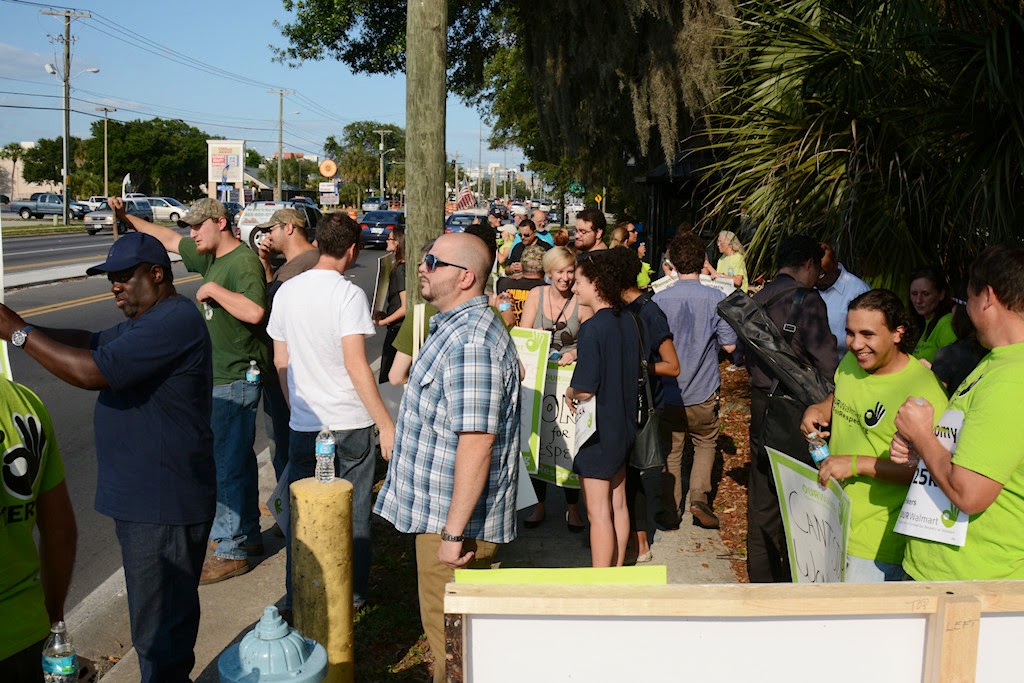
On Wednesday, June 4, there were several protests staged at Walmart's across the country, including one in Tampa, on East Fletcher Avenue.  EyeOnTampaBay was there.

We estimate that about 30  or so people were protesting.  Some said they were from Walmart, and some appeared they were from labor organizer or activist groups.  Others just looked like they like a good protest. We were not able to determine which organization if any was in charge.


One woman did much of the speaking, and she'd already come from protests earlier in the day in Merritt Island and Orlando before arriving in Tampa.  She spoke of pregnant women's rights, created a group called "Respect the Bump", which helped Walmart recognize that pregnancy is a medical condition.

She also spoke about "a wall" Walmart strikers have created to document their stories and complaints, and what the "Walmart economy" means to them, as well as the larger community.

The Wall of the Walmart economy
Another speaker was a (former?) Walmart employee and striker, although we could not hear him well.

Another young man grabbed the mike and spoke of workers rights, and stated
"Here's the deal. Workers, everything that you have you must take."
Got that?
"The fact is, we have the capacity to not only raise wages, but reduce work hours worldwide."
"I believe you have to fight for every inch...OK, I ran out of ideas. Thanks."
Also,  they announced Chuck did not make it, and could not be found, but he's supposed to go on strike tonight.

Good luck, Chuck!

We also saw a protester we could have sworn we saw and talked to at the Greenlight Pinellas Rally in Largo, FL on May 27, carrying a different sign this time.  They do get around.

Protesters protesting
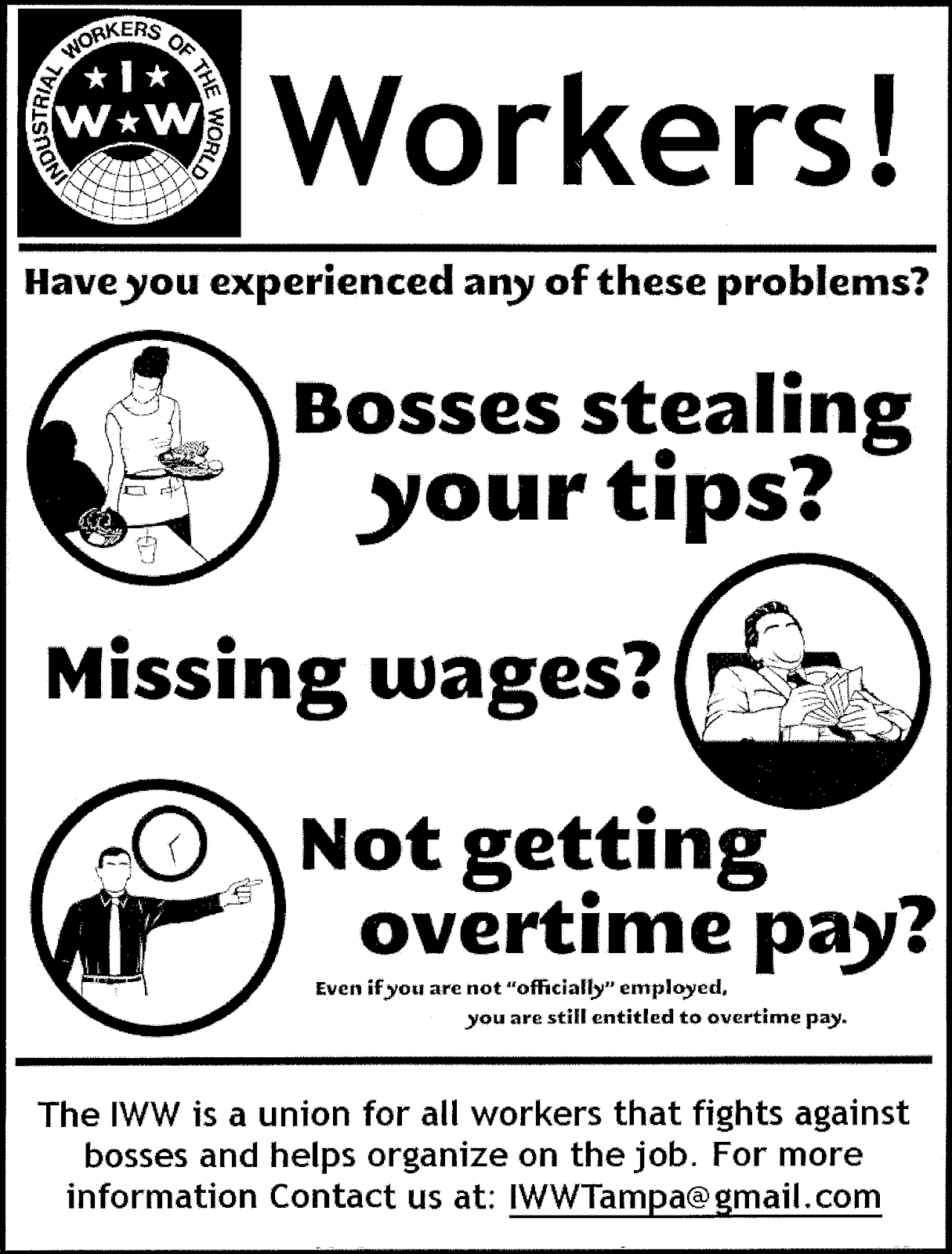
We were also handed a flyer from the Industrial Workers of the World, which is a union for all workers that fights against bosses and helps organize on the job.  It's not clear if they were organizing this rally or not.  According to Wikepedia,
The IWW promotes the concept of "One Big Union", contends that all workers should be united as a social class and that capitalism and wage labor should be abolished. They are known for the Wobbly Shop model of workplace democracy, in which workers elect their managers and other forms of grassroots democracy (self-management) are implemented. IWW membership does not require that one work in a represented workplace, nor does it exclude membership in another labor union.
If everyone gets to vote on everything, I bet they'll need a lot of meetings.  Not sure that'll make a great place to work.

IWW handout
Several cars, and at least one Walmart truck driver, honked their horns in support while we were there.

Take a look at the video above and see the Walmart protest for yourself.