Friday, January 20, 2017

Aggressive Timeline: Merge HART PSTA Into Tampa Bay Transit Authority

We recently posted here there is an orchestrated backdoor effort to merge HART and PSTA.

This is the latest.

After some HART Board members had issues with the Inter-local Agreement HART drafted, an MOU (Memorandum of Understanding) was subsequently drafted.

PSTA held a Legislative committee meeting on January 4, 2017 where the MOU was discussed. 

A video of the meeting can be found here. At about 3:00 PSTA CEO Brad Miller starts the discussion of the MOU with admitting HART and PSTA already work closely together. He states the MOU is binding just like an Inter-local agreement but this MOU is more definitive about merging departments and looking at all functions to "combine".

Miller said Pinellas County Commissioner Janet Long, who is pushing the regionalism agenda, spoke with HART's CEO Katherine Eagan to create a "timeline that was more important than a MOU". Miller indicated that the full PSTA Board would be "comfortable" voting for this MOU at their January 25 Board meeting. 

PSTA also held an Executive committee meeting on January 6, 2017 and video of that meeting can be found here.

At about 2:00 in the video Miller begins speaking about the MOU stating the intent of it was to present it to the state legislature. He outlined a timeline of PSTA approving it 1/25, HART approving it 2/6 and then he and Eagan and their lobbyist(s) going to Tallahassee on 2/7 to jointly present it. 

Such an aggressive schedule indicates the orchestration for this has been going on for a long time. 

Miller states this agreement fits into the larger context of a governance study they are asking the state legislature to pay for on how to implement Commissioner Long's proposed Regional Council of Governments Cronies. Miller also states "it's not going to take an act of the legislature" to do this - merging without going through a legal merger.

At 6:55 in the video, the question of how funding works with this "joint" agency is asked. Through Long's proposed regional entity? Long responded that the state legislators did not like the name "Regional Council of Governments" and preferred Tampa Bay Transit Authority, confirming this is really about merging and regionalizing decision making.

At about 8:30 in the video, Long states a merged entity speaking with "one regional voice" will enable the merged entity to get more federal funding. At 10:59 Long says that because the two entities were established differently - PSTA by a local bill and HART by general law, it is difficult to legally "undo"(because it would take a referendum).

PSTA then held a Board workshop on January 13, 2017 off site so there is no video recording of the meeting.  The agenda packet found here included Long's Regional Vision Proposal and Proposed Regional Planning Governance Study.
Agenda for January 13, 2017 PSTA Workshop
The proposed MOU is also in the agenda packet. 

Long's Regional vision presentation reflects where "they" are going - REGIONAL SALES TAX FUNDING. 
Long's Regional Vision includes
Regional Sales Tax funding
UPDATE:  Long's Regional Vision of REGIONAL SALES TAX FUNDING IS IN ADDITION TO THE EXISTING LOCAL JURISDICTIONAL PROPERTY TAX FUNDING - NOT A TAX SWAP.

Included with Long's presentation is an editorial by the Tampa Bay Times last month supporting Long's proposal, the HART - PSTA merger and all the scheming done behind the scenes orchestrating it all.
The quiet discussions are particularly reassuring in the wake of three failed transit initiatives in the bay area in recent years. 
This approach has the opportunity to improve bus service, ease road congestion, lay a path for regional rail, save tax money and make for smarter growth, easing the costly impacts of sprawl. To voters looking for a better strategy before agreeing to tax themselves more for transit, these are positive developments.
There are more particulars to deal with, and Tampa Bay is still a long way from a robust regional transportation authority and one common plan for mass transit that includes light rail.
The Times have been wrong and on the losing side of every proposed transportation sales tax hike in Tampa Bay. Including an oped of support from those who consistently lose seems odd but it does reflect how our local rail cartel operates in their own echo chamber.

What's missing from their "collective" narrative?  Ridership at both HART and PSTA has been declining. Innovation and technology from the private sector are driving the future of transportation which will be a disruptive factor to transit, especially on costly fixed guideways. 

In addition, with a new Trump Administration there will be change that very well could change the criteria and decision making for what and how federal funds are awarded. 

The net of all this scheming and aggressive "timeline" is to quickly ram through HART and PSTA Boards the approval of this MOU before the public can appropriately weigh in or even fully understand what is actually occurring (get it passed before the public knows what's in it). 

Then HART, PSTA and their lobbyists can immediately take the MOU to Tallahassee and jointly present it. The MOU is being used to get Senator Latvala's (Senate Appropriations Committee Chair) blessing to fund yet another study for how to implement Long's Regional vision and somehow the merging of the two transit agencies.

The fast path of this MOU Miller expects is first approval at the January 25 PSTA Board meeting. It will then be discussed at the HART Board Legislative meeting on Monday, 1/23 at 10am. Then Miller expects the MOU to be on the agenda for approval at the next full HART Board meeting on February 6th.

There is method to their madness because the transit agency merger action is being pushed in  conjunction with the completion of the Tampa Bay Premium Transit Feasibility Study Plan (a post for another day) targeted for late 2018. 

Reminder: pursuing federal capital grants for transit requires a long term committed local funding source. (Watch out Hillsborough and Pinellas in 2020…) 

Watch the video again and cringe. The egregiousness of recommending going around voters is appalling and PSTA was using taxpayer funded consultants and attorneys to recommend such action.

Hillsborough taxpayers should not be put at any risk and we certainly do not want to bailout PSTA. 

HART and PSTA can and should collaborate when it is mutually beneficial but no merger is needed to collaborate.

Can we stop all the "quiet discussions" scheming behind the scenes for new baseball stadiums and how to regionalize power and more time focusing on fixing our neglected roads (that 98% of us and buses use everyday), and our stormwater and sewage systems that impacts us all?

Thursday, January 12, 2017

Backdoor Attempt to Merge HART PSTA?

As has been reported, Pinellas County Commissioner Janet Long has proposed creating a Regional Council of Governments that would serve as a decision-making body for transportation and function as the regions consolidated MPO.

As we posted yesterday, the impetus for regional decision making is the new MPO merger dictate pushed through in December by the lame duck Obama Admin. However, there is a good chance this midnight rule will be eliminated by the new Congress under the new Trump Admin.

Part of Long's regionalism proposal is an interlocal agreement between HART and PSTA.

But what is really going on regarding such interlocal agreement?

Go back to the end of 2012, beginning of 2013 when Senator Latvala was demanding the first of his two taxpayer funded studies be done regarding a merger. Note that merging was rejected after both studies.

Here is a video from January 2013 of a presentation being given to Latvala and some others by PSTA CEO Brad Miller. Miller presented how to merge and consolidate HART and PSTA through a backdoor Joint Powers Authority (JPA). This backdoor agreement is a way to get around a voter referendum that is required to merge and create a new legal entity. A direct link to the youtube video is here.


As Miller explains consultants and lawyers (of course) came up with this proposal to go around voters and taxpayers. At 2:11 in the video Miller states that this JPA or some type of interlocal agreement is "the answer" (at least to the consultants, lawyers and Brad Miller) to merging the two agencies without going through a referendum to actually legally merge them.
PSTA CEO recommends JPA or interlocal agreement to merge/consolidate
HART & PSTA without going through a referendum
What this backdoor merger does is leave HART and PSTA as the legal taxing authority to collect the taxes. All the decision making regarding how those revenues are spent would be made by a new merged/consolidated Board. As Miller states, the existing Boards of HART and PSTA would have no powers or become nonexistent which takes away local control. This JPA/interlocal agreement regionalizes all decision making, including how revenues collected in both counties are spent - such as costly shiny new toys like the fiscal disaster called SunRail.

It is apparent why this interlocal agreement between HART and PSTA is being pushed as part of Long's proposal for regional power and decision making regarding transportation. It creates a single, larger pot of money that would be controlled by a new highly politicized Board run by either all electeds or by electeds, cronies and special interests.

Let's connect the dots.

Long first proposed her regional council of governments in October.

As reported in December here
Long would fold PSTA, HART, and other transportation providers such as the Tampa Hillsborough Expressway Authority, ferryboat operations and others under the regional council of government. Certain functions, or entire organizations, could be consolidated within the council of governments concept.
HART, the transit authority in Hillsborough, voted in November to develop a written interlocal agreement with the PSTA that would commit the two to continuous collaboration and coordination for the region’s benefit.
And here
The two [HART and PSTA] would continue collaborating on those items and would research areas that could benefit from joint ventures. That could eventually mean the merger of some departments, Miller said.
HART drafted an interlocal agreement but concerns were raised by some HART Board members (who are citizen appointees not electeds) as reported here.
Among the more problematic proposals for Jaroch, as well as board member Mickey Jacobs, was one that said that “staff will develop a strategic coordination plan to merge operational functions in IT.” Another said that “Staff will identify two departments, including IT, for functional merge in calendar 2017.”
HART CEO Katherine Eagan said that she would work with board members and Smith and have a new draft of the interlocal agreement available for review at the committee’s meeting next month. 
Meanwhile, PSTA officials want to see the agreement go forward.
Of course PSTA, who has been fiscally mismanaged for years wants to consolidate and merge with HART. Their CEO Brad Miller said so back in 2013.

According to this article, Pinellas County Commissioner Long based her regional proposal on SANDAG (San Diego Association of Governments) that is a regional decision making Board composed of 18 cities and county government with advisory representatives from numerous other government agencies.

Modeling anything after how any government agency is run in the almost bankrupted state of California is highly suspect.

This is how huge regional entities with deep pockets use taxpayer monies to "sell" their plan. SANDAG created a taxpayer funded campaign to sell a $204 BILLION 35 year plan where 75% of the money spent goes to transit:  How SANDAG Worked The Media On Transportation Plan

Does using taxpayer monies egregiously on taxpayer funded campaigns sound familiar? Go Hillsborough, Greenlight Pinellas….and could a new regional campaign be starting now with the launch of the $1.5 million "Premium Transit Study"…We'll save that for another post.

We cannot forget Brad Miller misused federal transit security funds on the Greenlight Pinellas campaign. Miller had to return the $350,000 to the feds, he still has his job and last year earned praises and a raise just six months after one Board member proposed a vote whether to fire him.

We also cannot forget Hillsborough County Administrator Mike Merrill's ridiculous proposal in 2014 to reconfigure the HART Board into a super sized agency with an expanded mission and governed by all electeds which would totally politicize the agency.

Long's Regional Council of Governments is Merrill's proposal on steroids.

Government entities and agencies can collaborate whenever it is mutually beneficial and agreed upon. Collaboration does not require consolidation and merger creating a bigger and more powerful bureaucracy that controls all the purse strings.

As we posted here, it is time to dump Long's proposal to regionalize transportation decision making.

Watch the video above again of Brad Miller.  No one should be recommending circumventing the taxpayer and the voters to consolidate power and decision making away from them.

Now watch closely the interlocal agreement between HART and PSTA because such backdoor shenanigans must be stopped in its tracks.

Wednesday, January 11, 2017

Local Disconnect On Federal Over Reach Dictating MPO Mergers

As this article Regionalism: Spreading the Fiscal Irresponsibility by Wendell Cox reports, smaller government and decision making closer to the people are more fiscally responsible and tend to better reflect those most impacted.
The only economies of scale in larger local government benefit lobbyists and special interests, not taxpayers or residents.
The voters are no match for the spending interests with more efficient access to City Hall. The incentives in such larger jurisdictions are skewed against fiscal responsibility and the interests of taxpayers. Making an even larger pool of tax revenues available can only make things worse. 
One of the 4000 new rules and regulations winding through the last year of the Obama Admin's Federal bureaucracies in 2016 was a rule by the Feds dictating the merging of MPO's to create larger regional MPO"s.

According to the rule published December 20, 2016 to be effective January 19, 2017, MPO Coordination and Planning Reform, Final Rule 40 CFR 613, (Fed Register 12-20-2016):
The purpose of this rule making is to improve the transportation planning process by strengthening the coordination of MPOs and States and promoting the use of regional approaches to planning and decision making.
The FHWA and FTA believe that the benefits of the rule justify the costs. The total costs for merging 142 MPOs, the cost of transportation conformity adjustments, and the one-time cost of developing a dispute resolution process results in an estimated maximum average annual cost of this rule of $86.3 million. The FHWA and FTA were unable to quantify the benefits for this rule making.
Sixteen commenters expressed support for the NPRM. The FHWA and FTA received 156 comments in support of the stated purpose…..While these commenters supported the stated purpose of the rule making, they did not support the specific requirements and procedures articulated in the proposed rule because the commenters believe the rule will not strengthen coordination efforts beyond current practices.  
The FHWA and FTA received 299 comments in opposition to the NPRM, of which 249 requested that FHWA and FTA withdraw the rule making. Commenters expressed various concerns about the NPRM.
The Feds cannot quantify the benefits of this rule but somehow they "believe the benefits justify the costs". Only in government…can that attitude exist.

Many who commented on the rule raised issues, including that it overstepped the DOT Secretary's authority, it contradicted Congressional intent and it stepped on state laws, those federalism issues.

The Florida Department of Transportation opposed the new rule. They sent their letter dated August 17, 2016 opposing it and asking that the rule making be suspended. The letter clearly summarizes their opposition.
Summary of FDOT 8/17/2016 letter to Feds opposing mandated MPO mergers
In addition, our Florida MPO Advisory Council (MPOAC) sent their letter to the Feds opposing the rule and they succinctly brought up more issues and clearly stated their strong opposition to this over-reaching mandated rule by the Feds. 
FL MPO Advisory Council letter to Feds opposing mandated MPO mergers
This new federal rule was being pushed by the Obama Admin right before the Presidential election and it was published by the lame duck Obama Admin after the election. House Republican leadership sent a letter to Obama Administration on November 15 cautioning them to not push last minute regulations through in the last two months of Obama's term but that caution was ignored.

Why did our Hillsborough County Commission support this rule? Why did they vote 7-0 on August 17, 2016 to send a letter to the Feds fully supporting the rule? That was the very same day our FDOT sent a letter to the Feds opposing the rule.  

Why would our Republican dominant county commission support an over reaching federal dictate right before a Presidential election?

The letter to support the MPO merger rule was drafted by County Attorney Chip Fletcher and can be found here. The letter not only states the county commissioners fully support the rule but they request a specific change to prevent any "institutional inertia" from delaying implementing the stated objective (regionalism) of the rule. 

Commissioner Miller sits on the MPOAC Governing Board, the decision making body for the MPOAC which consists of one representative from each MPO in the State (27), that opposed the rule.

Why the disconnect? 

It's all about money. 

Below is from the transcript/video found online at HTV (starts at 18:22) of the August 17, 2016 county commission meeting discussing the Feds new dictate

County Attorney Chip Fletcher:  
I DON'T THINK THAT THEY'RE PARTICULARLY CONTROVERSIAL OR EVEN NOTEWORTHY IN THE SENSE OF THE SUBSTANCE OF THOSE ISSUES.BUT REALLY MORE ABOUT THE PROCESS FOR HOW THEY WERE TO BE DEVELOPED.
Sandy Murman:
THE PINELLAS COUNTY COMMISSIONER AND I HAVE WORKED ON THIS FOR ABOUT TWO OR THREE YEARS. I FEEL THAT THIS IS A VERY IMPORTANT STEP FOR US HERE A THE COUNTY TO TAKE TO MOVE FORWARD. I AM NOT IN AGREEMENT WITH THE LETTER THAT WAS SENT FROM THE MPO — STATE MPO TO THE FEDERAL
PEOPLE REGARDING — IT WAS MORE ABOUT, LEAVE US ALONE, WE WANT TO STAY AS WE ARE, THAT WE WILL TRY SOME REGIONAL COORDINATION. 
FEDERAL, STATE, LEGISLATIVE LEADERS ARE NOW GOING TO LOOK AT THE REGIONAL COORDINATION WHEN THEY'RE ALLOCATING DOLLARS. ORLANDO HAS BEEN VERY SUCCESSFUL. AND THEY HAVE GOTTEN THE LION'S SHARE OF THE MONEY AND THEY HAVE GOTTEN THE LION'S
SHARE OF THE MONEY. IN FACT, DANIEL WEBSTER AND TONY JENNINGS, THEY DIDN'T HAVE A SACK BIG ENOUGH TO TAKE ALL THE MONEY THEY TOOK OVER THERE. SAME THING WITH MIAMI, CUBAN CAUCUS WAS ALWAYS VERY EFFECTIVE IN GETTING WHAT THEY NEEDED WELL, WE NEED TO CHANGE THAT SEAT AND MAKE A STATEMENT THAT WE NEED THOSE DOLLARS COMING HERE.
Merging MPO's is not controversial? 

Pinellas County MPO, who rebranded themselves as Forward Pinellas, sent their letter opposing the merger rule on August 23, 2016. Regional special interest organization Tampa Bay Partnership sent an opposition letter on August 26, 2016. Find both of those letters here.

Pasco County MPO also opposed the rule and Hillsborough County MPO seemed squishy and a bit nebulous about the rule.

As we previously posted here scheming is going on behind the scenes to push regionalism in Tampa Bay. Pinellas County Commissioner Janet Long admitted she believes regional power is the way to get more state/federal tax dollars.

Some powers to be are using this federal MPO merger mandate as the impetus excuse for pushing a regional agenda in Tampa Bay and push again to merge our transit agencies HART and PSTA. 

The House recently passed HR 21, the Midnight Rules Relief Act, that will eliminate a group of rules pushed through by a lame duck Administration after the election all together instead of one by one. This bill is now in the Senate. 

There is a good chance the controversial and over reaching MPO merger rule will soon be eliminated. 

So the MPO's will not need yet another consultant they were hiring to facilitate a so-called "collaboration" workshop for how to implement a rule that will be going away.

But the question remains why our local county commissioners are so disconnected and want more Federal dictates.

Sunday, January 8, 2017

The 2016-2017 Baseball "Third Season" – a sleeper so far


Are the Rays are having some trouble getting a serious stadium conversation started?


St. Petersburg, Fl
Opinion by: E. Eugene Webb PhD
Author: In Search of Robin

I have defined the Tampa Bay Baseball "Third Season" as that time between the last world series game and the start of the spring training media hype or roughly late October to late February.


This is the time when the Rays usually beat the drum loudly complaining about poor attendance blaming it on Tropicana Field and lack luster appreciation of the sport by the local population.

In the past the Third Season" has included games between Tampa, Hillsborough County, St. Petersburg, Pinellas County and this year the City of Oldsmar and a small skirmish with Derby Lane.

There has been little of the normal posturing and hype associated previous "Third Seasons." While one could conclude that there is a lot going on in the background, the silence is deafening.

Mark Topkin, Tampa Bay Times staff writer reports some interesting comments from Baseball Commissioner Rob Manfred in, Manfred: There has to be "end game" in Rays stadium bid or ...

Manfred said, "Ultimately, there has to be an end game. If in fact, there's not a site or there's not a financial arrangement that's viable and we become convinced of that, our rules allow for the possibility of relocation."

Every since Jeff Vinik made the statement about his downtown Tampa development "Baseball is not the best and highest use of the property" (paraphrase) interest seems to have waned across the Bay.

Smart money in Tampa has apparently heard Tampa's premier developer and current talk in the Legislature about limiting funding for sports stadiums has thrown a bit of cold Gator Aid on the new stadium site.

The clock is ticking.

With the dawn of 2017, the Rays have just ten years left on their lease agreement with the City of St. Petersburg. That may sound like a long time but when it comes to new stadiums, the time window from start to first pitch could consume most of that time.

Consider getting land accumulated, an actual agreement, arranging a controversial and complicated financing deal, a possible referendum, a plan for paying for infrastructure costs, and an electorate not real thrilled with public funds being diverted to sports franchise owners, the whole process spanning several major political races and elections while baseball interest in the Bay area continues to deteriorate.

How much of your money would you invest in a new stadium?

It could be the reason why we have not heard much during this "Third Season" is the Rays are having some trouble getting a serious conversation started.

It is starting to look like Mayor Kriseman may be correct about the Rays looking around and finding the Trop site is the best place after all. Maybe what they find is it is the ONLY place.

I have long said the real problem St. Petersburg faces with the Rays is not that they leave, but they will want to stay.

As the Commissioner said, "Ultimately, there has to be an end game. If in fact, there's not a site or there's not a financial arrangement that's viable and we become convinced of that, our rules allow for the possibility of relocation."

So far, not so good.

Or there's always Oldsmar. See Christopher O'Donnell, Times Staff Writer  Rays stadium in Oldsmar? The mayor sure thinks so.

E-mail Doc at mail to: dr.gwebb@yahoo.com or send me a Facebook (Gene Webb) Friend request. Please comment below, be sure to Like or share on Facebook and follow me on TWITTER  @DOC ON THE BAY

See Doc's Photo Gallery at Bay Post Photos.

Disclosures:

Thursday, December 29, 2016

Dump Pinellas Commissioner Janet Long's Push for a Regional Council of Cronies

"They" are at it again. And it's all to get more of your tax dollars.
Pinellas County Commissioner Janet Long
Because Hillsborough and Pinellas have overwhelmingly defeated sales tax hikes, Pinellas County Commissioner Janet Long and some powers to be are pushing regionalism in another attempt to merge HART and PSTA as reported by the Times back in October.
The move comes on the heels of the federal government's insistence on one regional set of transportation priorities similar to those serving metro areas such as Denver, Seattle and Minneapolis-St. Paul. The government wants one regional plan that would cover 20 years of expected growth in overlapping metro areas. Local leaders would have two years to devise a plan once the federal rules are finalized.
We agree there are too many entities and agencies who have their fingers in the transportation pie but the answer is not to consolidate them into some regional super agency. Bigger in government is never better. Bigger agencies result in a more costly, less accountable entity. 

Bigger regional government agencies puts the decision makers an arms length from those impacted, especially the taxpayers. Regional entities enables greater influence by special interests and reduces local influence and local control.

The push for merging HART and PSTA is always coming from Pinellas County. 

Why? Follow the money. 

PSTA has been mismanaged for years and is a fiscally mismanaged agency and a mess. Instead of fixing its problems, PSTA wants a bailout and some powers to be are willing to be their accomplices for the bailout.

Beware Hillsborough County taxpayers. We do not want to be part of PSTA's mess or paying to fix their mess. PSTA needs a big housecleaning and a new governing Board appointed with a majority of citizens not elected officials.

HART and PSTA already can and do collaborate. When it makes fiscal sense, they can play in the same sandbox to achieve a mutually beneficial result. 

With the Obama Administration push to regionalize MPO's, some powers to be are trying to ride those coattails with another HART-PSTA merger push. 

However, our own Florida Department of Transportation formally sent their comment August 17th to the Feds (Federal Highway Administration and Federal Transit Administration) requesting the Obama Admin MPO mandatory merger rule be suspended. Our state MPO Advisory Council aka MPOAC also commented in opposition to the Obama Admin MPO merger rule. The MPOAC has a representative from each of the 27 MPO's in the state of Florida.

Why did the Hillsborough County Commission vote on August 17, the very same day FDOT sent their letter opposing the MPO merger rule, to send a letter to the Feds supporting the Obama Admin MPO mandatory merger rule. (We have asked for a copy of the letter Commissioner Miller sent to the Federal Highway Administration and Federal Transit Administration.)
Hillsborough BOCC vote on 8/17/2016 to send letter to Feds
supporting Obama Admin MPO mandatory merger rule
(click to enalarge)
And more odd is Commissioner Miller sits on the Governing Board of the MPOAC.  

Why did our commissioners support the Obama regional MPO merger rule? How could Miller and our county commissioners miss the FDOT and MPOAC letters?

In addition, this MPO merger rule was being foisted on us right before an election as the Obama Administration tries to push as much rule-making and regulations through before Obama leaves office.

And now things are about to change. There will be a brand new Trump Administration and Republican Congress who may have very different thoughts about all the rules and regulations thrust on us by the Obama Admin. The push for regionalism may just get stopped in its tracks.

None of that stopped HART from drafting a proposed inter-local agreement with HART as a result of Long's regional proposal.  But kudos to HART Board member Karen Jaroch. who according to this Saintpetersblog post, pointed out her concerns about the poorly written, vague proposed inter-local agreement with PSTA. Putting Hillsborough County taxpayers at risk is certainly not the answer to solving any problem. 

PSTA, who wants a bailout, is ready to jump on board. This Saintpetersblog post reported on December 7:
Members of the governing board of Pinellas’ bus transportation authority voted unanimously Wednesday to develop an agreement to coordinate with the Hillsborough transit authority. 
The agreement, which would be forwarded to the State Legislature, is a step to creating a regional council of governments that’s been proposed by Pinellas County Commissioner Janet Long.
This was also reported:
Long said the proposal is a “framework” for merging several governmental agencies into one regional organization that can provide regional solutions to transit, land and economic development, affordable housing and other region-wide issues. Such a group, Long said, could provide “better, more nimble” solutions to problems.
This is eerily similar to what the Obama Admin did in 2009 when they created the HUD-DOT-EPA Partnership for Sustainable Communities:
On June 16, 2009, EPA joined with HUD and DOT to help improve access to affordable housing, more transportation options, and lower transportation costs while protecting the environment in communities nationwide.
Has bigger government ever been better or more nimble?

Pinellas County Commissioner Long started this regionalism push but is she playing the proxy role for Senator Jack Latvala? Latvala already forced taxpayers to TWICE pay for studies about merging HART and PSTA. Merging was rejected after both studies.

The key driver for pushing regionalism is money.

Long admitted she believes regional power is the way to procure more state and federal funding. As the December SaintPetersblog post reported (emphasis mine):
Long would fold PSTA, HART, and other transportation providers such as the Tampa Hillsborough Expressway Authority, ferryboat operations and others under the regional council of government. Certain functions, or entire organizations, could be consolidated within the council of governments concept. 
The regional council of governments membership would include mayors, county commissioners, council members, business/private sector leaders and advisory staff members from Pinellas, Hillsborough and Pasco counties.
What Commissioner Long has proposed is a regional council of cronies who's goal is to pursue as much taxpayer money as possible for costly transit/train solutions. 

We know who the members would be - the same electeds who want to unnecessarily raise our taxes, the crony business leader special interests (and we know and they know exactly who they are) and the entrenched unelected bureaucrats who want to grow their bureaucracy and their power.

And since the Times has supported every failed attempt to raise our taxes to fund boondoggles, it's no surprise they weigh in on December 20th with this:  Editorial: Encouraging Tampa Bay transit talks. Let's breakdown down what the Times said (emphasis mine):
After several failed starts, Tampa Bay may be finally starting to get its act together on mass transit. The transit agencies on both sides of the bay are looking at more ways to cooperate — a step toward improving regional bus service, saving time and taxpayer money and laying a foundation for new regional transit. County leaders in Pinellas and Hillsborough are also considering how to sharpen the region's focus and make the area more competitive for state and federal transit money. There is plenty of work to do and details to iron out, but the work behind the scenes is encouraging.
The quiet discussions are particularly reassuring in the wake of three failed transit initiatives in the bay area in recent years. They also are in stark contrast to the controversy around Tampa Bay Express, the proposed overhaul of the interstate system that calls for toll lanes and a massive highway rebuild over parts of neighborhoods near downtown Tampa.
The movement sets the table for local leaders to be prepared when the state completes its regional premium transit study in 2018. That study should offer big fixes for regional mobility, and by having a more responsive government in place the region will be better positioned to move quickly on big solutions. 
Long and other leaders across the bay, including HART chief executive Katharine Eagan, are bringing order, direction and a sense of urgency to the region's transit efforts. This approach has the opportunity to improve bus service, ease road congestion, lay a path for regional rail, save tax money and make for smarter growth, easing the costly impacts of sprawl. To voters looking for a better strategy before agreeing to tax themselves more for transit, these are positive developments. 
There are more particulars to deal with, and Tampa Bay is still a long way from a robust regional transportation authority and one common plan for mass transit that includes light rail.
Again PSTA and HART already collaborates and if there are more places where they can collaborate, that is fine, but no consolidation is needed to collaborate. And no regional council of cronies is needed either. Who thinks a regional council of cronies is "more responsive government"?

Considering trust is such a huge issue in Tampa Bay, it is appalling that the Times likes "quiet discussions" and that all the work for Long's scheme was being done "behind the scenes" outside of Sunshine with little transparency. Why? Because they are part of the council of cronies.

TBX was not schemed behind the scenes in "quiet discussions". Expanding the interstate has been in FDOT's plan for decades, documentation was published for years and numerous opportunities for public input was provided. FDOT already owns most of the right of way for TBX. We understand most of the remaining right of way near downtown needed for TBX are tenant-occupied property owned by investors not owner-occupied. 

The Times does not even use the term transportation because their agenda is focused solely on getting more state and federal money for transit…….when ridership at both PSTA and HART has been declining for several years now….and vehicle miles travelled is increasing. 

Has the Times reported about the declining transit ridership of both PSTA and HART? Nope! But SaintPetersblog and Tampa Bay Guardian have.

The Times admits the regional council of cronies is to pursue higher taxes and more state and federal grant money for costly trains.

How absurd to think that a regional council of cronies is a strategy to convince taxpayers to tax themselves more for trains they will never ride.

But the Tampa Bay power brokers know the runway for trying to fund any costly rail solutions is quickly shrinking.

At the Hillsborough County local delegation meeting held December 16th, State Senator Tom Lee asked Katherine Eagan, HART's CEO who spoke at the meeting, that very question about whether emerging and evolving technology is making pursuing costly fixed guidways/rail solutions irrelevant. 

Eagan responded by honestly stating "We're so far behind, we're ahead…"  

We appreciate her honesty. It is good that Tampa Bay taxpayers are not stuck paying billions and millions into perpetuity for costly solutions that are becoming irrelevant and few will use. 

The push for costly light rail and trains is so out of touch with reality. 

The train is already off the track and we're not looking back. 

Innovation and technology are driving the future of transportation. That is what we are looking forward to and what we should embrace.

We'd all be better off getting rid of (not consolidating) some of the bureaucracies and we can start by eliminating TBARTA.

No regional council of cronies schemed behind the scenes is needed to fix our transportation issue. 

Long's proposal should be dumped ASAP.

Sunday, December 11, 2016

Janet Long - A Regional Council of Governments to Manage Bay Area Public Transit

Long is using a mandate from the federal government to propose a regional transportation governing board that would have taxing authority.


St. Petersburg, Fl
Opinion by: E. Eugene Webb PhD
Author: In Search of Robin

Janet Long, Chairperson of the Pinellas County Commission, has been struggling with the dysfunctional nature of public transit governance for some time.

Here is some background from local-area print and social media:


Long has been frustrated with the political players in public transit in the bay area such as: the Metropolitan Planning Organizations in Pinellas, Pasco and Hillsborough counties; the Hillsborough Area Regional Transit Authority and the Pinellas Suncoast Regional Transit Authority; the Tampa Bay Area Regional Transportation Authority and the Tampa Bay Regional Planning Council.

However, Long's real frustration has been with the public's ability to control the public transportation process by denying property and sales tax referendums that support ideas like Pinellas GreenLight and Go Hillsborough.

I have personally seen Ms. Long's ire raised at those who opposed these poorly designed special interest driven initiatives at PSTA Board meetings.

Long's latest attempt to go around the taxpayers is supported by the federal government's insistence on one regional set of transportation priorities to secure federal funding.

The federal government wants one regional plan that would cover 20 years of expected growth in overlapping metro areas such as the bay area. Local leaders would have two years to devise a plan once the federal rules are finalized.

Long is seizing on this mandate from the federal government to propose a regional transportation governing authority or commission that would have taxing authority.

Read that again: would have taxing authority. 

Should Long's plan come to fruition the public could lose the ability to control the purse strings through referendum, and you can look for light rail and every other inefficient form of transportation promoted by the big public transportation players to show up with all of us footing the bill.

Putting together a political shift of this magnitude will take a while but local City and 
 County officials weary of dealing with the transportation problem may be more willing to turn control over to this super commission than you might think.

Everyone who fought Pinellas GreenLight, Go Hillsborough and the other taxing referendums for public transportation need to go on high alert.

Waiting until Long and her political partners have this on the agenda in the State legislature will be way too late. 

The Federal mandate is real, and it needs to be addressed, but doing it in the backrooms of county and local governments is a big mistake. The public needs to be involved in every jurisdiction, and every elected official needs to be held accountable for his or her decisions in this process.

Unless you want a new and potentially quite large line item for "Transportation" showing up on your bill from the property appraiser sometime  in the next two years you better keep an eye on Pinellas County Commission Chairperson Janet Long and her "Regional Council of Governments" idea.

E-mail Doc at mail to: dr.gwebb@yahoo.com or send me a Facebook (Gene Webb) Friend request. Please comment below, be sure to Like or share on Facebook and follow me on TWITTER  @DOC ON THE BAY

See Doc's Photo Gallery at Bay Post Photos.

Wednesday, December 7, 2016

Merrill's Contract Extended to 2020 Two Years Before It Was Set to Expire - But Who Knew?

While everyone focused on the election, the County Commissioners were busy taking some actions that probably flew under the radar of most of us.

The October 19th BOCC meeting included an agenda item to complete the annual performance evaluations for County Administrator Mike Merrill and County Attorney Chip Fletcher. That is normal procedure.

However……who knew the commissioners would also be addressing a motion to extend County Administrator Mike Merrill's contract to 2020? 
County Administrator Mike Merrill
The action was led by then Chair Les Miller. These actions do not occur without prior orchestration behind the green curtain. We can infer who orchestrated it.

Let's back up to November 13, 2014. That BOCC meeting also was addressing Merrill's annual performance evaluation. At that time, Merrill's contract was set to expire at the end of 2015. According to the video/transcript of that meeting on the county's HTV website, a motion was passed that day to extend his contract for three years through the end of 2018. 

Commissioner Miller initially motioned to extend Merrill's contract for two yeas through 2017 but the motion was amended by Commissioner Murman to extend for three years through 2018 which was passed unanimously.

This action in 2014 was fully reported that day by the Times (emphasis mine):
Hillsborough County Administrator Mike Merrill earned rave reviews from county commissioners again Thursday, reinforcing his stature as one of the most powerful non elected public officials in Tampa Bay. 
Commissioners asked Merrill, 61, to stay on the job until 2018 and re-evaluated his $217,360 salary, implying he could be in for a significant raise. Merrill's contract was not set to expire until December 2015, but commissioners didn't want to wait. 
What was going on in 2014? 

County Administrator Mike Merrill was leading the transportation initiative for a sales tax hike and in November had just handed Parsons Brinckerhoff a million dollar no bid contract to start the Go Hillsborough campaign. 

Read the transcript or watch the video of that November meeting. The commissioners heaped accolades on Merrill that day including this bizarre statement by then BOCC Chair Commissioner Sharpe: "you [Merrill] just have a remarkable way of leading this county, you have a disarming personality."

"Disarming" is defined as removing feelings of distrust through charm. That statement and all those accolades of 2014 seem a bit stomach churning now after the failed, costly Go Hillsborough debacle Merrill led that created more distrust.

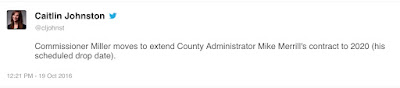
Back to the October 19, 2016 BOCC meeting. When the agenda item for Merrill's performance evaluation came up, Chair Miller handed off the gavel and made a motion to extend Merrill's contract, that was set to expire at the end of 2018, to June 30, 2020 - conveniently when Merrill's drop program expires.

Not one commissioner questioned why they should extend Merrill's contract more than two years before it was set to expire. Not one commissioner questioned why they should take such action right before the election of a new Board. Was that right? 

But what a deal for Merrill!

Few people in Hillsborough probably know Merrill's contract was extended October 19th. We searched online but could not find any media reporting about it except for a liveblog post made by Times reporter Caitlin Johnson during the meeting.
Times reporter blogs about October 19, 2016 BOCC organizational meeting
However, Johnson never included anything about the Board's action to extend Merrill's contract in her actual Times article, nor did Steve Contorno in his Times article. 

The Times wrote two articles about the October 19 BOCC meeting and the only thing reported by both was about angry transit activists showing up for public comment.   

The Times made such a splash about Merrill's contract extension in November 2014 when he was leading the Go Hillsborough campaign for a sales tax hike - that the Times supported. 

And last month the Times enthusiastically reported about the evaluation and salary increase of Mark Woodard, the County Administrator for Pinellas County. 

Why didn't the Times consider Merrill's contract extension in October newsworthy? Why did the Times ignore real news from that meeting? Didn't the public deserve to know Merrill's contract was extended two years before it was to expire and that the action was taken right before an election that would create a new Board?

When elected officials take unnecessary important actions right before an election that would create a new Board and the media ignores the real news but creates news narratives to fit their specific agenda….

That is why Americans distrust of the media and government is so "YUGE".