Wednesday, May 22, 2013

Tampa IRS Protests

Guest post submitted by the Tampa Tea Party.
"When the people fear the government, there is tyranny. When the government fears the people, there is liberty." Thomas Jefferson
 Thomas Jefferson defined tyranny as "Oppressive power exerted by government".

Our Founding Fathers were prescient in warning of tyranny by an over-reaching, too powerful government.  The Tea Party has been warning of this tyranny since it burst on the scene in 2009 opposing the exploding size, scope and intrusiveness of government.  Today we see the reality of tyranny played out by the most feared government agency gone rogue, the IRS.


Photos from Tampa IRS Protest on May 21

Tampa Tea Party thanks everyone who participated in the protest rally yesterday at our local IRS office.  Various news reports stated up to 300 liberty minded protesters participated.  We appreciate all who stood in unity opposing the tyrannical, and what also appears to be criminal activities, the IRS took against Tea Party, 912, Patriot and Conservative organizations and individuals.  We will continue to demand the truth and to hold accountable those who participated in the activities, those who facilitated and created the environment for this to occur and those who knew long ago and did nothing.  We will continue to demand that a special counsel, independent of the DOJ, be appointed to get to the bottom of this issue.

Here are more pictures from the rally. Photos courtesy of Arthur Paul.

Thank you again for your support.  Stay engaged, stay energized and we will prevail!

Saturday, May 18, 2013

IRS Scandal highlights DC corruption

Joe Henderson's column today takes on the IRS scandal but is a lame description of the tactics we now know were being used since 2010 against Tea Party, 912, Patriot and other Conservative organizations and individuals.  Instead of lamenting "hyperbole" that he got 2nd hand, out of context from another reporter,  perhaps Joe should be reporting that those in the Tea Party movement are vindicated in our opposition to the size, scope and power of our government and our advocacy for limited government and Constitutional governance.

The media knew about the IRS issue since 2010. If this scandal (or any of the other numerous scandals swirling around the Obama Administration) had been associated with a Republican Administration, Americans would have been subject to daily "hyperbole" about the scandals with Nixonian comparisons from the Mainstream media and the Democrats.  But the media refused to investigate and report on the IRS issues during the critical 2012 election cycle. We are all left wondering how this scandal would have impacted the 2012 election if it had been investigated and reported last year.

So much information has recently come out and we now know that Senate Democrat leaders Schumer, Baucus and Durbin (who has since scrubbed his website urging the IRS to investigate conservative organizations) and other prominent Dems were urging the IRS to take this action too as this WSJ column reports.  In addition, the dots are also being connected to higher ups in the Obama Administration as another WSJ column reports.  And Kimberly Strassel goes straight to the top with her WSJ column.
"The IRS is easy to demonize, but it doesn't exist in a vacuum. It got its heading from a president, and his party, who did in fact send it orders—openly, for the world to see.
It appears Joe never contacted or spoke directly to a person or an organization directly impacted by the tyrannical tactics.  Was Joe paying attention that this issue has gotten broader and broader each day and it's not about the IRS "requesting more forms." The IRS targeted individuals not just organizations.  Perhaps Joe should've contacted the Founder of True the Vote in Texas who was on the Hugh Hewitt radio show last evening. It was jaw dropping to hear her story of having to deal not only with the IRS but the FBI and the ATF.   The Thomas More Society reports on this from 2009:
 “Coalition for Life of Iowa found itself in the IRS’s crosshairs when the group applied for tax exempt status in October 2008. Nearly ten months of interrogation about the group’s opposition to Planned Parenthood included a demand by a Ms. Richards from the IRS’ Cincinnati office unlawfully insisted that all board members sign a sworn declaration promising not to picket/protest Planned Parenthood. Further questioning by the IRS requested detailed information about the content of the group’s prayer meetings, educational seminars, and signs their members hold outside Planned Parenthood.”  
We certainly do not hear these tactics being used against Liberal, Progressive groups or Unions or their members. And Progressive organizations were given their tax-exempt status in record times, sometimes within weeks. Conservative groups languished for years, some given their status right after the 2012 election and some still waiting.

Democrats have been coordinating with Unions and Progressive organizations during elections for decades:
"Thousands of Democratic campaigns, progressive organizations, labor unions, and non-profits use VAN voter contact tools to manage their voter contact and civic engagement programs. Whether branded as VoteBuilder, SmartVAN, the Labor Action Network, or just VAN, these are the tools Democratic and progressive activists rely on."
Any outrage about that?  Has the media ever reported about their collaboration or do they simply ignore it and look the other way?

The IRS which is the most feared government agency, has become a "rogue" organization in the Obama Administration committing illegal activities.  It will now be the enforcer of 25,000 pages of ObamaCare regulations. How will they do that?  This IRS scandal alone should warrant a call for immediate REPEAL of the tax bill called ObamaCare.

The tyrannical tactics were more than simply "asking for more forms" Joe. They were used to target conservatives and conservative organizations for audits and to inhibit their ability to fundraise during a critical election cycle. All these tactics were used for one reason - to SHUT DOWN OBAMA/DEM OPPOSITION for the 2012 election.  Joe, what do you call these tactics?

Monday, April 15, 2013

Politics giveth... and may taketh away

We've discussed some concerns about Tampa's "MediFuture" here.  The net of it is despite our local political and thought leaders, there are some real hurdles and issues ahead if we are to depend on the medical arts for further growth in the Tampa Bay area.

H Lee Moffitt Cancer Center

Clearly, we have some key assets we can leverage, such as H. Lee Moffitt Cancer Center, USF Medical, and many others in the Tampa Bay area.  But so do other areas in Florida, not to mention nation wide.  Shands in Gainesville, Mayo Clinic satellites in Jacksonville, Cleveland Clinic in South Florida, and Orlando is investing heavily with the Lake Nona Medical City, and has a branch of the renown MD Anderson Cancer Center as well.

Now, for another blow.
TAMPA - Political efforts to promote Florida as a premiere destination for cancer care are raising concern at the state’s elite oncology hospital, Moffitt Cancer Center.

The state Senate last week unanimously passed the “Quality Cancer Care and Research” bill, which establishes a legislative seal of approval for cancer centers that meet certain standards. House members are expected to take up the issue this week.

Minimum criteria listed in the bill would make 71 of the state’s hospitals eligible for the designation, meant to help hospitals attract more patients through marketing and ads on TV, billboards and newspapers. They also would earn preference in bids for state biomedical grants.
These efforts at the Florida Senate level are potentially diluting H Lee Moffit's positioning in in Florida, and the country, as a premiere destination for cancer research and treatment.
Moffitt prides itself as being Florida’s only hospital with the prestigious National Cancer Institute Comprehensive Cancer Center designation, and it uses that elite title in its own advertising. The Tampa-based hospital is one of 41 such research-based programs nationwide.
 ...
"The governor wants Florida to be a destination site for people with cancer, much like MD Anderson (Cancer Center) is in the state of Texas,” List said. “That was his goal and priority to make that happen.”
The Florida Senate and Governor are trying to increase Florida's visibility as a medical destination.  That includes other municipalities in addition to Tampa.

It does appear to have caused a little consternation at H Lee Moffitt, as they may have more competition across the state for cancer treatment as additional clinics and hospitals become eligible for the new designation and can market their services.

Competition is usually a good thing, right?

But in this case, we have the State level politicians pushing an agenda that may cause some pain for the Tampa Bay area politicians and healthcare leaders, who are pushing a MediFuture for Tampa Bay.

We'll see where this all ends up.

But be aware of the political process.  What politicians giveth, they may taketh away.

Friday, April 12, 2013

Hillsborough looking for Film Czar


Today, we're proposing to spend $500,000 for a film czar.
Those who have doubts about the wisdom of Hillsborough County devoting $500,000 over two years to help build the local film industry should consider this:
A high-budget feature film can spend as much as $260,000 a day on workers, hotels, restaurants and other local services.
According to the Association of Film Commissioners International, even a low-budget independent film can spend $30,000 a day. A music video can bring in between $30,000 and $110,000 a day in spending. A commercial, between $25,000 and $150,000.
Obviously, this is an industry that pumps money and jobs into the economy, and Hillsborough County Commission Chairman Ken Hagan is right to push the county to pursue it.
We have a few doubts. First, why would the Tribune solely cite Association for Film Commissioners International, a special interest group if there ever was one?

Spring Breakers -- Shot in Tampa Bay!
The film industry is notorious for chasing tax incentives to subsidize it productions. Not just nationally, but globally.  Politicians cannot resist being close to the "lights, camera, action", perhaps to get a cameo appearance, and rub elbows with the stars.

Is this why?
It wouldn’t take many successes to have a big fiscal impact. As we’ve pointed out, “Dolphin Tale,” which was filmed in Pinellas County, had an economic impact of $17 million and provided jobs for about 1,500 Floridians. It is still attracting tourists to the Clearwater Marine Aquarium.
Actually, Commissioner Ken Hagan recently stated on 970 WFLA the impact was $580M(!). (around the 2:30 mark).

A Dolphin Tale - Shot in Clearwater
We just need a little creative Hollywood accounting to make up the difference.  According to the Trib:
But the focus would not be solely on attracting feature films. Digital media is creating many high-paying jobs, including animators, computer specialists and graphic designers.
Florida has already been down this road... and failed.  $20M down the drain.
TALLAHASSEE -- Call it another unfortunate plot twist in an already upsetting script.
State taxpayers, who handed out $20 million in incentives to a now bankrupt movie studio, are being asked to dig back into their pockets to pay lawyers to try to get the money back.
The state Department of Economic Opportunity has hired bankruptcy attorneys Sean Cork and Albert del Castillo at $540 per hour to try to reclaim money awarded in 2009 to Digital Domain Media Group — the animation company behind Titanic and founded by popular director James Cameron.

The $20 million in incentives helped lured Digital Domain to Port St. Lucie. But the company filed for bankruptcy in September, closed its offices and laid off 300 Florida workers.
Sounds like good work for bankruptcy attorneys.
A special deal ripe with cronyism as well.
Scott has ordered an investigation into how [Digital Domain] received state funding.
In September, the Herald/Times reported that state Rep. Kevin Ambler, R-Tampa, tucked the funding into the 2009 state budget. Ambler later got a $20,000 position on Digital Domain’s board, and the company hired Ambler’s son.
Neither Ambler nor Digital Domain could be reached for comment.
There are still open questions on this deal.
Regardless, this digital production jobs are highly portable, and increasingly offshored (page 23).

Like most of these targeted subsidies, it has doubtful economic value to the local community.  From the heart of Hollywood, the LA Times:
SACRAMENTO — As Gov. Jerry Brown mulls whether to sign into law another round of subsidies for Hollywood production companies, the question that confronts him is how much each job on a movie set is worth to taxpayers.
In Massachusetts, lawmakers recently discovered a similar program was much more expensive than they thought. After years of subsidizing film productions without looking too closely at how that was helping the economy, state officials put it under a lens and found that taxpayers were spending as much as $300,000 to bankroll each position.
Other states that went in for a close-up after dispensing hundreds of millions of dollars in tax breaks found that every public dollar put into the film industry was generating a few dimes, or less, in revenue. 
At least the Trib raises some caution:
There are plenty of challenges. The county will need to attract private funding to be able to provide the kind of incentives needed to close digital-film deals.
The report recommends half of the $500,000 be allocated for incentives in the program’s first full year. It also would tie any incentives to minimum economic impact, use of local workers and other requirements.
It is important any incentives come with such strings tightly attached. With many states competing for these projects, incentives can be a necessary — and appropriate — investment. But we also have seen how overly generous incentives can result in waste and abuse.
But is there any evidence we've seen lately that our local politicians can exercise this kind of judgement and discretion?

If we proceed with caution, perhaps we'll have a blockbuster.  If not, we won't be celebrating another Hollywood flop.

Thursday, April 11, 2013

Hillsborough BOCC stunned they spent all the money

This is not new news, if you've been following Hillsborough County Commission:
TAMPA - Big projects like roads, parks and storm-water drainage will be stalled for years in Hillsborough County unless the county finds new sources of money.
County commissioners learned Wednesday that $129 million worth of capital projects approved in past years are sitting on the table because no money is available. And the capital improvement tax – a half penny sales tax used for building parks, schools and roads – has been depleted by five years of recession so nothing is left for new projects.
This is old news.  Let's dial the wayback machine  to 2007.
Tucked along side the state's 7 percent piece of your purchase is another half-cent that Hillsborough County tacked on in 1996. At the time, the half-cent, known as the Community Investment Tax, was created largely to fund the construction of Raymond James Stadium.
Now, halfway through its 30-year lifespan, the tax has become a reliable pot of money the county and its four cities use to build the kind of quality-of-life amenities that shout "your tax dollars at work."
But those governments have also borrowed heavily against the tax revenue – a practice that, in recent years, has claimed large chunks of the CIT proceeds since the recession cut into local sales taxes in 2009.
...
By 2007, Hillsborough County had committed virtually all of the $2.4 billion it expected to get from the tax through 2026, largely by bonding the proceeds years before they were to be collected. At the time, commissioners defended their decision by noting they were saving money in the long run.
The City of Tampa also borrowed heavily against its community investment income, issuing bonds in 2001 and 2006 to finance several big-ticket projects. That debt paid for Curtis Hixon Waterfront Park and the Tampa Museum of Art, two of former mayor Pam Iorio's signature projects. It also helped expand Lowry Park Zoo and built baseball fields in New Tampa.
More recently, it paid for nearly $1 million in renovations to Ballast Point Park in South Tampa, renovations Mayor Bob Buckhorn unveiled earlier this month.
The county commissioners bonded out the 30 year tax revenue stream from the Community Investment Tax back in the good old days of 2007.  The recession hit, the revenues dipped, so county services get cut.

http://i50.photobucket.com/albums/f345/MK275/TrafficJamPinellas.jpg
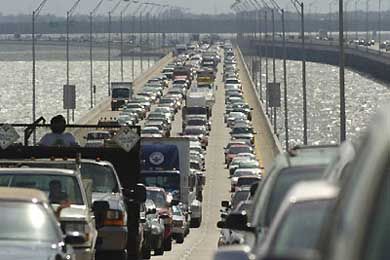
Traffic jam!
Back to the present.
The grim financial report seemed to stun commissioners, who mostly greeted it with silence. Commission Chairman Ken Hagan questioned why a recovering economy wouldn’t generate enough growth in the Community Investment Tax to add new projects.
“I was always told when revenues went up, our bonding capacity would increase, thus allowing us to bring in more projects,” Hagan said. “We’ve had a couple of years now where things are up. How is it that we’re at zero capacity?”
They bet. We lost.

Hagan and Mark Sharpe where on the BOCC in 2007 when the CIT was bonded out. This should not be a surprise.

We did get some new parks and museums.  But road improvements, one of the core selling points of the CIT, are a now faint memory.

Did I mention Hillsborough County has a $3.2 billion backlog in road maintenance and safety improvements?

Did I mention we'll be paying for the CIT until 2026?

We are spending $500,000 for local film industry, another $28M for parks and soccer fields.  Are those our new priorities?

Neglect, incompetence, or politics?  What ever this is, it is not inspiring confidence in our BOCC.

Are you read to give these people more money?

Wednesday, April 10, 2013

Wrong direction on Complete Streets

In Disney parlance, it might be called "Imagineering," where creativity and practicality intersect in new and innovative ways.
Here, at the University of South Florida's Marshall Student Center, metro planners captured the attention of the lunch crowd one day last week with an issue of compelling interest to all who navigate the most-traveled -- and least pedestrian-friendly -- corridor in the county.
The summit was a coming-out party of sorts for the Hillsborough County Metropolitan Planning Organization's (MPO) Livable Roadways Committee -- the first time the group has taken its Complete Streets plan to the people who have the most at stake: the car-less masses that use them every day.
From Smart Growth America, what does a complete street look like?
There is no singular design prescription for Complete Streets; each one is unique and responds to its community context. A complete street may include: sidewalks, bike lanes (or wide paved shoulders), special bus lanes, comfortable and accessible public transportation stops, frequent and safe crossing opportunities, median islands, accessible pedestrian signals, curb extensions, narrower travel lanes, roundabouts, and more.
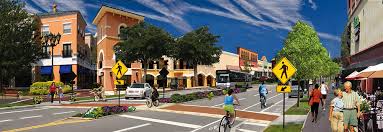
A "complete street"
Smart Growth America has a hard time defining Complete Streets. Let me help.  Take a look at the suburbs.

Many of these ideas are worthy of discussion, but they do not come without costs or other tradeoffs.  For example, we favor more and safer bike lanes.  However, we are against carving bike lanes out of existing roads, which is often a remedy -- it reduces road capacity and is less safe for the bikers.  Similarly, we are against carving out special bus lanes or beautification projects on our overloaded roads.

Meanwhile, back at the Complete Streets summit:

Streets are about moving people, not moving cars, and people move in many ways," says Lynn Merenda, a public engagement specialist for MPO.

On and around the USF campus, that might entail a bike, a skateboard, a bus, a wheelchair or a sturdy pair of feet -- all of which present unique challenges and opportunities for roadway design.

Don't forget the horses and buggies.  

Seriously, what about golf carts?  100,000 people in the The Villages get around the town entirely accessible by golf carts.

How does all this "imagineering" get paid for?  By automobile driver, with their gas taxes... that pay for this.
"This is about people who don't have cars," says Stephen Benson, a student, a citizen and a planner on the MPO roadways committee. Not everyone can afford a car or has the ability to drive one, he says, and finding ways to address their needs "is how we should be spending our transportation money."
Actually, cars have been a great equalizer over time, empowering the vast majority of people mobility and to live where they want.  Cars are not always cheap, of for everyone, of course, but those who drive cars are also the main source of  "our transportation money" via gas taxes.

MPO has embraced the Complete Streets concept and Lisa Montelione, chairwoman of the Livable Roadways Committee, was ecstatic with the amount of information collected and shared at the summit, the result of setting up shop in a high-traffic area frequented by a critical target population.

Livable roadways? What is that?  Can we have some driveable roadways?

A number of projects are in progress, among them a University Area Transit Circulator Study to improve bus service in an area that encompasses USF, Moffitt Cancer Center, Florida Hospital and other large employers in the area.

"We already have the ridership," says Montelione. "The issue at the end of the day is money."

University Area Transit Center
We like the idea of circulators. They don't require a livable roadway or complete street.  A driveable roadway or regular street will do.  Start now.  It will be less money than waiting for "livable roadways".

Now for some imagineering:

The budding Imagineers drew walkways in the middle of parking lots, wide bike lanes, raised crosswalks that served as speed humps and dedicated bus corridors that would allow mass transit to breeze past cars choked in traffic.

Multiple elevated walkways were envisioned to allow safe passage across Fletcher and Fowler avenues. Medians -- green with grass and lined with trees -- supplied aesthetic appeal with an underlying practical agenda.

"If you have a beautiful environment, people (driving cars) tend to slow down," Merenda says.

This does seem to be all about impeding traffic and slowing down on some of our most traveled, most highly utilized, and most congested roads.  I'm not exactly sure how these ideas improves mobility for the vast majority of people who use their cars as the primary mode of transportation.

For sure, plenty of roads in Tampa Bay need drastic improvement.  There is at least $3.2B in unfunded road maintenance, traffic and safety improvements backlog in Hillsborough County alone.  So let's keep the eye on the target -- improving safety and mobility in a cost effective manner.
"We have got to take the 'duh' out of Florida," he says. "It's going to take time." 
Duh! 

Tuesday, April 9, 2013

Is downtown Tampa the future?

TAMPA — The ultra-modern SouthGate Tower was to be the starting domino of downtown's workplace revival, the first new office tower since 1992, when Hurricane Andrew raged and Boyz II Men topped the charts.

The 20-story tower was trumpeted as "the beginning of the beginning," as Republican National Convention host committee president Ken Jones called it, of building up a fresher, busier downtown.

But the celebration may have to wait. With too few tenants on board, downtown's big new hope has yet to break ground. Developers now plan to open for business a year later than expected, in the middle of 2015.
It's been 20 years since the last office tower was built downtown, yet still nearly a million square feet of office space is vacant. 

Downtown Tampa


The downtown crowd was dominated by big law, finance, and government workers, all of which have been taking their hits in the employment these days.  Tampa is no longer a banking headquarters fro many mid-sized banks as it was 20 years ago or more.  All those banks have been bought up by the big players, and taking jobs with them.
Building back from a recession that emptied a fifth of downtown's office space, vacancies have improved to 15 percent and rental rates have climbed. About 200,000 square feet downtown were leased in new deals last year, on par with 2005, Jones Lang LaSalle data show, including big deals with a GE subsidiary, PNC Bank and Tampa Bay Lightning owner Jeff Vinik's hedge fund.
There is some progress, but not enough to move the needle quickly... or enough to build a new tower downtown.

Despite the other improvements downtown --which we enjoy --  the Riverwalk, museums,  and some new parks, and new apartments, we are not yet getting the business to return downtown at high enough level to make a difference.  Or at least risk the developers and investors money.
Abberger said last year that SouthGate will be built "where corporate America wants to be." That honor, though, may be better suited for West Shore, Florida's largest business district boasting twice as much office space as downtown.

Close to the Tampa International Airport, the interstate and routes to St. Petersburg and Clearwater, West Shore sits at the nexus of Tampa's office workforce. Even with pricier rents than downtown, it has lower vacancy, at 13 percent, and last year it newly leased three times as much space.

It's also the only Tampa market now fielding big office construction, including the new 10-story home of PricewaterhouseCoopers, MetWest Two.
More convenient located, more space.  It costs more.  Convenience matters.   But there are headwinds for any development these days.

http://xkcurtainwall.com/yahoo_site_admin/assets/images/METWEST_1.291125729_large.jpeg
Tampa MetWest at Westshore

But SouthGate could face broader challenges from a rapidly changing office model. Blue-chip firms, hyper-vigilant for efficiencies, are renting less room and crowding workers closer to cut costs and spark creativity. Smart phones, cloud computing and changing work styles are leading employees to log their hours at home or in the field. And with the job market sputtering shakily to life, some executives remain hesitant to commit to long leases or large spaces.
Telework is the big change, along with office "hoteling", shared (i.e., less) work spaces, more collaboration, less direct supervision, more results oriented management policies... and mobile computing.  Where ever you are, you are working... not just in the office.  Certainly for knowledge workers.

Perhaps that's the future.