Showing posts with label economic development. Show all posts

Sunday, June 26, 2016

Tampa Bay Partnership Reinvents itself

You can toss The Tampa Bay Partnership into the same bucket as the Metropolitan Planning Organizations (MPOs) and TBARTA.


St. Petersburg, Fl
Opinion by: E. Eugene Webb PhD
Author: In Search of Robin

The Tampa Bay Partnership (TBP) was formed in 1994 as a regional joint public/private organization to encourage and support major economic issues.

You can read the details of the TBP reinvention in the Tampa Bay Times piece by Robert Trigaux Business Columnist: Tampa Bay Partnership  2.0: To meet regional challenge, economic advocacy group reinvents itself.

The Tampa Bay Partnership is made up of CEOs and government officials, and the primary aim was to support economic development from a regional perspective.

From the Tampa Bay Partnership web site:

About the Tampa Bay Partnership
The Tampa Bay Partnership galvanizes the business and political leadership of Tampa Bay to exert its collective influence on the policies, programs and projects that enhance the economic competitiveness and prosperity of our region.

Through the Partnership’s public policy, political action and research initiatives, a diverse community is united with one shared vision and one powerful voice on issues of regional significance.

Founded in 1994, the regional advocacy organization is today supported by more than 120 private investors, public partners and community stakeholders from the counties of Citrus, Hernando, Hillsborough, Manatee, Pasco, Pinellas, Polk and Sarasota.

You can check out their Facebook page at: https://www.facebook.com/TBPartnership

In this reincarnation “The Partnership plans to end its public-private structure and instead be run exclusively by a "council of governors" consisting of up to 40 CEOs of major companies based or operating here who would pay $50,000 a year to serve on the board. A second-tier "leadership council" of another 40-plus senior area executives will pay $25,000 a year to participate.”

They will dump their public funding along with the politicians (Public Partners) and the public scrutiny that come with the public money and simply become a regional lobbying club made up of people who can afford the “dues” or feel the investment will be in their best interest.

The TBP has not been all that effective of late, except for the recent TBX effort but there is little to indicate their support made much difference.

You can toss The Tampa Bay Partnership into the same bucket as the Metropolitan Planning Organizations (MPOs) and TBARTA.

The Tampa Bay region is such an alphabet soup of planning organizations, cities, counties and special-interest groups and organizations that it is a wonder that anything gets done.

Once TBP is successful in filling its Board at $50K and $25K, a pop and unfettered by the restrictions that come along with the public funding it will be interesting to see what the Tampa Bay Partnership 2.0 looks like. Will they be a good old boys club, a lobbying group, self-serving special interest group, a Political Action Committee (PAC) or some hybrid combination?

One thing is for sure, if you can’t afford a seat at the TBP table the likelihood they will be supporting anything in your best interest is slim.

E-mail Doc at mail to: dr.gwebb@yahoo.com or send me a Facebook (Gene Webb) Friend request. Please comment below, and be sure to share on Facebook.

See Doc's Photo Gallery at Bay Post Photos.

Disclosures:
Contributor: Bob Gualtieri for Pinellas County Sheriff

Thursday, January 7, 2016

NYU Study: Faster Commuting Improves Productivity

We became aware a week or so ago of a couple of related studies released recently by NYU Marron Institute of Urban Management. Some new and unexpected insights on the relationship between commuting and productivity of cities. Please take some time to read COMMUTING AND THE PRODUCTIVITY OF AMERICAN CITIES: How self-adjusting commuting patterns sustain the productive advantage of larger metropolitan labor markets by Shlomo Angel and Alejandro M. Blei. It is some rather academic reading, but worth gaining some new perspectives. They also released a companion study, COMMUTING AND THE SPATIALSTRUCTURE OF AMERICAN CITIES:The dispersal of the great majority of workplaces away from CBDs, employment sub-centers, and live-work communities. which we'll review another time. It also provides some new perspectives on the urban form.

The net of the "Commuting and Productivity" publication is that as cities double in size the expected commute times do not increase nearly as much as expected. The authors seek to find out why that is by analyzing commuting times across 40 cities in the US.

This was reported in Citylab on January 4th as Why Commutes Aren't Twice as Long in Cities With Twice the Population. We'll start with Citylab's take on the research.
A productivity analysis of 40 U.S. metros of varying populations, conducted by Shlomo Angel and Alejandro Blei of
 the Urbanization Project at New York University, found that cities with twice the number of jobs sustained a labor market nearly double in size within a “tolerable” commute of 30 (87 percent), 45 (94 percent), or 60 minutes (97 percent).
An important concept in Angel's and Blei's work is the actual jobs available within a "tolerable" commute, which is really the key driver behind the greater productivity, known locally as "economic development", of larger cities.

Angel and Blei found that increased density, residential and business relocation, and improved mobility were the factors in reducing expected commutes as the cities grew. From Citylab:
All told, density, relocation, and mobility reduced expected commute times in a large metro area by a factor of six, relative to one half its population size. For those keeping close score at home: density contributed to 25 percent of the reduction, relocation 41 percent, and mobility 34 percent. Angel and Blei conclude with some broad policy suggestions for urban planners: help people find affordable homes near work, help businesses relocate near workers, and help commuters get from home to office.
Another way to look at it, only 25 percent of the reduction is attributed to increased density as cities grew, the other 75 percent reduction is due to where people choose to live, where the jobs are, or move to, and improvements in the broader transportation infrastructure resulting in higher speeds.

Faster commuting to jobs
(Courtesy AHeneen, WikiMedia Commons)
Citylab goes on concerned the study did not separate transit components, nor does it seek to quantify if one form of metro areas such as Atlanta is bettor or worse than more dense New York. (emphasis mine)
The work also offers some mixed planning messages. On one hand, the benefits of density and mobility suggest a need for compact development near transit lines; on the other hand, the benefits of freeway speed would seem to endorse a transportation status quo that centers on car travel. Angel prefers to focus on the bigger picture: local initiatives that make commuting less tolerable might reduce overall productivity—and right now, for better or worse, commuting in American metros mostly means driving.
“The only realistic future, as far as I see, is replacing the car with driverless cars that are less polluting, require less road space and less parking space, and offer services for the car-less,” he emails. “Compact development along transport corridors is fine and I have nothing against it, but it is certainly not a comprehensive solution for cities that now have three out of four jobs outside these corridors.”
Bingo! There it is, urbanists lamenting their rhetoric does not match reality.

If the vast majority of jobs are not along transit corridors, the vast majority of job growth and businesses will not emerge along transit corridors.

Citylab does not want to admit it, but as the study shows, as the cities grow, they also grow their interstate system to improve the speed over what they would expect on growth alone. This, along with people making decisions on where to live and work, and employers deciding where to locate, closer to available employees, in the suburban ring, along with increased density, make it all work better than otherwise expected.

No planners required.

Cities such as Tampa now have vast majority of jobs outside transit corridors and the central business district. The suburban form is well entrenched and growing around here, therefore improving speed for suburban to suburban commutes in the metro area becomes increasingly important.

Some quotes from Angel's and Blei's conclusion: (emphasis mine)
Given the productivity advantages of large, integrated metropolitan labor markets, the policy implications of these findings are clear. Urban transportation and land use planners and policy makers who are committed to fostering and maintaining the productivity of large metropolitan areas need to focus on facilitating commuting travel in the metropolitan area as a whole. Not just on commuting to the central city, and not just on short commutes within the small self]governing cities and neighborhoods that make up the metropolitan area, but on commuting in the metropolitan area as a whole. Why? Because one of the most important economic advantages of a metropolitan area— if not its most important one—is the size of its labor market or, more precisely, the overall access of its labor to the jobs it offers: the access of firms to the largest possible pool of workers and the access of workers to the largest possible pool of jobs. Not its overall mobility necessarily, but the overall mobility of its labor to its jobs. Commuting may take up slightly more than one]quarter of all personal vehicle miles travelled (data for 2009, AASHTO 2013, table 2.1, 9), but it is that quarter which drives the metropolitan economy....
A simple transportation policy goal that will maintain and increase the productivity of American cities is a renewed emphasis on maintaining and increasing the mobility of workers throughout the metropolitan area: developing and maintaining fast and efficient regional transportation systems that can connect all locations within a metropolitan area to all other locations. This necessarily requires a renewed emphasis on longer, rather than on shorter commutes, and on suburb to suburb commutes—journeys to work that now comprise the great majority of commuter travel— rather than commutes to the city center. And since, as we noted earlier, larger metropolitan areas may require, on average, longer commuting distances between residences and workplaces, they can only maintain that goal by ensuring that commuting takes place at higher average speeds. In other words, other things being equal, larger metropolitan areas require better metro wide transportation infrastructure and better metro]wide traffic management than smaller ones, allowing commuters to travel longer distances at higher average speeds so as to maintain comparable overall access to their labor markets. As it turns out, cities in general and large cities in particular are self organizing.

The efficiency with which metropolitan labor markets arrange and rearrange themselves so that jobs remain within workers’ tolerable commute range and so that workers can continue to reach their workplaces quickly as cities grow larger and larger is not the result of planning. It comes about through the many location and travel decisions of workers seeking to improve their economic well being and firms seeking to improve their profitability, given the range of locations and travel possibilities that the city offers or denies them. Transportation and land use policies can and do make possible the efficient and equitable operation of metropolitan labor markets, but they can also hinder and damage it.
It is about jobs. Expanding the access to jobs, expanding the access to collaboration, expanding the access to each other that ultimately drives economic productivity. Therefore, transportation policy should promote

  • Faster commuting across the metro area
  • Longer commuting distances
  • More rather than less commuting
Lesson learned for Tampa Bay? We hope so. The Angel and Blei study implicitly supports FDOT's Tampa Bay Express plans, as we'll need increased capacity on the highways for the anticipated growth in Tampa Bay, and most of the new arrivals will be commuters across the metro area. They'll be driving the growth in productivity in Tampa Bay, and will need improved transportation speed to support them.

Time, after all, is money.

Tuesday, August 4, 2015

More on Millennials

Attracting millennials is a recurring theme in Tampa Bay, particularly around the downtown development strategies for both Tampa and St. Petersburg.

As Bob Buckhorn is quoted.
[On attracting millennials] “I don’t think there’s anything standing in our way of accomplishing that. We’ve just got to be focused. We can’t be divided. We can’t worry about who gets the credits. We can’t worry about who’s Democrat, who’s Republican. We know what our plan is, and we’ve just got to go execute it and we’ve got to be relentless about doing it. There’ s a tendency for cities to rest on their laurels, and we’ve had a good couple years, but we can’t rest on our laurels. Every day we’re out there competing for talents, jobs, corporate relocations.”
And another, Buckhorn expressing satisfaction with success.
One accomplishment Buckhorn takes great pride in is his success in luring millennials to Tampa. Explosive growth is attractive, so is Tampa's new, aggressive attitude.
"As evidenced by the RNC or Bollywood awards, when we set our mind to something we can accomplish it, and we can set the bar as high as any city in America," said Buckhorn.
Another recent analysis identified St. Petersburg and Tampa among the top destinations for millennials.
The Tampa Bay region is a top destination for millennial job seekers according to an analysis by NerdWallet. Both St. Petersburg and Tampa ranked in the 10 best cities for those ages 20-34 to find a job. In fact, St. Pete ranked No. 1 in Florida with Tampa coming close behind at No. 3.
Despite the concerns of our local leaders about our future relevance and our ability to attract millennials, St. Pete  comes in at #1, and Tampa lands at #3! Nice!

We keep coming up well in many of these rankings, for whatever its worth. There are others we don't always do so well, but that's the nature of these lists -- many can be subjective, perhaps this NerdWallet study less so than others.

Yet, there are concerns about our continued focus on millennials as part of our economic foundation.
About 42 million 18-to-34-year-olds lived independently of their families on the eve of the recession. About 42 million of them live on their own today, even as the size of this age bracket has grown. That means a young adult is even more likely to live at home in 2015 than back in 2008.
So now we have a modest, more perplexing new trend: Millennials are finding work, but they still seem stuck at home.
Reasons? Student debt overhang, increasing rent outpacing their increasing incomes.
"What I [Richard Fry, a senior researcher at the Pew Research Center] do know is the number of households being run by young adults is stuck at 25 million. It was 25 million in 2010, and it’s still 25 million in 2015," he says. "That does have serious larger economic ramifications. A lot of money gets spent when you set up your house, whether you’re a renter or an owner. Realtors care. Home Depot cares. The cable company cares."
It's possible other sectors of the economy are benefiting — maybe restaurants and bars — from the money these particular Millennials aren't spending on build-it-yourself bed frames. But it's also possible they're saving it. Or maybe they're paying rent at home. Back in a 2011 Pew survey, about a third of 18 to 34-year-olds living at home said they pay rent there, and three-quarters said they contribute to household expenses. Maybe their parents could use that money.
No millennials here
(source Flickr, Nicholas Fitzgerald Kidd)
Steven Ratner picked up on this theme in the NY Times.
Americans between 18 and 34 are earning less today (after adjustment for inflation) than the same age group did in the past. A typical millennial averaged earnings of $33,883 (in 2013 dollars) between 2009 and 2013. That was down 9.3 percent (after adjustment for inflation) in just a decade and is the lowest since 1980. Older Americans have fared considerably better; earnings of all full-time workers were roughly flat between 2000 and 2011.
Still more striking is that millennials have endured falling earnings even though they have attended college in record numbers. . . .
Another huge drag on the finances of younger Americans is the mountain of student debt that has been piled up in recent years. Members of this year’s graduating class left their campuses owing an average of $35,051, about twice the levels borne by their counterparts two decades earlier (after adjusting for inflation). That’s in large part because college is becoming less affordable even as it has become increasingly necessary. Since 1993, average tuition has risen by 234 percent, far above the 63 percent overall inflation rate.
Saddled with debt and thin paychecks, millennials are delaying purchasing cars and new homes, low mortgage rates notwithstanding.
Here's another point of view, confirming the above points, and adding a couple of more explanations, including

  1. Declining birth rates, thus fewer siblings, thus less stifling to live at home.
  2. More single parents, which may be more amenable to companionship of their children.
  3. Rising ethnic diversity, in which blacks, Hispanics, and Asians are more likely to live in multi-generation households.
  4. Changing attitudes towards sex, "Living at home might have meant forfeiting one’s romantic life. Today, thanks to more permissive sexual norms, that may no longer be the case."

Perhaps a generation of helicopter parenting is paying dividends as well.

Even as the job market has improved for millennials, there are plenty of other factors why they are still living at home.

Regardless, this all points to concerns about building our economic foundation on millennials. Yes, we want to attract millennials. We also want and need to attract all generations to contribute economically, culturally, spiritually... or just enjoy the Tampa Bay area.

We should also make sure we are building a foundation for millennials as well. The foundation to support all of us.

That is built on a solid plan of jobs, affordable housing and rent, and low regulations and taxes.

Something we all can benefit from.

Sunday, July 12, 2015

Another apartment? Who cares?

More apartments in Tampa? 

What's the big deal? Do we want more renters?

The way the Tribune stenographers take dictation from the urbanistas you'd think the only place people are moving are into apartments near downtown Tampa.

We'll check some public data sources to see what's really happening in Hillsborough County and city of Tampa.

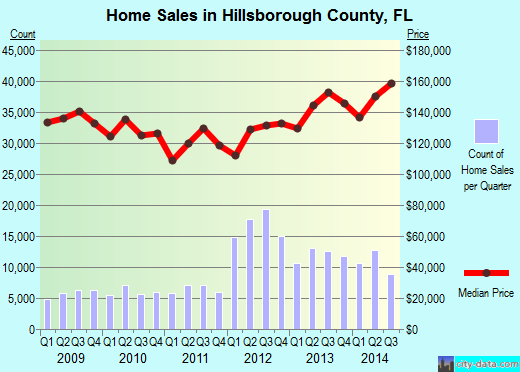
First stop, lets check home sales in Hillsborough County.

Hillsborough County,FL real estate house value trend
Hillsborough County home sales (source: City Data)
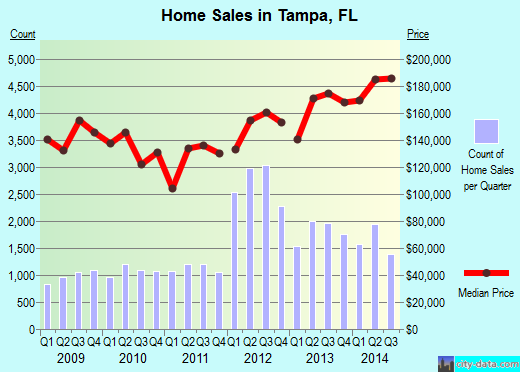
How is Tampa doing?

Tampa,FL real estate house value index trend
Tampa home sales (source: Coy Data)
Be sure to note difference in the scale on the left y-axis. Eyeballing the charts, between 2009 and 3Q2014, Hillsborough County quarterly home sales have run between 28,000 and 40,000 units, and Tampa between 2,600 and 4,600.  Even subtracting the Tampa sales from the Hillsborough sales, Hillsborough is moving 7 - 8 times the housing sales as Tampa.

The vast majority of people are not settling down and buying homes in Tampa, but in the county.

Next stop, lets check building permits, starting with 1Q2015 numbers.


PERMITTED NEW HOUSING UNITS BY TYPE AND JURISDICTION
Hillsborough County
2014 Quarter 1 & 2015 Quarter 1


Single-Family Single-Family


Detached Attached Apartment Mobile Home Total
Jurisdiction 2014Q1 2015Q1 2014Q1 2015Q1 2014Q1 2015Q1 2014Q1 2015Q1 2014Q1 2015Q1
Unincorporated County 675 865 114 157 400 551 5 5 1,194 1,578
Tampa 165 135 37 26 320 629 0 0 522 790
Plant City 23 19 0 18 0 0 0 0 23 37
Temple Terrace 1 2 0 0 0 0 0 0 1 2
County-wide 864 1,021 151 201 720 1,180 5 5 1,740 2,407


Note: Figures above represent all new construction excluding demolitions, remodeling, additions and any alterations to existing buildings.
Source: Hillsborough County City-County Planning Commission.


Might as well check the Q42014 numbers while we're at it.


PERMITTED HOUSING UNITS BY TYPE AND JURISDICTION

Hillsborough County

2013 Quarter 4 & 2014 Quarter 4


Single-Family Single-Family


Detached Attached Apartment Mobile Home Total
Jurisdiction 2013Q4 2014Q4 2013Q4 2014Q4 2013Q4 2014Q4 2013Q4 2014Q4 2013Q4 2014Q4
Unincorporated County 581 686 68 116 551 16 7 10 1,207 828
Tampa 162 177 24 42 651 502 0 0 837 721
Plant City 10 24 0 0 0 0 0 0 10 24
Temple Terrace 0 0 0 0 0 0 0 0 0 0
County-wide 753 887 92 158 1,202 518 7 10 2,054 1,573

Note: Figures above represent all new construction including demolitions and excluding remodeling, additions and any alterations to existing buildings.
Source: Hillsborough County City-County Planning Commission.

As the numbers above show, unincorporated Hillsborough County continues to be at least 5 times more single family development than Tampa.  Even adding in the apartment numbers, where Tampa somewhat closes the edge, the county is still leading the development over Tampa.

This is no surprise to anyone who's lived in the area for a while. This just confirms the existing trend, since practically all the growth in Hillsborough over the last 30 years has been in the unincorporated, not in the city of Tampa.  And the trend continues.

Is our future one of more apartments and renters, or do we want more homeowners? Why are the homeowners buying predominately in the county?

Another questions, while we're in the mood. Is anyone else concerned about the impact on our roads, water and sewer infrastructure when a neighborhood block is rezoned from 6 - 12 homes per acre to 200+ apartments?  Increased density on rezoned or infilled properties in the Tampa have significant impact on our infrastructure, just as single family homes in the suburbs.

Density begets congestion.  Been to South Howard lately? Do we really want more like that?

Is it too much, too painful to ask and confront this reality?

But the Tribune won't ask. They'll just continue to shake the pom-poms for the Tampa urbanist interests, while people in the real world make real world decisions on where they live, and the inconvenient truth is that it is in the suburbs.

Wednesday, September 3, 2014

Where will next 600,000 live?

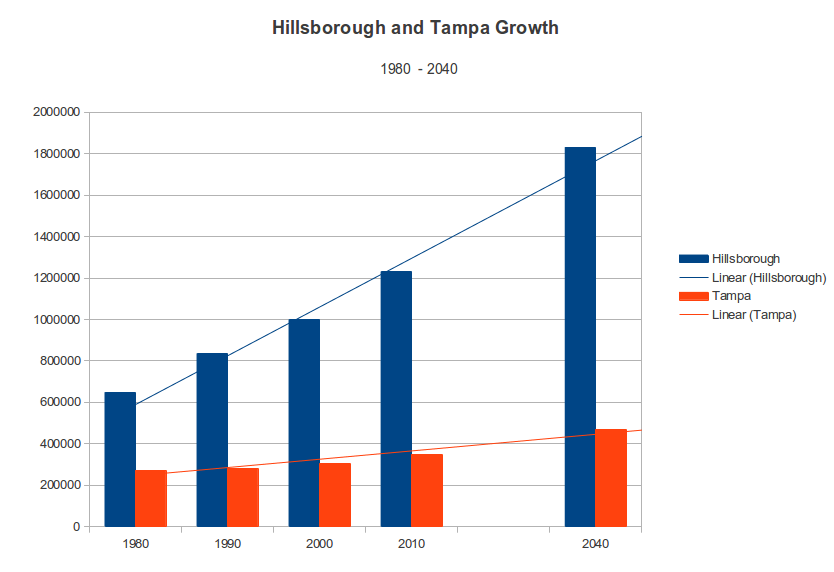
The University of Florida Bureau of Economic and Business Research forecasts another 600,000 new residents in Hillsborough county by between now and 2040. We've reviewed these estimates in the past, and find them feasible, since about 600,000 people moved to Hillsborough in the last 25 years.

Hillsborough and Tampa Growth 1980 - 2040
Where did the most recent 600,000 people who moved into Hillsborough end up?

Let's start where they did NOT go in the last 25 years.

By comparing the UF BEBR forecasts for Hillsborough with city of Tampa census data, most new residents in the last 25 years did not move into the city of Tampa. From 1980 to 2010, Hillsborough grew by 582,000, while during the same timespan, Tampa grew by only 76,000, most of which occurred in New Tampa, which Tampa annexed in 1988.

Is there any reason to assume the next 600,000 residents will do much different over the next 25 years?

There is nothing to indicate any changes in the demographics of the incoming residents. Some politicians state we must attract millennials, as if fresh out of college kids are our future. By the time any schemes claiming to attract millennials are started, much less completed, they will be well on their way to middle age and will have a much different set of priorities.

Can land use and zoning policies affect where people will reside?

There's been no meaningful change in any zoning, land use, urban growth boundaries, etc. in Tampa or in Hillsborough County.

Yet, if you listen to anti-sprawlers, we can't allow more sprawl! These new residents must abide and live where we want them to live! If we can't disperse with sprawl, what is their alternative?

Tampa's 2013 population 346,000, so to add 600,000 people in Tampa, the population will nearly triple.

Where in Tampa will they live and work?

Downtown has experienced some great residential growth in the last few years, where there are now around 6,000 to 8,000 thousand residents, maybe up to 10,000 soon.

590,000 to go! Come on in.

Anti-sprawlers don't have a solution.

As a simple word problem, how many Residences on the Riverwalk towers will it take to house 600,000 new residents? The tower will be home to approximately 550 residents.

If you do the 4th grade math (not common core math), you'll find we need about 1091 new towers to be built, or one about every 8.3 days for the next 25 years. We can start building in downtown Tampa, build one about every block up I-275 and I-75 to Micanopy.

We better start now.

By the way, the Residence on the Riverwalk was approved about year ago and has yet to break ground.

Obviously not all these 600,000 will choose to be stacked and packed in a series of 36 story towers to be built every week.

Anti-sprawlers have ruled out dispersing a substantial portion of 600,000 into more of the hundreds of square miles of unincorporated Hillsborough.

Can the anti-sprawlers find space in Tampa?

Where in Tampa? Tampa is already pretty dense and pretty well built out in the city limits.

Anti-sprawlers will need to greatly increase the residential density in Tampa to make room.

Tampa will have to change zoning and residential density laws, and promote massive and denser redevelopment.

Sulfur Springs, Town and Country, Palma Ceia, Seminole Heights, Forest Hills, Hyde Park...

Which neighborhoods will retain their current qualities of life? Which ones will be rezoned to much denser land use?

Will Hillsborough invalidate Community Plans that inhibit development and densification in many communities throughout the county and impact the residents chosen qualify of life?

We've seen change already around the Westshore district, which has experienced business and residential growth and increased density. This has resulted in increased congestion and traffic in the established residential neighborhoods, such that the local residents have expressed concerned about their property values. 


These 600,000 new residents are the elephant(s?) in the room that our local leaders are ignoring in the transportation discussions. The current “plans” such as they are make little mention where these new people will reside and work.

But we may have 10 miles of light rail between the airport and downtown by 2040!

Here's another 4th grade word problem. If HART triples its ridership over the next 25 years, how many of those 600,000 new residents will ride transit? How many will still ride in their cars?

HART riders are less than 2% of the current residents in Hillsborough. Triple that to 6%, and we get 36,000 new HART riders from the 600,000.

We will still have 564,000 new residents on the roads every day.

Bonus question. How many transit agencies in the last 25 years have tripled their ridership?

That's a trick question.

No transit agency has tripled ridership in the last 25 years.

Time to introduce some reality.

Reality is the next 600,000 residents, should they actually arrive, will largely go where they have in the past 25 years, into unincorporated Hillsborough County. They will most likely move into the South and East part of the county. We should acknowledge that, and build that into our plans.

Yet there is no aspect to the plan that addresses substantial growth further out in the county.

By the way, another 200,000 residents are expected mostly in southern Pasco. Many of them will regularly commute into Tampa and Hillsborough County. 

We'll need roads. Not just improving and fixing our current roads, which absolutely must be fixed. We'll need brand new roads and major commuting arteries.

New roads won't be cheap either, and proposing a new road will likely be caught up in lawsuits, "not in my back yard" protests, and environmentalists saving a spotted snail.

The only way anti-sprawlers can avoid sprawl is for Hillsborough County and city of Tampa to aggressively rezone and force new highly restrictive growth boundaries. This will impact and displace large amounts of the current population currently residing in the unfortunate rezoned areas.

This massive rezoning won't be cheap, and will also likely be subject to rounds of lawsuits further driving up the costs.

Ask the residents of of established neighborhoods Seminole Heights, Sulfur Springs, Wellswood, Town and Country, Hyde Park, Palma Ceia, when they are ready to move out to make room for the new folks.

If they want to stay where they live, ask them if they want to live surrounded by a few 35 story towers each with 550 of their new friends.

Saturday, August 9, 2014

Advances in the Marketplace for Transportation

Megan McArdle, columnist/blogger for Bloomberg View, recently dipped into why streetcars are a bad idea
One of my favorite former colleagues, Emily Bobrow of the Economist, explains why streetcars are a bad idea. The short version: They don’t move faster than buses, at least not in the U.S., where they’re rarely given dedicated lanes. And because they require a big fixed investment, they’re very expensive, and inflexible, compared to buses.
So why are cities suddenly going streetcar-mad? Oh, you can cite the small advantages of streetcars -- they’re less likely to give people motion sickness, for example -- but these advantages don’t really seem to outweigh the huge costs. Yet American cities are laying streetcar track as fast as they can get financing.
My theory is that for cities, the high investment, as well as the inflexibility of the routes, may often be a feature rather than a bug. Building a streetcar is a way to attract investment to an area where you would like to encourage rapid development. And the reason that it’s attractive to investment is that once they’ve been built, the streetcars can’t be moved.
Megan concludes
So, ironically, the very fact that it is a big, risky investment may help everyone agree to rapidly develop a streetcar route, generating tax revenue for a city, cash for developers, and votes and campaign contributions for the politicians who install the thing. It’s hideously inefficient, of course ... but that’s politics for you.
This "it's fixed, it's great for development" mantra is something that has been often cited by Greenlight proponents.


At the 83 Degrees Media "Not Your Average Speakers" event on transportation held on March 12 in St. Petersburg, Mike Meidel, Director of Pinellas County Economic Development, recites that mantra precisely.

 "The important part of the rail really is the abililty to attract investment, at least on the economic development side.  And the advantage of that over a bus transit system is that it can't move."

When challenged by the questioner that a bus is infinitely more flexible, and a rail is fixed, "It's locked in", Meidel responded, "That's the beauty of it."

It really is not about mobility, its about development.

They said this would stimulate downtown Tampa development.
Another take, as Glenn Reynolds stated when linking to the McArdle post,
So the preference for those rails is a concrete embodiment of distrust of politicians. By this standard, the more corrupt the locality, the more likely it is to be enthusiastic about streetcars
Given the recent mea culpas from PSTA we've reported, we can only say "Exactly".

Then there's this peek into the art of possibilities, from one of McArdle's commenters, Sweet_Lou:
Applying advances in technology to streetcars would increase their popularity and usefulness.
Currently, streetcars are constrained in their routing. They can only travel where the tracks are. By fitting the streetcars with modern pneumatic tires, we could expand their possible routes to anywhere there are paved roads, and indeed, to some degree, unpaved ones.
Streetcars also require power lines -- unsightly, expensive to install and maintain, and, again, constraining potential routes. An onboard energy reservoir would reduce or even eliminate the need for these power lines. This energy reservoir need not be electrical -- an internal combustion engine, paired with a tank of diesel or even gasoline could power the drive train, either indirectly by running a generator, or even directly by means of a transmission and drive train.
But the most radical idea is to reduce the size of the street cars. These small, personal street car might even be produced at such a price as to allow purchase and ownership by groups or even individuals, facilitating privatization of the street car network. These small, autonomous mobility vehicles, or "auto-mobiles" as I like to think of them, would provide almost infinite variation in route, passengership, and even type of cargo.
One might, given a wild enough imagination, even envision companies springing forth to design, sell, insure, maintain, and fuel these "auto-mobiles", should demand provide sufficient.
Priceless!

Tuesday, April 22, 2014

To plan or not to plan

One of the heaviest traveled roads in the Tampa Bay Area is State Road 60 through Brandon. The Brandon area has grown tremendously in the last 30 years, often with little forethought, which has resulted in more congestion.

So what to do?

People in the Brandon - Valrico area literally and figuratively are not going anywhere. Another 600,000 people will be moving to Hillsborough County in the next 25 - 30 years, and it's likely that a big chunk of them will move out to Eastern Hillsborough County, further impeding traffic.

Can we get ahead of the rush?

From the Tribune on April 13,
VALRICO — The time will come when State Road 60’s rural swath won’t be so rural, state road officials say.
Traffic on the ribbon of pavement between Valrico Road and the Polk County line will increase 54 percent — some 71,000 vehicle trips per day — by 2040, Florida’s Department of Transportation estimates. Unless that 12.3-mile segment is widened to six lanes, it will not measure up to its designation as a major east-west corridor and evacuation route, transportation officials say.
“It’s not going to be built anytime soon, but at least we can look at the impacts,” said Kirk Bogen, environmental management engineer for the DOT. Bogen estimates it will be five to 15 years before any construction gets under way.
No one is plowing up SR 60 anytime soon.  Sounds like someone is thinking about a plan.  With the growth forecasts in Hillsborough, there will be more new neighborhoods taking over the rural areas along State Road 60.

Planned widening on SR-60
Of course, the Trib found many folks against the plan, yet no viable alternative plan that would address the future needs, except the gratuitous mention of light rail, which is in no one's plans to go that far out along SR 60 in the next 50 years.

The Tribune editorial board weighted in on April 21.
The Florida Department of Transportation’s plans to six-lane a rural stretch of State Road 60 illustrates how the state can undermine local growth plans.
Nothing may happen anytime soon, but as the Tribune’s Yvette C. Hammett reports, the DOT already is making preparations to widen the 12.3-mile length of road between Valrico Road and the Polk County line.

Traffic flow now is adequate on much of that strip, but DOT engineer Kirk Bogen says the agency is trying to plan ahead instead of “getting behind the 8 ball and waiting for congestion.”

Those are reasonable concerns. But there are far more pressing needs than developing a rural highway, where expansion would likely encourage development and sprawl.
The Trib goes on that the Hillsborough MPO, one of twelve(!) government agencies that have some say on local transportation projects, should be consulted.
Hillsborough County Commissioner and MPO Chairman Mark Sharpe wrote to the DOT pointing out there is no demand for the project, it would be built in an area the county envisioned as remaining rural, and there are more pressing transportation needs.

That stretch of State Road 60 is outside the county’s urban service area — the area where local roads and other infrastructure are planned for future development. Such boundaries are intended to discourage sprawling subdivisions that generate high costs for taxpayers.
Perhaps so. The MPO are planners, but their priorities are to control growth into predetermined areas, while the FDOT's priorities are to plan ahead and avoid traffic congestion and enhance evacuation routes... such as SR 60. We will have growth, and this is a plan that at least attempts to get ahead of that growth.  600,000 people are not all moving into downtown Tampa, where only about 7,000 currently live, and over 83% of the local population lives greater than 10 miles from downtown.

Then the Trib states:
It is bad public policy to use state highway construction as a growth driver. We don’t believe that is the DOT’s motive here, but it is likely to be the result.
But how is using highway construction for a growth driver any different than using light rail and transit oriented development as a growth driver, a position the Tribune has repeatedly proposed?

They are BOTH bad policies.  Let's have transportation policies that address our mobility needs.  Lets have economic and development policies that address those issues.  Yes, they are some dependencies, but they are different issues, and can be addressed with much different solutions.

We see this pattern over and over again the Tampa Bay area.  There's a plan to fix or enhance a heavily traveled road, trying to get ahead of the growth, only to be thwarted by NIMBYs, special interests, community plans, and the Urban Land Institute.

Adding a toll road to complement heavily traveled, State Road 54, in south Pasco, has met with stiff local and political opposition. Yet they have no viable solution to address the expectations of another 20,000 homes along the route.

At least the Tribune has taken a more muted approach on SR 54, but not endorsing the toll road idea.
Although we’re not sold on the proposal, that doesn’t mean it shouldn’t be explored. Clearly, something has to be done.
Of course, everyone cites Pascos Urban Land Institute $125,000 study (why do they always use ULI around here?), which always come up with the same answer around "walkable communities" whether its in the exurbs of Pasco or downtown St. Petersburg?  Next time, save taxpayer money, and regardless of the plan, community, transportation needs, just change the title of ULI's standard template and insert "walkable communities" into some report and be done.

Let's not forget Hillsborough County's great contribution to anti-planning, the Community Plans.  Once these community plans are approved, they are adopted into the Hillsborough County Land Development Code, where they can place all sorts of restrictions on road and land use.
Gunn Highway will be identified as a County roadway, which cannot be widened further due to social, economic, policy and environmental constraints.
Hillsborough County... as envisioned by Community Plans
Here we have a major commuting artery between Pasco and northwest Hillsborough constrained as a 2 lane road by a community plan.  Development continues in Pasco County, traffic increases on Gunn Highway, which is becoming more and more dangerous.  But we can't do anything about it since the Keystone - Odessa community plan prohibits addressing Gunn Highway.

So here we are. We can't plan and get ahead of the growth.  We have to wait until we really need improvements.  That's the way we've always done it, right?  But, then its too late, then everyone complains. The NIMBY's and Community Plan proponents complain when planners actually plan for growth, yet they won't much like the alternative of further congestion if nothing is done.  They will only have themselves to blame when congestion worsens with the expected growth in Hillsborough County.

Sunday, April 13, 2014

Traffic jams, Transformation and the Jetsons

In Hillsborough county a traffic jam occurred last weekend on I-275 where construction is being done. The Tribune published their editorial Wednesday using the traffic jam to advocate for more transit options including claims that transit (rail) spurs economic development.
Episodes such as these make the case for diversifying mass transit options far better than any marketing campaign.
Diversifying transit presents options, many of them more affordable and more conducive to a better quality of life than being stuck in traffic for a couple of hours every day. It also spurs economic development and makes the area more attractive to visitors. 
Motorists need to remember delays such as these when their local leaders seek support for mass transit initiatives in the coming months.
Diversifying transit options isn’t going to eliminate massive traffic jams that result from road work.
So how's that logic? A traffic jam created by road construction makes the case for more diverse transit options but diversifying transit options won't eliminate traffic jams resulting from road work. Sound circular? It is.

We note not nary a word from the Tribune about holding those responsible for when and how the re-route occurred causing the traffic jam. 

Also, coincidentally on Wednesday, County Commissioner Mark Sharpe, who also sits on the HART board sent this open letter to the HART board.  Certainly there was no coordination between the Tribune editorial and the timing of Sharpe's letter.


Sharpe Open Letter to HART Board
We are not lawyers but our first reaction was whether there was any violation of our Florida Sunshine Laws.  According to the Sunshine Law Manual
Written correspondence, e-mails, texts, and other electronic communications
The Sunshine Law requires boards to meet in public; boards may not take action on or engage in private discussions of board business via written correspondence, e-mails, text messages or other electronic communications. See AGO 89-39 (members of a public board may not use computers to conduct private discussions among themselves about board business).
Accordingly, the law is applicable to any gathering, whether formal or casual, of two or more members of the same board or commission to discuss some matter on which foreseeable action will be taken by the public board or commission.
The Sunshine Law is, therefore, applicable to all functions of covered boards and commissions, whether formal or informal, which relate to the affairs and duties of the board or commission.
Board members of an agency under the Sunshine Laws are not supposed to be engaging in private conversations regarding the agency.  We'll let the lawyers figure out the legal aspects.

There have already been some discussion at previous HART board meetings about  a proposal to restructure HART into some type of super-sized agency responsible for roads, transit and economic development. This issue will come up again at HART. This restructuring of HART proposal will be a topic for a post another day but HART does not oversee road improvements nor have responsibility for economic development today. A transit agency should not be responsible for economic development. We already have the Economic Development Corporation (EDC), Tampa Bay Partnership, MPO's, Chambers of Commerce, Tampa Bay Regional Planning Council, the Planning Commission and the county commissioners themselves (there's probably more) responsible for some aspect of land use and economic development. Commissioner Sharpe is a board member of both the EDC and Tampa Bay Partnership and is chairman of the Hillsborough MPO. To digress, as we posted here, these entities should be focusing on recruiting corporate and regional headquarters not wasting so much of their time and energy on wanting to develop around train stations or baseball stadiums. 

Commissioner Sharpe, who chairs the Hillsborough County Commission, sits on the HART board and is a participant on the county's Transportation Leadership Policy Group. From his comments at the Transportation Leadership Policy Group meetings, he is a proponent of this super-sized, super-charged restructured HART. However, Sharpe's open letter appears to be an emotional plea rather than a rational, focused and measured response to something. 

In addition, Sharpe states in his letter:
There is no nice and easy way to push transformation....
The quality of service HART provides ultimately should be on par with private service providers.
Sharpe wants to "transform" HART? Transform to what? No details were provided. HART does not need transforming to provide quality, cost-effective service for those who need or want to use their services. HART does not need to be transformed to continue improving their bus services. Is it the role of government for taxpayers to provide services "on par" with private sector providers? How much will that cost taxpayers?  Is that realistically doable since innovation is constantly occurring in the private sector?  

The fare box revenue of our bus service in Hillsborough County is about 25% of the operating costs, meaning taxpayers pick up subsidizing about 75% of the costs. If Sharpe wants to transform HART to be like private service providers, then doesn't the discussion  need to include market based fares? If Sharpe wants more people to ride transit, then why shouldn't those riders pay their "fare share" at the fare box to recover transit's costs. Why should taxpayers highly subsidize those with higher incomes to take transit? What about privatization or out-sourcing? Are those part of the "transformation" discussion?

Thursday Tribune columnist Joe Henderson jumped in with his column trying to explain Sharpe's exasperation (didn't I just say Sharpe's letter sounded emotional?) and his
....Sharpe-tongued comments about HART.....
“We must change the perception of HART from the transportation provider of last resort to one that is a desirable choice for residents and visitors,” Sharpe wrote. “This will require retooling the agency into something dramatically different from what it is today.”
HART Board member and former chairwoman of HART Fran Davin apparently disagreed:
“Our core mission is to provide transportation for those who otherwise don’t have private transportation,” she said.
The lower income who depend on the bus service to get to their jobs or those who cannot drive and need public transit are often hurt when transit systems are "transformed" to over extending themselves with high cost rail systems. There are too many instances of bus services being cut or the bus service expansion promised cannot occur because of the high cost of operating a rail. The role of government is to provide a safety net of quality public transit services for the those who need the service not force taxpayers to pay for transit options that costs too much, benefits too few and does nothing about congestion.  Reality is most of (98%) drive.

The elephant in the room is COST. With no details or specifics in Sharpe's letter, no one knows. Where is the money coming from and who is going to pay? Who will benefit? The federal transportation dollars are dwindling and they come with all kinds of strings attached. We are over $17.5 TRILLION in debt. We have gotten into our fiscal mess pursuing grandiose ideas, even with good intentions, that then become a fiscal disaster and put taxpayers at risk and on the hook at the benefit of a few.

We appreciate Commissioner Sharpe's enthusiasm for transit. However, the most critical transportation issue in Hillsborough is lack of road funding. Buses need roads. Hillsborough county is a large county over 1100 square miles and there are unmet transportation needs that we need NOW or in the very near future not 12-15 years from now. 

Let's also get rid of the PTC and it's burdensome regulations so that the new innovative, on-demand ride sharing services can operate and compete in Hillsborough County.  We live in a highly mobile and on-demand society today. New car and ride sharing services can provide a transportation alternative when and where you need it at the touch of an App on your smartphone or tablet.

Perhaps when Sharpe leaves office in November, he'll continue his passion for the transportation issue pursuing private sector transportation solutions. 
Flying Car TF-X, a four-seat, plug-in hybrid electric car
that can do vertical take-offs and landings.
Transportation innovation is occurring in the private sector where it should occur. We may not only have autonomous vehicles but perhaps we'll finally be like the Jetson's and we'll be driving flying cars too. 

Now that's transformative!